
Skip to content
The Encyclopedia of Horology

Clock · Musical longcase clock

English Musical Longcase Clock

Partially verified

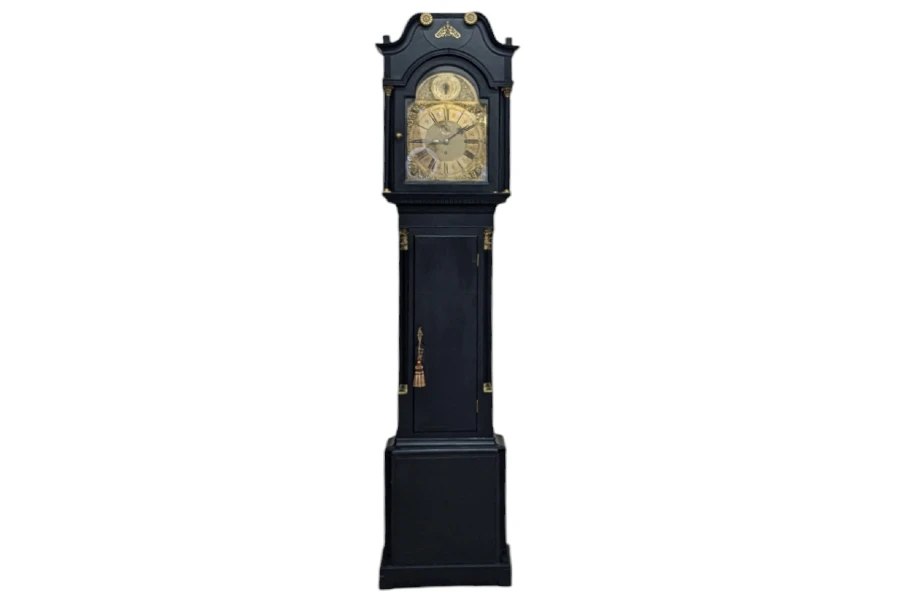
This English musical longcase clock, dated circa 1750, is housed in an ebonised case. The timepiece features an 8-day, key-wound, weight-driven movement equipped with an anchor escapement and a rack striking mechanism. It is designed to chime on eight bells, offering a choice of tunes—Winchester or St Michaels—on each quarter-hour, while striking the full hours on a steel gong; a silencing function is provided. The brass dial is break-arched and includes a chapter ring with Roman numerals, corner spandrels, and a seconds dial. A subsidiary chime/silent dial is located within the arch, accompanied by a chime change lever positioned to the side. The exterior case incorporates fluted columns with brass cappings on both the hood and the trunk, which is further decorated with brass rosettes and garland wreaths. The clock stands 220cm high, 50cm wide, and 26cm deep.

Front view of the English musical longcase clock, showing the dial, hood, and trunk detail.
Front view of the English musical longcase clock, showing the dial, hood, and trunk detail. — W J Morris Clocks. Rights pending — permission not yet requested. Original source

Catalogue identity

Source
wjmorrisclocks.co.uk
Category
Clock · Musical longcase clock
Maker / attribution
Not established
Reference
Not recorded
Catalogue / lot identifier
Source URL identifies the listing
Source-reported date
circa 1750
Source-reported place
England

Source-reported attribution and specifications are not independent authentication. A listing does not establish present ownership, current display, availability or permission to reproduce.

Object description

Movement and Musical Mechanism

The clock is powered by an 8-day, key-wound, weight-driven movement that utilizes an anchor escapement. The striking and chiming system operates on a rack striking principle. The musical complication is configured to play a selection of two tunes, Winchester or St Michaels, on a set of eight bells at each quarter-hour interval.

Full hours are marked by striking on a steel gong, and the mechanism includes a user-controlled feature to silence the chimes entirely. Cast steel weights are employed to drive the movement, and the pendulum is fitted with a brass bob, as stated in the documentation provided.

Evidence for this section
  • “8 Day key wound weight driven movement, anchor escapement, rack striking.”
  • “Chiming on 8 Bells to Winchester or St Michaels on each quarter, striking the full hours to a steel gong, availability to silence all.”
  • “Cast steel weights, brass bob to pendulum.”

Dial and Instrumentation

The clock features a brass break-arched dial plate. The chapter ring is graduated with Roman numerals and the dial includes corner spandrels. A subsidiary seconds dial is integrated into the main display.

In the arch of the dial, a chime/silent selector dial is present. A chime change lever is positioned to the side of the numeral 3, allowing for the selection of the desired musical tune.

Evidence for this section
  • “Brass break arched face, brass chapter ring with Roman numerals with spandrels to each corner, seconds dial, chiming/silent dial above & chiming change lever to the side of no 3.”

Case Construction

The clock is enclosed in an ebonised case measuring 220cm in height. The hood features a cushion top design with a break-arched glazed door, flanked by fluted columns with brass cappings.

The trunk also incorporates fluted columns with brass cappings that mirror those on the hood. Decorative brass rosettes and garland wreaths are applied to the exterior of the case.

Evidence for this section
  • “Ebonised case with fluted columns to front surmounted by brass cappings, cushion top hood with break arched glazed door, fluted columns with brass cappings to match the trunk, topped by brass rosettes & garland wreath.”

Open research questions

  • What is the historical origin of the 'Winchester' and 'St Michaels' tune sequence?
  • Are there any maker's marks inscribed on the backplate of the movement that were not captured in the provided photographs?

Source evidence

Recorded claims and source quotations for English Musical Longcase Clock
FieldSource-reported valueSource quotation
Datecirca 1750“circa 1750”
Movement type8 Day key wound weight driven movement“8 Day key wound weight driven movement”
Escapementanchor escapement“anchor escapement”
Musical functionChiming on 8 Bells to Winchester or St Michaels on each quarter“Chiming on 8 Bells to Winchester or St Michaels on each quarter”
Dial featuresBrass break arched face“Brass break arched face”
Case material and finishEbonised case“Ebonised case”
DimensionsHeight 220cm Width 50cm Depth 26cm“Height 220cm Width 50cm Depth 26cm”

Visible details

  • Brass corner spandrels on the dial
  • Chime/silent dial within the arch
  • Fluted columns with brass cappings on the hood and trunk
  • Tasselled key or winding hole cover visible on the trunk door

Research qualifications

  • The exact origin of manufacture beyond the attributed region is not specified
  • The specific historical provenance or previous ownership of the clock remains unverified

Photograph identity and source facts were screened before import; rights clearance remains pending.

Consulted source

English Musical Longcase Clock

Reviewed 2026-11-02 · Record aaa97c68e8

Terms in this record

Glossary explanations for terms named in this object’s record.

Other musical longcase clock records