
Skip to content
The Encyclopedia of Horology

Clock · Musical longcase clock

Clock and carillon by Mayne Swete

Partially verified

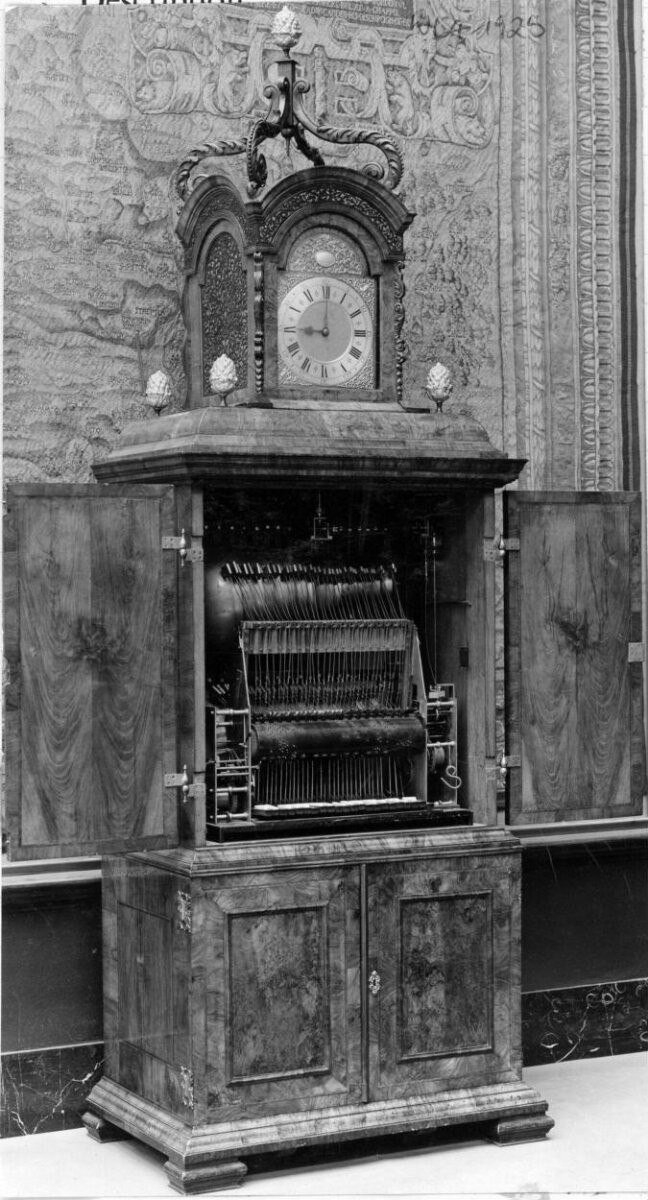
This musical longcase clock and carillon, dated to circa 1725, was constructed by Mayne Swete in Trayne, Modbury, Devon. Housed in a walnut cabinet, the assembly consists of an upper clock section and a lower cabinet section. The clock features an arched dial with a symmetrical design of openwork scrolls and masks. The upper housing contains the primary clock mechanism, a bell for hour striking, and a carillon system comprising twenty-eight bells tuned in semitones across three octaves. This musical apparatus is operated via an ivory and ebony keyboard or a brass cylinder set with pins. The cabinet is decorated with acanthus moulding and fretwork, with decorative gilt pineapples atop the upper section and corners. Mayne Swete, a campanologist, reportedly built the instrument over seven years as a gift for his brother, Adrian Swete, High Sheriff of Devon.

Musical longcase clock by Mayne Swete with cabinet doors open, revealing the carillon mechanism.
Musical longcase clock by Mayne Swete with cabinet doors open, revealing the carillon mechanism. — Victoria and Albert Museum, London. Rights pending — permission not yet requested. Original source

Catalogue identity

Source
collections.vam.ac.uk
Category
Clock · Musical longcase clock
Maker / attribution
Mayne Swete
Reference
Not recorded
Catalogue / lot identifier
W.64-1925
Source-reported date
ca. 1725
Source-reported place
Devon, England

Source-reported attribution and specifications are not independent authentication. A listing does not establish present ownership, current display, availability or permission to reproduce.

Object description

Cabinet Construction and Design

The clock is housed within a walnut cabinet constructed in two distinct sections. The upper portion, containing the clock face and movement, is surmounted by an arched top and features acanthus moulding and fretwork friezes. Four scrolls at the top support a central gilt pineapple, a motif repeated at the corners of the upper housing. The front is composed of two doors with moulded panels.

The lower section serves as a pedestal and includes two additional doors with moulded panels, supported by four small feet. The primary wood used is walnut, and the entire structure stands approximately 295 centimeters high.

Evidence for this section
  • “Clock in square case of walnut with arched top, decorated with acanthus moulding and fretwork frieze”
  • “In front are two doors with moulded panels. The lower part has two doors in front with moulded panels and rests on four small feet.”

Clock and Musical Mechanism

The clock serves as the housing for a complex carillon mechanism. The dial features symmetrical gilt openwork scrolls within the arch, while the spandrels incorporate masks. Internally, the upper section contains the timekeeping works, a bell for the hour strike, and twenty-eight bells tuned in semitones to cover three octaves.

The musical component can be activated through an ivory and ebony keyboard or via a brass cylinder set with pins, similar to a musical box. This system plays a tune every three hours. The cylinder is designed to be replaceable, specifically to accommodate the playing of a psalm on Sundays. The construction of this mechanical instrument reportedly took seven years of work at a private forge maintained by the maker.

Evidence for this section
  • “Inside the top section of the cabinet is a bell to strike the hours and a carillon with 27 bells tuned in semi-tones”
  • “The dial has a gilt symmetrical design of openwork scrolls in the arch and in the spandrels is similar ornament with masks.”

Provenance and Documentation

The clock was acquired by the museum from E. Lyall Swete in 1925. The object is attributed to Mayne Swete, who allegedly created the instrument as a gift for his brother, Adrian Swete of Trayne, Modbury, who served as the High Sheriff of Devon in 1724. Historical records include extensive correspondence regarding the object's history and repair, maintained in departmental files.

The museum's records indicate that E. Lyall Swete altered the date on the non-plate, an intervention noted upon the clock's acquisition. Despite this modification, the piece was formally recognized by the museum's curators in 1925 as an object of considerable importance, both for its fine workmanship and as a study for designers.

Evidence for this section
  • “The musical clock was made by Mayne Swete as a gift for his brother, Adrian Swete of Trayne, Modbury”
  • “notes that Mr Lyall Swete altered the date on the non plate "but this could be removed".”

Open research questions

  • What is the metallurgical composition of the twenty-eight bells?
  • To what extent is the original 18th-century mechanism intact following the reported repairs?

Source evidence

Recorded claims and source quotations for Clock and carillon by Mayne Swete
FieldSource-reported valueSource quotation
MakerMayne Swete“made by Mayne Swete”
Dateca. 1725“in about 1725”
MaterialWalnut“Clock in square case of walnut”
Musical systemCarillon with twenty-eight bells“Inside the upper half are the works and twenty eight bells tuned in semitones to play three octaves”
Maker's provenanceTrayne, Modbury, Devon“made by Mayne Swete, Trayne, Modbury, Devon”
Accession numberW.64-1925“W.64-1925”

Visible details

  • Case features arched top with acanthus moulding
  • Dial arch and spandrels decorated with openwork scroll and mask ornamentation
  • Carillon mechanism visible behind opening cabinet doors
  • Case rests on four small feet

Research qualifications

  • Historical provenance relies on correspondence and reports from E. Lyall Swete
  • Date on the clock mechanism was reportedly altered by E. Lyall Swete

Photograph identity and source facts were screened before import; rights clearance remains pending.

Consulted source

Clock and carillon, made by Mayne Swete, Trayne, Modbury, Devon, in about 1725

Reviewed 2026-11-02 · Record 3d184430a9

Terms in this record

Glossary explanations for terms named in this object’s record.

Other musical longcase clock records