
Skip to content
The Encyclopedia of Horology

Clock · Longcase clock

Eight-Day Longcase Clock by Edward East in a Later Marquetry Case

Partially verified

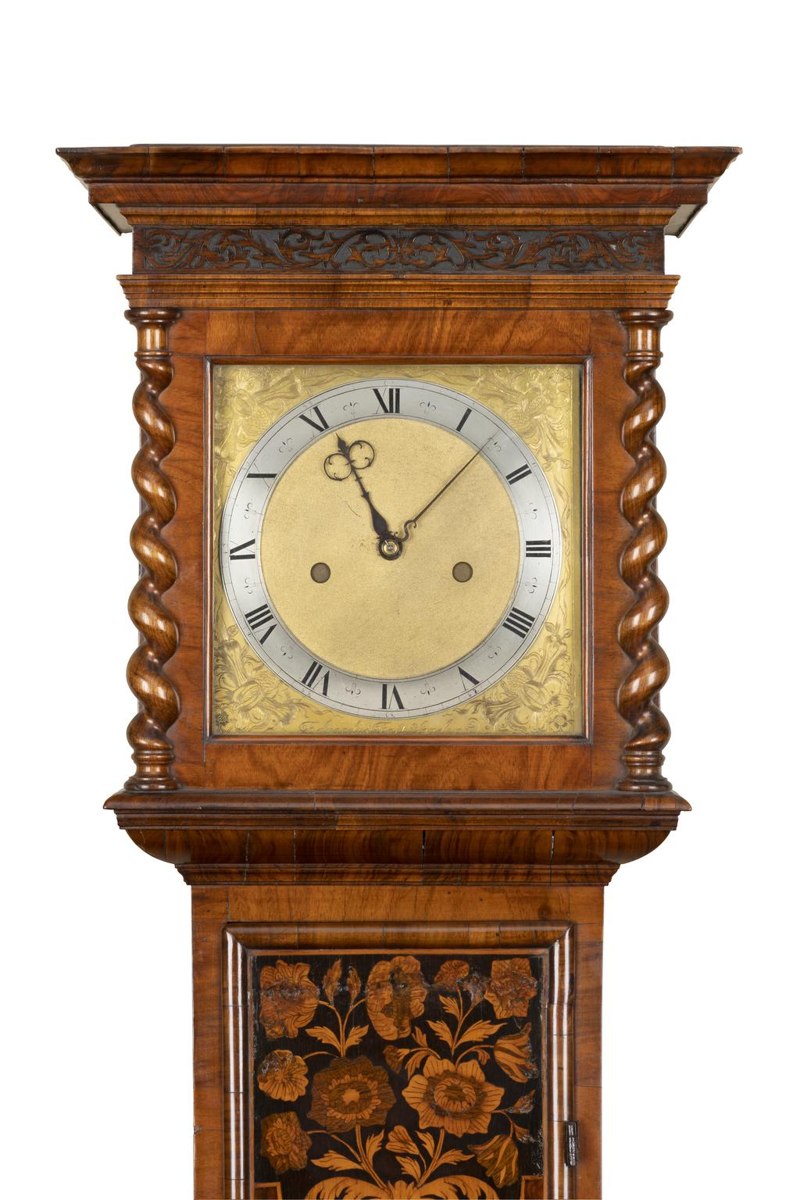
This eight-day striking longcase clock combines an earlier movement by London maker Edward East dating to circa 1675 with an altered oak case veneered in walnut and floral marquetry dating to circa 1685. The 9¼-inch brass dial features engraved corner spandrels, a matted centre, two winding arbors, and a narrow silvered chapter ring marked with Roman hour numerals and Arabic minute numbers at five-minute intervals. The dial is signed 'Edwardus East Londini'. The source reports a two-train movement equipped with an anchor escapement, count-wheel striking, and bolt-and-shutter maintaining power.

Hood and upper trunk of the eight-day longcase clock by Edward East in a floral marquetry case
Hood and upper trunk of the eight-day longcase clock by Edward East in a floral marquetry case — The Clockmakers' Museum / Clarissa Bruce / The Clockmakers’ Charity / Science Museum Group. Rights pending — permission not yet requested. Original source

Catalogue identity

Source
collection.sciencemuseumgroup.org.uk
Category
Clock · Longcase clock
Maker / attribution
Edward East
Reference
Clockmakers' Museum No. 544
Catalogue / lot identifier
L2015-3429
Source-reported date
1675-1685
Country
United Kingdom

Source-reported attribution and specifications are not independent authentication. A listing does not establish present ownership, current display, availability or permission to reproduce.

Object description

Dial and Visual Architecture

The clock is fitted with a 9¼-inch brass dial featuring engraved spandrels at the corners and a narrow silvered hour circle marked with Arabic minute numbers at every five. It is signed 'Edwardus East Londini'. In visual inspection, two winding holes are visible in the dial plate flanking the central hand arbor, and Roman numerals mark the hours on the silvered chapter ring.

The case hood is surmounted by a molded cornice above a fretted frieze and flanked by spiral-turned (barley-twist) wooden columns. Below the hood, the upper section of the trunk door displays an inlaid rectangular panel decorated with floral and foliate marquetry.

Evidence for this section
  • “The 9¼-inch brass dial has a narrow silvered hour circle with minute figures at every 5, engraved spandrels, and is signed 'Edwardus East Londini'.”
  • “Two winding holes are visible in the dial plate flanking the central hand arbor.”
  • “The square brass dial features engraved spandrels around a silvered chapter ring with Roman hour numerals and Arabic five-minute divisions.”
  • “The hood is surmounted by a molded cornice above a fretted frieze and flanked by spiral-turned (barley-twist) wooden columns.”
  • “The upper section of the trunk door shows an inlaid rectangular panel of floral and foliate marquetry.”

Case Construction and Movement Association

The housing is constructed of oak veneered in walnut and floral marquetry. According to institutional documentation, the case dates to circa 1685 and has been altered to fit the earlier movement, which dates to around 1675.

The museum record lists the constituent materials for the overall object as oak (wood), walnut (wood), unidentified wood, brass (copper, zinc alloy), steel (metal), lead (metal), glass, and silvered brass.

Evidence for this section
  • “The oak case, veneered in walnut and floral marquetry, has been altered to fit the movement, which is earlier.”
  • “The movement dates to around 1675 and the case c.1685.”
  • “Materials: oak (wood) , walnut (wood) , wood (unidentified) , brass (copper, zinc alloy) , steel (metal) , lead (metal) , glass and silvered brass”

Reported Movement and Technical Characteristics

The clock is catalogued as an eight-day striking longcase with an anchor escapement. The movement is two-train and incorporates count-wheel striking as well as bolt-and-shutter maintaining power.

These internal mechanical characteristics are recorded by the museum and cannot be directly observed from the exterior photograph. The object is catalogued under Clockmakers' Museum No. 544 and object number L2015-3429.

Evidence for this section
  • “Anchor escapement, eight-day, striking longcase by Edward East London.”
  • “The two-train movement has count-wheel striking and bolt-and-shutter maintaining power.”
  • “Clockmakers' Museum No. 544”
  • “Object Number: L2015-3429”

Open research questions

  • What specific structural modifications were made to the circa 1685 case to accommodate the circa 1675 movement?
  • Which parts of the longcase clock account for the lead and unidentified wood listed in the museum materials inventory?
  • Does the movement retain its original bolt-and-shutter maintaining power and count-wheel components?

Source evidence

Recorded claims and source quotations for Eight-Day Longcase Clock by Edward East in a Later Marquetry Case
FieldSource-reported valueSource quotation
Escapement and strikingAnchor escapement, eight-day, striking longcase clock“Anchor escapement, eight-day, striking longcase by Edward East London.”
Case construction and dateOak case veneered in walnut and floral marquetry, dating c. 1685“The oak case, veneered in walnut and floral marquetry, has been altered to fit the movement, which is earlier.”
Dial dimensions and signature9¼-inch brass dial signed 'Edwardus East Londini'“The 9¼-inch brass dial has a narrow silvered hour circle with minute figures at every 5, engraved spandrels, and is signed 'Edwardus East Londini'.”
Movement mechanismTwo-train movement with count-wheel striking and bolt-and-shutter maintaining power“The two-train movement has count-wheel striking and bolt-and-shutter maintaining power.”
Movement datingMovement dates to around 1675“The movement dates to around 1675 and the case c.1685.”
Maker company roleAssistant of the Clockmakers’ Company in 1632; Master in 1645 and 1652“became an Assistant of the Clockmakers’ Company in 1632. He was elected Master in 1645 and 1652”
Royal appointmentAppointed 'Chief Clockmaker to the King' in 1660“appointed ‘Chief Clockmaker to the King’ in 1660.”
Collection loan statusLent by the Worshipful Company of Clockmakers“credit: Lent by the Worshipful Company of Clockmakers”

Visible details

  • The hood is surmounted by a molded cornice above a fretted frieze and flanked by spiral-turned (barley-twist) wooden columns.
  • The square brass dial features engraved spandrels around a silvered chapter ring with Roman hour numerals and Arabic five-minute divisions.
  • Two winding holes are visible in the dial plate flanking the central hand arbor.
  • The upper section of the trunk door shows an inlaid rectangular panel of floral and foliate marquetry.

Research qualifications

  • Source notes the case dates to circa 1685 and was altered to fit the earlier movement of circa 1675.
  • Internal movement features including the anchor escapement, count-wheel, and maintaining power are source-reported and not visible in the exterior photograph.

Photograph identity and source facts were screened before import; rights clearance remains pending.

Terms in this record

Glossary explanations for terms named in this object’s record.