
Skip to content
The Encyclopedia of Horology

Clock · Regulator longcase clock

Edward Yeomans regulator longcase clock

Partially verified

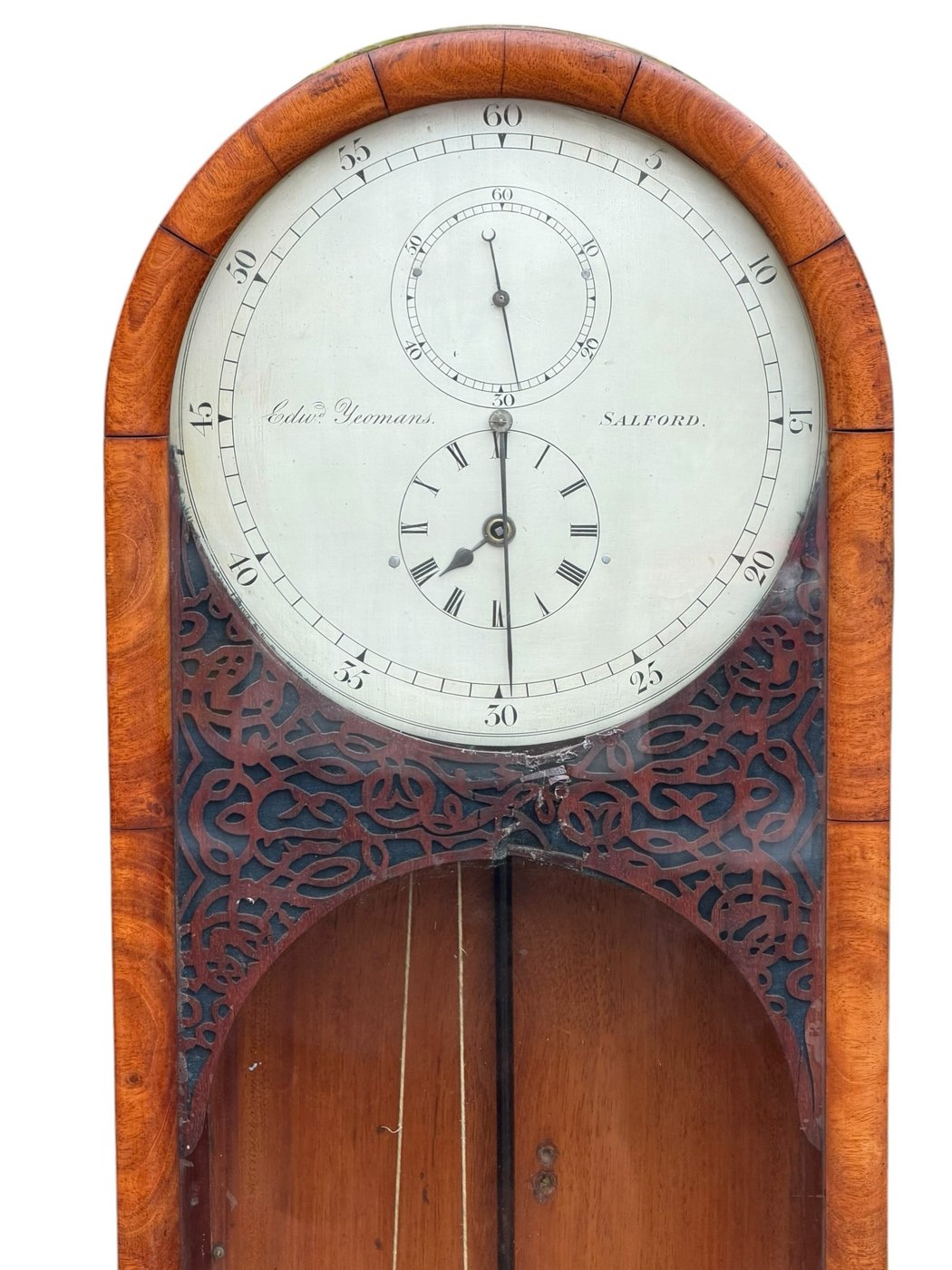
This 19th-century regulator longcase clock is signed by Edward Yeomans of Salford. Designed as a high-precision timekeeping instrument, it features a regulator dial layout with a central minute hand and separate sub-dials for hours and seconds. The clock is powered by a weight-driven movement equipped with a deadbeat escapement and an integrated maintaining power mechanism. The silvered dial, which features Roman numerals for the hours, is held within a mahogany case featuring a round-top hood and intricate carved wooden fretwork below the dial. The trunk door is glass-fronted, exposing the pendulum rod and brass weight. The clock measures 189 cm in height and includes its original pendulum and pulley system. The auction description reports the object is in excellent antique condition, with minor historical scuffs consistent with its age.

Frontal view showing the regulator dial, carved fretwork, and upper trunk of the Edward Yeomans longcase clock.
Frontal view showing the regulator dial, carved fretwork, and upper trunk of the Edward Yeomans longcase clock. — Vintage Clocks UK. Rights pending — permission not yet requested. Original source

Catalogue identity

Source
vintageclocks.uk
Category
Clock · Regulator longcase clock
Maker / attribution
Edward Yeomans
Reference
JN229
Catalogue / lot identifier
JN229
Source-reported date
19th century
Source-reported place
England

Source-reported attribution and specifications are not independent authentication. A listing does not establish present ownership, current display, availability or permission to reproduce.

Object description

Dial and Case Design

The clock is configured in a regulator layout, which isolates the time-telling functions into distinct sub-registers. The primary minute track occupies the perimeter of the silvered dial, while the hours, marked in Roman numerals, and the seconds are displayed on separate sub-dials. The dial is engraved with the maker's signature and location.

The movement is enclosed in a mahogany case that features a round-top hood. A decorative element of the case is the carved wooden fretwork panel positioned directly below the dial. The trunk door is fitted with a glass pane, allowing for a view of the precision pendulum rod and the heavy brass weight suspended by a spoked pulley.

Evidence for this section
  • “The prominent main hand sweeps the outer minute track, while the hours (in Roman numerals) and seconds are isolated on individual sub-dials.”
  • “The clock features a classic, large regulator layout designed for ultimate legibility.”
  • “The movement is housed in a magnificent round-topped mahogany case displaying rich grain patterns and a superb warm patina.”
  • “Below the dial sits a beautiful, intricately carved wooden fretwork panel.”

Movement and Mechanics

The clock is built with technical components intended for precision timekeeping. It utilizes a deadbeat escapement, a mechanism that prevents recoil of the escape wheel. Additionally, the clock is equipped with a maintaining power system, which allows the timepiece to continue operating while it is being wound.

The pendulum is described as a precision rod and bob assembly, which is visible through the glass-fronted trunk. The clock is driven by a single brass weight.

Evidence for this section
  • “this masterpiece is engineered with a deadbeat escapement and integrated maintaining power, ensuring the movement continues to tick accurately without losing power during winding.”
  • “The long glass-fronted trunk door offers a clear view of the heavy single brass weight suspended by its spoked pulley, alongside the long precision pendulum rod and bob.”

Condition

The auction description reports the clock is in excellent antique condition. The silvered dial is noted to be sharp and legible, with engravings remaining clear.

The mahogany case shows wear that is considered consistent with its age, including minor historical scuffs and light surface wear. The clock is noted as being complete with its weight, pulley, and pendulum.

Evidence for this section
  • “The silvered dial is sharp and highly legible.”
  • “The case retains a beautiful finish with only minor historical scuffs and light wear expected from an authentic antique of this age.”

Open research questions

  • What is the approximate manufacturing date of this clock within the 19th century?
  • Are there any identifiable archives or records for Edward Yeomans of Salford?

Source evidence

Recorded claims and source quotations for Edward Yeomans regulator longcase clock
FieldSource-reported valueSource quotation
MakerEdward Yeomans, Salford“Edwd. Yeomans, Salford”
Clock typeRegulator longcase clock“regulator longcase clock”
EscapementDeadbeat“deadbeat escapement”
FeaturesMaintaining power“integrated maintaining power”
Height189 cm“189 cm”

Visible details

  • Silvered regulator dial with separate hour and seconds sub-dials
  • Carved wooden fretwork panel below the dial
  • Mahogany case with round-top hood
  • Glass-fronted trunk displaying brass weight and pendulum

Research qualifications

  • The specific production decade within the 19th century is not provided
  • The exact material of the pendulum bob is not specified

Photograph identity and source facts were screened before import; rights clearance remains pending.

Terms in this record

Glossary explanations for terms named in this object’s record.

Other regulator longcase clock records