
Skip to content
The Encyclopedia of Horology

Clock · Longcase clock

Edward East Walnut Longcase Clock

Partially verified

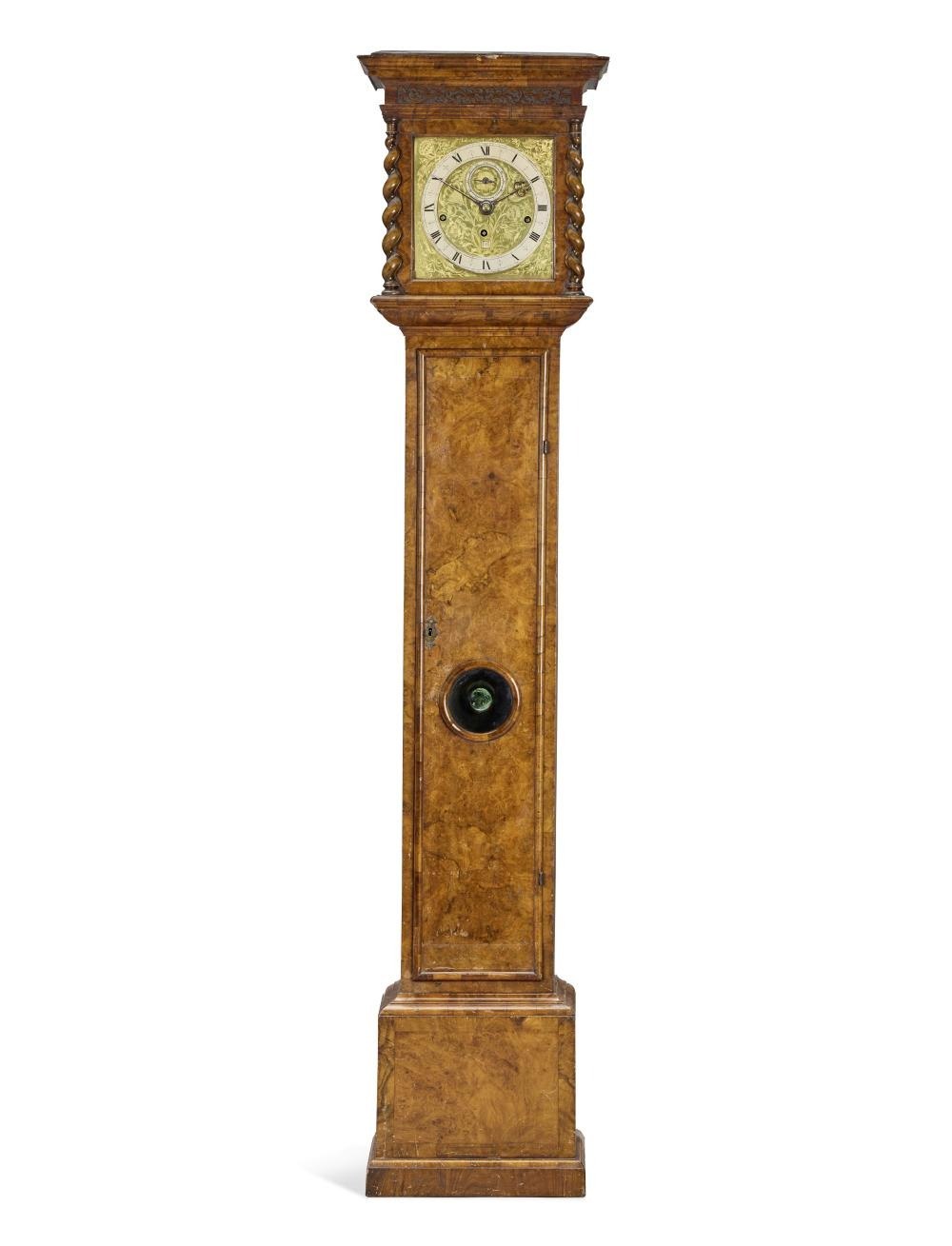
This longcase clock, attributed to Edward East of London, dates to the third quarter of the 17th century. The clock is constructed in walnut, featuring a flat-topped case with a pierced sound fret and twisted columns flanking the dial. The trunk door includes a large circular lenticle and a brass escutcheon. The 10-inch brass dial displays a silvered chapter ring with Roman numerals, fleur-de-lys markers, and Arabic five-minute divisions. The centre is engraved with tulip and still life motifs. The movement is a substantial three-train mechanism featuring eleven latched, turned knopped pillars and split plates. It includes a quarter-striking system using an external countwheel on a nest of six bells, with a separate countwheel for the hours on an additional bell. The escapement has been modified to an anchor configuration. The total height is recorded as 198 cm.

Full view of the Edward East walnut longcase clock.
Full view of the Edward East walnut longcase clock. — Bonhams / Invaluable. Rights pending — permission not yet requested. Original source

Catalogue identity

Source
orbiscollectibles.com
Category
Clock · Longcase clock
Maker / attribution
Edward East
Reference
Not recorded
Catalogue / lot identifier
201086677
Source-reported date
third quarter of the 17th century
Source-reported place
England

Source-reported attribution and specifications are not independent authentication. A listing does not establish present ownership, current display, availability or permission to reproduce.

Object description

Case Construction

The walnut case is designed with a flat top section that features a pierced sound fret, which serves as an ornamental ventilation for the movement. The hood is supported by turned and twisted columns, providing a visual rhythm alongside the convex throat moulding situated just below the dial frame.

The trunk is dominated by a door fitted with a large circular lenticle, allowing a view of the pendulum. While the door retains its visual profile, it features a brass escutcheon that is identified as a later addition. The entire structure is set upon a moulded base and elevated by a shallow plinth.

Evidence for this section
  • “The case with a flat top surmounted by a pierced sound fret over a moulded top supported by turned and twisted columns, over a convex throat moulding.”
  • “the long trunk door with later brass escutcheon and large circular lenticle, above a moulded base and further raised on a shallow plinth.”

Dial and Indication

The 10-inch brass dial plate is a central element of the clock, featuring finely executed engraving work. The silvered chapter ring is calibrated with Roman numerals and five-minute Arabic intervals, with fleur-de-lys half-hour markers placed between the hours.

Beyond basic timekeeping, the dial incorporates a subsidiary seconds dial and a calendar aperture. The central field is heavily decorated with tulip and still life motifs, while the corners are framed by floral spandrels. The signature of Edward East is positioned prominently above the twelve o'clock marker.

Evidence for this section
  • “The 10 inch brass dial with slender and finely executed silvered chapter ring”
  • “The dial centre richly engraved with typical East tulip and still life motifs”
  • “Signed above XII Eduardus East Londini.”

Movement and Striking

The clock is powered by a substantial three-train movement constructed with eleven latched, turned knopped pillars and split plates. This configuration is designed to handle both timekeeping and a complex striking train.

The striking mechanism functions on two distinct systems. The quarters are struck via an external countwheel using a nest of six bells and hammers. A separate countwheel is employed to manage the hour strike on a larger bell mounted above the movement. It is noted that the escapement has undergone a modification, resulting in an anchor-type action.

Evidence for this section
  • “The substantial three-train movement with eleven latched, turned knopped pillars and split plates”
  • “the clock striking the quarters via an external countwheel on a nest of six bells and hammers”
  • “The escapement a modified to anchor.”

Open research questions

  • Does the serial number or internal movement mark confirm the provenance to Edward East?
  • What is the timeline for the escapement modification to the anchor type?

Source evidence

Recorded claims and source quotations for Edward East Walnut Longcase Clock
FieldSource-reported valueSource quotation
MakerEdward East“Edward East, London”
DateThird quarter of the 17th century“third quarter of the 17th century”
MaterialWalnut“walnut”
Height198 cm“198cms”
SignatureEduardus East Londini“Signed above XII Eduardus East Londini.”
EscapementModified to anchor“The escapement a modified to anchor.”

Visible details

  • Twisted columns flanking the dial
  • Large circular lenticle in the trunk door
  • Silvered chapter ring with fleur-de-lys markers
  • Pierced sound fret above the dial

Research qualifications

  • Independent verification of type attribution required
  • Modification of escapement from original configuration to anchor

Photograph identity and source facts were screened before import; rights clearance remains pending.

Consulted source

Edward East walnut longcase clock

Reviewed 2026-11-02 · Record d41b07fa75

Terms in this record

Glossary explanations for terms named in this object’s record.