
Skip to content
The Encyclopedia of Horology

Clock · Bracket clock

Ebonised bell top bracket clock by Joseph Lum

Partially verified

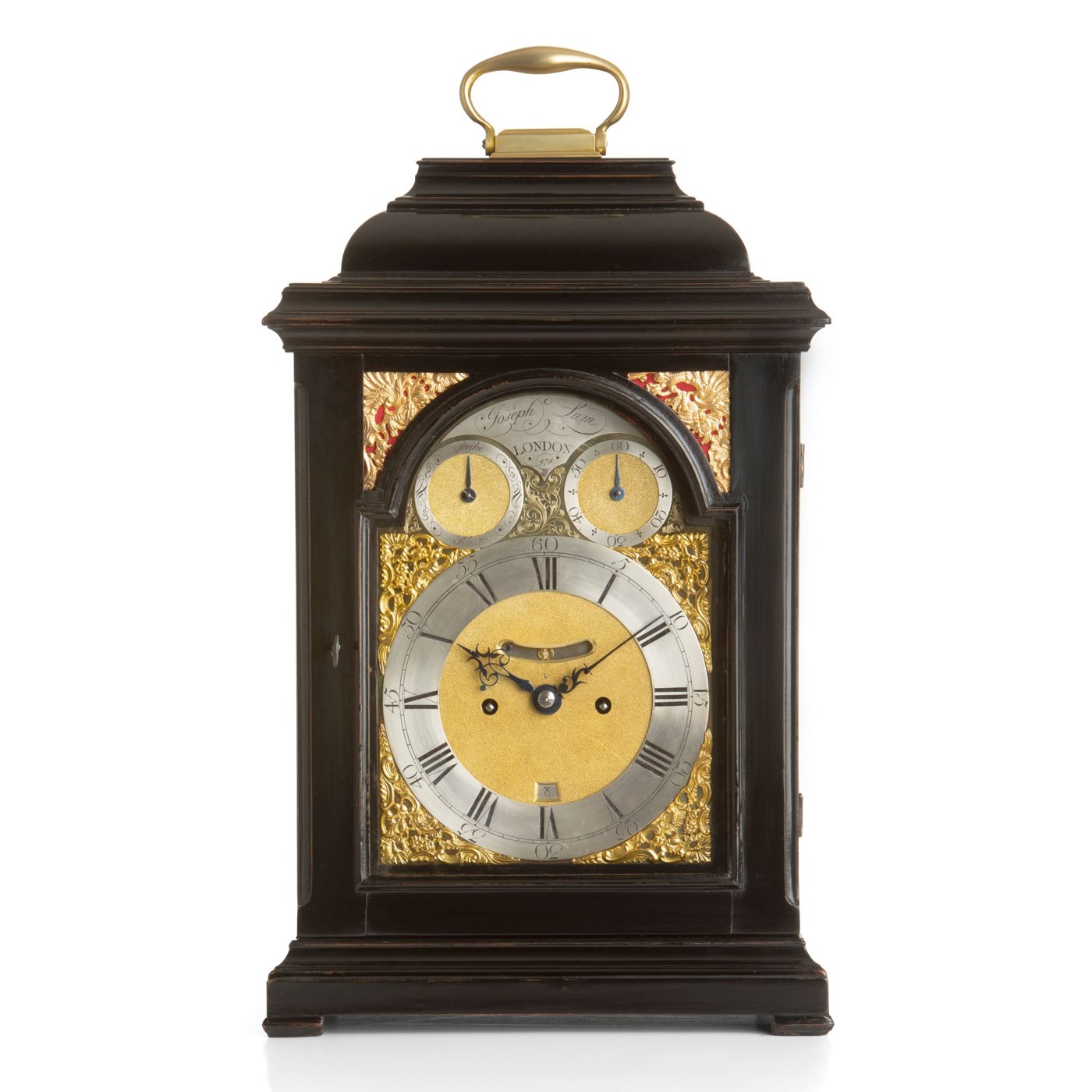
This ebonised bracket clock features a bell top case, measuring 51 cm in height including the handle. The clock houses a brass dial, 8-day movement which incorporates a verge escapement and strikes the hours on a single bell, with a pull repeat function. The dial includes a silvered chapter ring, an aperture for the date, and two subsidiary dials in the arch for strike/silent and rise/fall. The maker's name, Joseph Lum, is inscribed on an applied disc at the top of the dial. The movement is fitted with a fully engraved backplate featuring floral swags. The ebonised case includes a curved bell top, a brass carrying handle, ebonised feet, and gilded frets on the front glazed door. The object dates to approximately 1765 and has provenance from a private collection in the U.K.

Front view of the ebonised bracket clock, showing the brass dial, subsidiary dials, and the bell-top case design.
Front view of the ebonised bracket clock, showing the brass dial, subsidiary dials, and the bell-top case design. — Dorset Antique Clocks. Rights pending — permission not yet requested. Original source

Catalogue identity

Source
www.dorsetantiqueclocks.co.uk
Category
Clock · Bracket clock
Maker / attribution
Joseph Lum
Reference
Not recorded
Catalogue / lot identifier
Source URL identifies the listing
Source-reported date
circa 1765
Source-reported place
United Kingdom

Source-reported attribution and specifications are not independent authentication. A listing does not establish present ownership, current display, availability or permission to reproduce.

Object description

Case and Exterior

The clock is housed in an ebonised case, which features a curved bell top profile and ebonised feet. The design includes a brass carrying handle mounted to the top of the case for portability. The front glazed door is decorated with gilded frets, which are visible in the product photography.

The visual composition of the dial is marked by a brass centre, a silvered chapter ring, and ornate spandrels in the corners. The arch contains the maker's signature on an applied disc, flanked by two subsidiary dials designated for strike/silent and rise/fall adjustments. A date aperture is set into the main dial face above the numeral VI.

Evidence for this section
  • “The classic style of ebonised case for the period, with a curved bell top, gilded frets to the front glazed door. Brass centre carrying handle and ebonised feet.”
  • “two subsidiary dials in the arch for strike/silent and rise/fall with the maker’s signature on an applied disc at the top. There is an aperture for the date above VI.”

Movement and Escapement

The timekeeping is powered by an 8-day movement featuring a verge escapement. The mechanism strikes the hours on a single bell, with a pull repeat facility available for the user.

The backplate of the movement is fully engraved, featuring floral swags. The assembly, as shown in the provided photography, includes the bell mechanism and the pendulum suspension.

Evidence for this section
  • “The brass dial 8-day movement strikes the hours on a single bell”
  • “The movement has the original verge escapement and strikes the hours with a pull repeat on a single bell. The fully engraved backplate is beautifully engraved with floral swags.”

Maker and History

Joseph Lum is recorded as having initially set up a workshop in Chelmsford, Essex, during the early 18th century. He later relocated his business to London in 1745, where he continued to work until his death in 1770.

The object is recorded with provenance from a private collection in the United Kingdom.

Evidence for this section
  • “Joseph Lum: First set up a workshop in his home town of Chelmsford, Essex in the first part of the 18th Century. In 1745 he moved to London where he worked up until his death in 1770”
  • “Provenance: Private collection U.K.”

Open research questions

  • What is the specific history of Joseph Lum's output during his London period?
  • Are there recorded examples of Lum's work with similar rise/fall dial configurations in public collections?

Source evidence

Recorded claims and source quotations for Ebonised bell top bracket clock by Joseph Lum
FieldSource-reported valueSource quotation
MakerJoseph Lum“Joseph Lum”
Datecirca 1765“CIRCA. 1765”
Height51 cm“Height: 20″ or 51cm (Handle up)”
Movement type8-day brass dial“The brass dial 8-day movement”
EscapementVerge“The movement has the original verge escapement”
FunctionsStrike/silent and rise/fall“two subsidiary dials in the arch for strike/silent and rise/fall”
ProvenancePrivate collection U.K.“Provenance: Private collection U.K.”

Visible details

  • The dial arch features two subsidiary dials flanking the maker's signature disc.
  • The movement backplate is decorated with extensive floral engraving.
  • The clock case is finished in ebonised wood with a curved bell-top profile.
  • The clock face includes a date aperture positioned above the numeral VI.

Research qualifications

  • The exact date of manufacture is cited as circa 1765, which is an estimation.
  • The listing claims the movement has the original verge escapement.

Photograph identity and source facts were screened before import; rights clearance remains pending.

Consulted source

EBONISED STRIKING BRACKET CLOCK WITH BELL TOP CASE – JOSEPH LUM – LONDON

Reviewed 2026-11-02 · Record ba38a54064

Terms in this record

Glossary explanations for terms named in this object’s record.