
Skip to content
The Encyclopedia of Horology

Tool · Nuremberg diptych dial

Diptych Dial

Partially verified

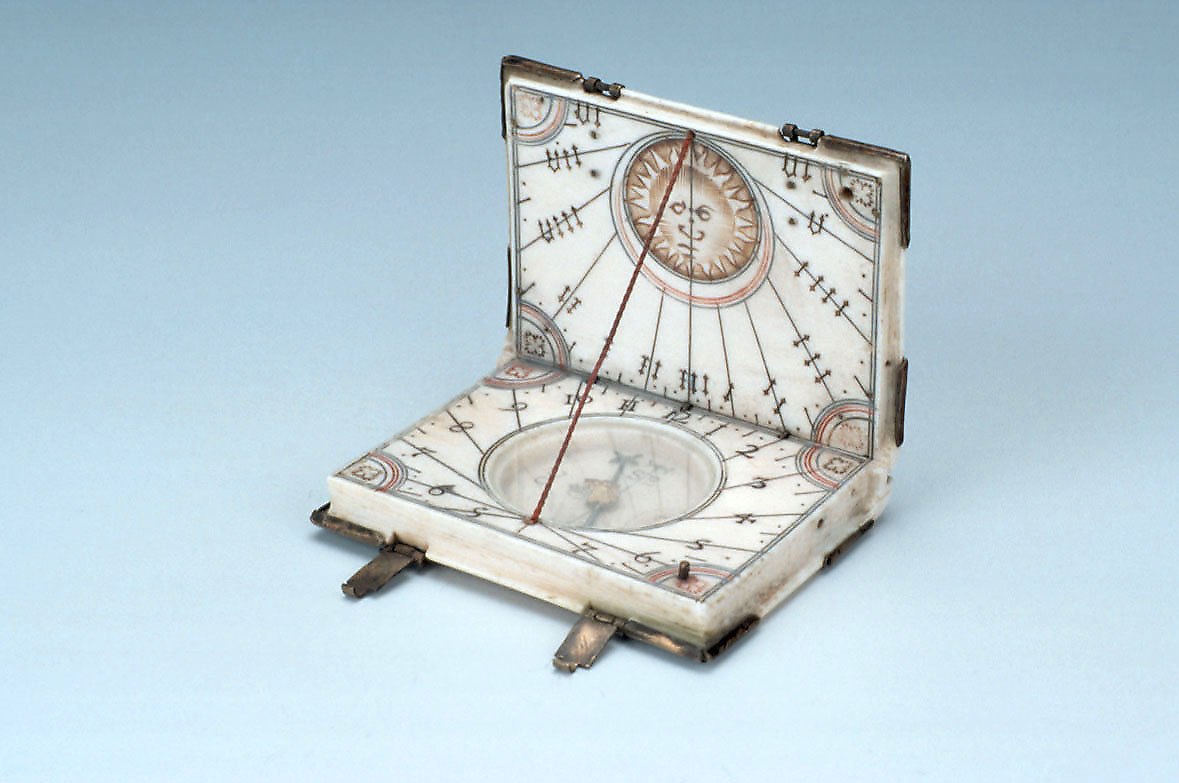
This diptych dial, measuring 69 x 48 x 11 mm, is constructed from ivory and brass in the form of a book. It is attributed to the Nuremberg maker Paul Reinmann and dated to approximately 1600. The exterior features brass spandrels, clasps, and four bun feet, with depictions of saints on the outer leaves. The upper interior leaf contains a string gnomon dial with common hours numbered VI to XII to VI, accompanied by a central sun effigy. The lower interior leaf includes a compass and a secondary string gnomon dial numbered 5 to 12 to 7. The maker's mark, a crown, is present within the compass. Because the same mark was utilized by Michael Lesel between 1609 and 1629, the attribution to Reinmann remains tentative. The object is currently held in the collection of the Museum of the History of Science, Oxford.

A diptych sundial in the form of a book, open to show internal dial faces and compass.
A diptych sundial in the form of a book, open to show internal dial faces and compass. — Museum of the History of Science, Oxford. Rights pending — permission not yet requested. Original source

Catalogue identity

Source
www.mhs.ox.ac.uk
Category
Tool · Nuremberg diptych dial
Maker / attribution
Attributed to Paul Reinmann
Reference
Not recorded
Catalogue / lot identifier
37833
Source-reported date
circa 1600
Source-reported place
Germany

Source-reported attribution and specifications are not independent authentication. A listing does not establish present ownership, current display, availability or permission to reproduce.

Object description

Construction and Exterior Decoration

The instrument is crafted in the form of a book, utilizing ivory as the primary material for the leaves and brass for the mechanical and decorative components. The exterior features include four bun feet for stability, along with functional brass clasps that secure the two leaves when closed. The outer surfaces are decorated with brass spandrels, providing both structural reinforcement and ornamentation.

Both outer leaves are adorned with figurative illustrations. The upper leaf displays an unidentified bearded saint dressed in a toga and holding a spear, flanked by foliate tendrils. The lower leaf depicts St. Peter, also in a toga and carrying a sword, featuring similar foliate decoration and matching brass spandrels to those found on the upper leaf.

Evidence for this section
  • “The dial has the form of a book with brass clasps and spandrels”
  • “has figures of saints on the outer sides of both leaves”
  • “Each of the outer leaves of this dial in the form of a book is decorated with brass spandrels and clasps, and has four bun feet”

Internal Dials and Instrumentation

The interior of the upper leaf houses a string gnomon dial with hours marked in Roman numerals from VI to XII and back to VI. A central sun effigy is engraved as part of the dial design. The spandrel areas are decorated with quatrefoil motifs.

The lower leaf contains a compass, though the original ring is noted as missing. The cardinal points are inscribed as 'SE', 'OR', 'ME', and 'OC'. Adjacent to the compass is a second string gnomon dial with hours numbered 5 to 12 to 7, which incorporates specific indicators for half and quarter hour intervals.

Evidence for this section
  • “inner part of the upper leaf has a string gnomon dial with common hours numbered from VI to XII to VI, a sun effigy in the centre”
  • “inner part of the lower leaf has a compass (ring missing) with the cardinal points marked 'SE', 'OR', 'ME' and 'OC'”
  • “The string gnomon dial has common hours numbered from 5 to 12 to 7 with dots and lines for the half and quarter hours”

Attribution and Markings

The instrument bears a crown as the maker's mark, located within the compass interior. While this mark is associated with the Nuremberg maker Paul Reinmann, its historical context is shared with other makers. Specifically, the same coronet mark was utilized by Michael Lesel during his period of activity between 1609 and 1629.

Due to this overlap in the use of the mark, the attribution to Reinmann is not considered definitive, even though it matches his known work period leading up to 1609. Consequently, the maker's mark alone is viewed as an incomplete diagnostic tool for determining the origin of the dial.

Evidence for this section
  • “A coronet was used by Paul Reinmann until his death in 1609, but the same coronet was used by another Nuremberg maker, Michael Lesel, from 1609 to 1629”
  • “The presence of the maker's mark is not always decisive in the attribution of an instrument, as in this case”

Open research questions

  • Could technical analysis of the foliate tendrils distinguish the hand of Paul Reinmann from that of Michael Lesel?
  • Is there physical evidence suggesting the missing compass ring was once silver or brass?

Source evidence

Recorded claims and source quotations for Diptych Dial
FieldSource-reported valueSource quotation
MakerAttributed to Paul Reinmann“Attributed to Paul Reinmann”
Datecirca 1600“circa 1600”
Dimensions69 x 48 x 11 mm“69 x 48 x 11 mm”
MaterialsIvory and brass“Ivory and brass”
Maker's MarkA crown“the maker's mark (a crown)”
Compass Cardinal PointsSE, OR, ME, OC“cardinal points marked 'SE', 'OR', 'ME' and 'OC'”
Holding InstitutionMuseum of the History of Science, Oxford“Museum of the History of Science, Oxford”

Visible details

  • The dial is oriented in an open position showing interior dials.
  • A thin red string acts as the gnomon connecting the two leaves.
  • Metal clasps are visible along the edges of the ivory leaves.
  • The compass bowl interior is visible on the lower leaf surface.

Research qualifications

  • The attribution to Paul Reinmann is complicated by the use of the same mark by Michael Lesel.
  • The ring for the compass on the lower leaf is missing.
  • The identity of the bearded saint on the upper leaf remains unconfirmed.

Photograph identity and source facts were screened before import; rights clearance remains pending.

Consulted source

Diptych Dial

Reviewed 2026-10-26 · Record debda4adcd

Terms in this record

Glossary explanations for terms named in this object’s record.