Construction and Design
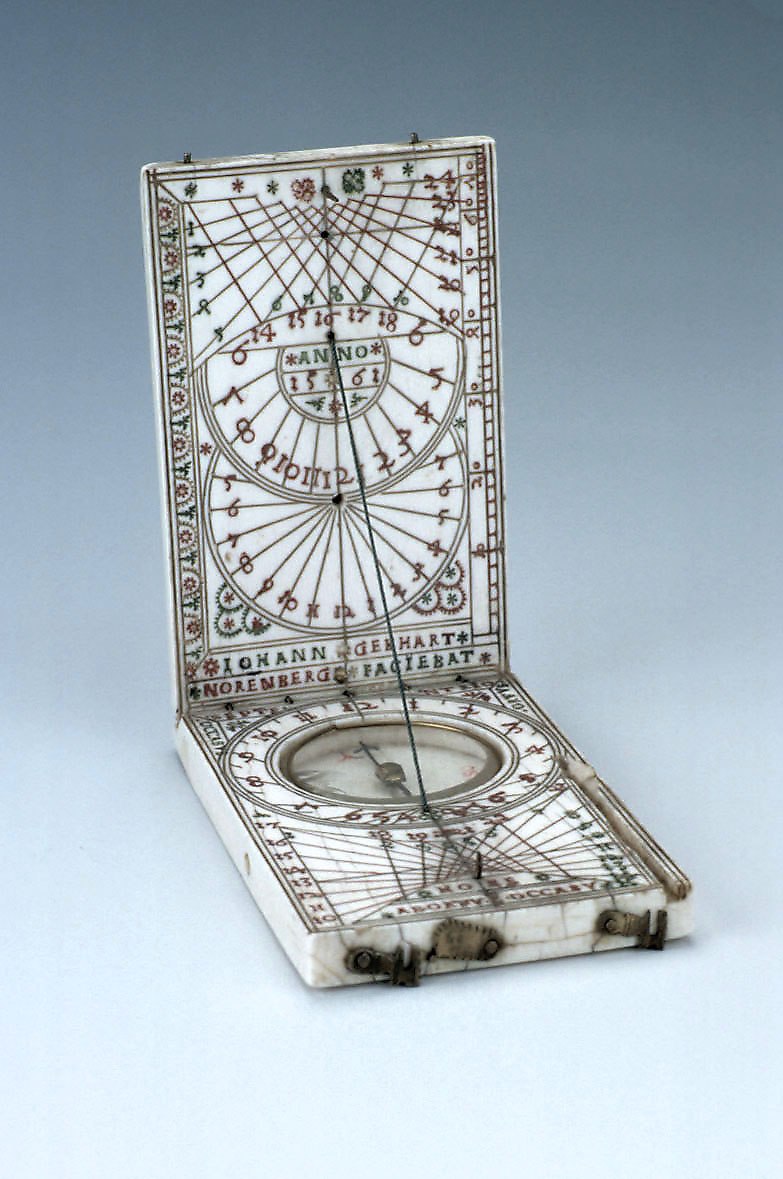
The diptych sundial is composed of two ivory leaves connected by a hinge, with brass components integrated throughout the instrument. The interior displays a complex array of dials, including pin gnomon dials and string gnomon dials, calibrated for common, Italian, and Babylonian hours. Decoration is applied across the surfaces, incorporating star patterns, geometrical motifs, and a sun effigy. The outer face of the upper leaf also features a pin gnomon dial alongside a latitude table for eighteen towns.
The lower leaf serves as the base for the compass, which is marked with cardinal directions in Latin: 'OST', 'S', and 'WEST'. Storage compartments are incorporated into the design to house the loose brass arm and the pin gnomon when the instrument is closed.
Evidence for this section
- “Ivory and brass; 55 x 89 x 13 mm”
- “The outer face of the upper leaf has a pin gnomon dial (pin missing)”
- “The lower leaf has a compass (the glass is slivered)”
- “The lower leaf of the dial has a hole drilled through it from side to side: the reason for this is unknown, but it is very likely a recent modification.”
Signatures and Markings
The dial bears the explicit signature of its maker, Johann Gebhart, positioned prominently on the inner face of the upper leaf along with the date of manufacture. The text reads '[star] IOHANN [star] GEBHART [star] [star] NORENBERGE [star] FACIEBAT [star]', indicating his work in Nuremberg. Further identifying marks include a series of the number '3', which is punched five times into the lower leaf near the hinge.
The instrument also features various inscriptions related to its timekeeping functions and geographical orientations, such as 'OCCASVS', 'SEPTE NTRIO', and 'ORTVS'. Maker's marks and initials are located on the exterior of the lower leaf, providing additional evidence of the object's origin and attribution within the tradition of Nuremberg ivory dial makers.
Evidence for this section
- “Signed by Johann Gebhart”
- “Dated 1561; Nuremberg”
- “At the bottom is the signature '[star] IOHANN [star] GEBHART [star] [star] NORENBERGE [star] FACIEBAT [star]'”
- “On the lower leaf, by the hinge, the mark '3' is punched five times.”
Condition and Completeness
The physical state of the instrument shows evidence of wear and missing original components. The pin gnomon required for the outer face of the upper leaf is currently absent. Similarly, the brass arm, intended for use with the internal dials, is no longer present within its designated compartment. The compass glass is noted as being slivered, reflecting the age of the instrument.
Despite these losses, the inscriptions and dial markings remain legible. The object is catalogued by the Museum of the History of Science, Oxford, under inventory number 63463. Research by P. Gouk regarding Nuremberg ivory sundials provides context for this type of instrument, though specific historical usage remains tied to the functional capacity of its surviving dial systems.
Evidence for this section
- “The outer face of the upper leaf has a pin gnomon dial (pin missing)”
- “On the right side is a compartment for the brass arm (the arm itself is missing)”
- “The lower leaf has a compass (the glass is slivered)”
- “See P. Gouk, The Ivory Sundials of Nuremberg 1500-1700”