
Skip to content
The Encyclopedia of Horology

Tool · Nuremberg diptych dial

Diptych Dial by Hans Tucher

Partially verified

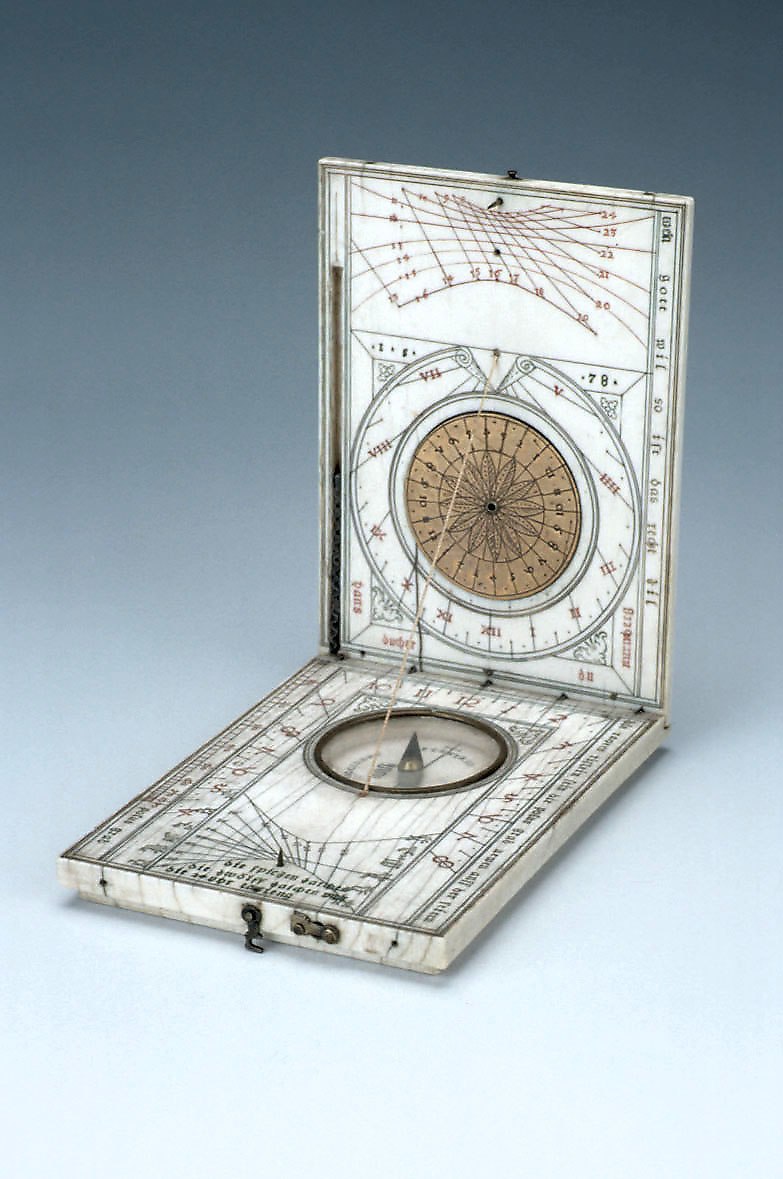
This 1578 diptych sundial, constructed from ivory and brass, measures 81 x 114 x 15 mm and is signed by the Nuremberg maker Hans Tucher. The instrument features a hinged construction with an integrated compass, pin gnomon dials, and string gnomon dials. The dial is extensively inscribed with mottoes in German and includes technical features such as a lunar volvelle, a wind rose with 16 directions, and an adjustable brass arm for latitude calibration. The lower leaf houses a compass and horizontal dial with Italian hour markings and solar declination symbols. The outer surfaces contain further markings, including a list of cities and their latitudes. The object incorporates various geometric and time-keeping functions, evidenced by the presence of multiple gnomons and scales for measuring day length and cardinal directions. It is currently held by the Museum of the History of Science, Oxford, under inventory number 65544.

Diptych dial by Hans Tucher, 1578, showing the internal configuration of the ivory leaves, the compass, and various gnomon scales.
Diptych dial by Hans Tucher, 1578, showing the internal configuration of the ivory leaves, the compass, and various gnomon scales. — Museum of the History of Science, Oxford. Rights pending — permission not yet requested. Original source

Catalogue identity

Source
www.mhs.ox.ac.uk
Category
Tool · Nuremberg diptych dial
Maker / attribution
Hans Tucher
Reference
Not recorded
Catalogue / lot identifier
65544
Source-reported date
1578
Source-reported place
Nuremberg

Source-reported attribution and specifications are not independent authentication. A listing does not establish present ownership, current display, availability or permission to reproduce.

Object description

Construction and Design

The diptych dial is a hinged, rectangular instrument crafted from ivory with brass fittings. It measures 81 by 114 by 15 millimeters. The object functions as a complex astronomical device, incorporating multiple time-keeping methods including pin gnomon dials, vertical string gnomon dials, and a horizontal dial.

The interior of the leaves are densely packed with engraved scales for Italian hours, day length indicators, and solar declination symbols based on zodiacal signs. The upper leaf includes a central brass volvelle featuring a twelve-leaf flower, while the lower leaf contains a compass featuring the cardinal points indicated in Latin.

Evidence for this section
  • “Ivory and brass; 81 x 114 x 15 mm”
  • “The outer part of the upper leaf has a lunar volvelle combined with a wind rose with 16 directions and a twelve-leaf flower at the centre.”
  • “The inner part of the lower leaf has a compass with the cardinal points named in Latin and the maker's mark (a snake).”

Inscriptions and Technical Features

Extensive inscriptions appear throughout the dial, serving both functional and thematic purposes. Mottoes written in German reflect on the nature of the device and the expertise of the user, such as warnings against using the compass near iron or challenges to the critic's ability.

Technical versatility is achieved through a combination of a lunar volvelle, a wind rose with 16 directions, and an adjustable brass arm for setting latitude. The device allows for the measurement of day length and the conversion of Italian hours, supported by a scale allowing latitude adjustment by two-degree increments.

Evidence for this section
  • “This instrument is extensively inscribed with mottoes and instructions on the use of the dial itself.”
  • “It also has an unusual combination of two basic elements in diptych dials , a lunar volvelle and a wind rose .”
  • “on the left an unequal scale with 'polus grad' inscribed allows to adjust the latitude from [0?] to 90? by 2?, numbered by 10?.”

Signatures and Attribution

The piece is signed 'hans ducher zu nurnberg' on the interior of the upper leaf. The inclusion of the year '15 78' on the central volvelle confirms the production date within the Nuremberg tradition. The maker is further identified by a specific mark, a snake, located within the compass area of the lower leaf.

The documentation for this object is supported by historical research into the ivory sundials of the Nuremberg region, as noted in the reference work by P. Gouk. The device remains a documented artifact in the collection of the Museum of the History of Science, Oxford.

Evidence for this section
  • “Signed by Hans Tucher”
  • “The signature 'hans ducher zu nurnberg' is at the bottom”
  • “See P. Gouk, The Ivory Sundials of Nuremberg 1500-1700 (Cambridge, 1988).”

Open research questions

  • What is the specific geographical scope of the city/latitude list on the outer leaf?
  • Does the '15 78' date marking signify the year of completion or a later addition by the maker?

Source evidence

Recorded claims and source quotations for Diptych Dial by Hans Tucher
FieldSource-reported valueSource quotation
MakerHans Tucher“Signed by Hans Tucher”
Date1578“Dated 1578”
Dimensions81 x 114 x 15 mm“81 x 114 x 15 mm”
MaterialIvory and brass“Ivory and brass”
Inventory Number65544“Inventory number 65544”
Maker's MarkSnake“the maker's mark (a snake)”
Location of ManufactureNuremberg“Nuremberg”

Visible details

  • The maker's mark, a snake, is visible within the compass housing.
  • A brass arm for latitude adjustment is positioned on the left side of the upper leaf interior.

Research qualifications

  • The exact significance of the '15 78' marking position relative to the volvelle construction remains implicit.
  • The specific latitude range and scale precision on the side of the dial are described as requiring adjustment by the user.

Photograph identity and source facts were screened before import; rights clearance remains pending.

Consulted source

Diptych Dial

Reviewed 2026-10-26 · Record 0f3cd2ebec

Terms in this record

Glossary explanations for terms named in this object’s record.