
Skip to content
The Encyclopedia of Horology

Tool · Nuremberg diptych dial

Paul Reinmann Diptych Dial

Partially verified

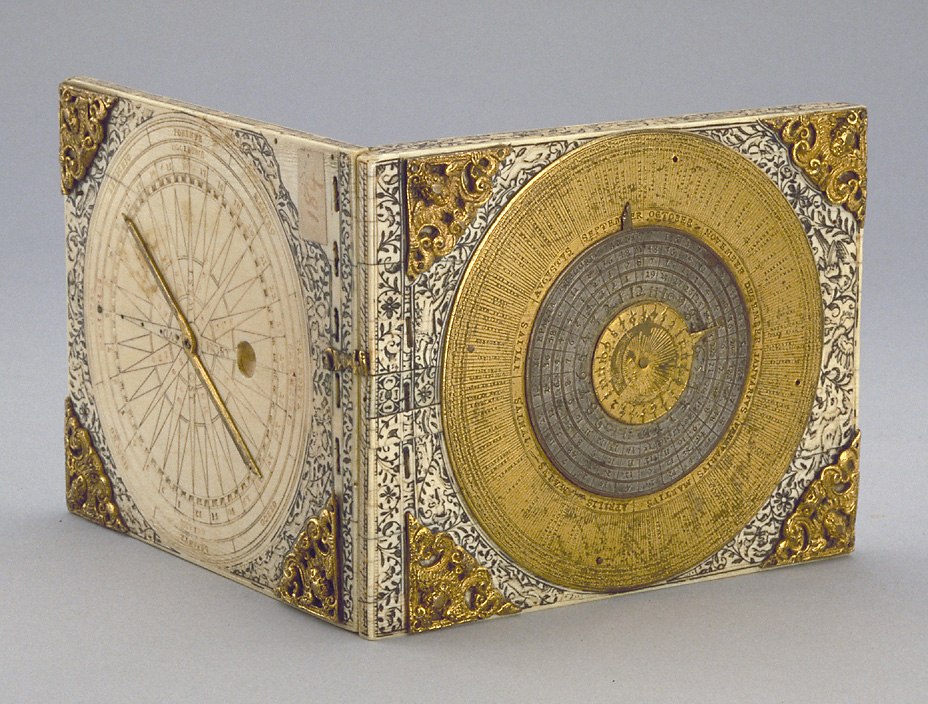
This 1607 diptych dial is constructed from ivory and brass, measuring 142 x 112 x 17 mm. The object is signed by the Nuremberg maker Paul Reinmann and features elaborate decorative engraving with red, green, black, and gold-filled inscriptions. The surface is adorned with floral, foliate, and scrollwork designs featuring animals, with gilt brass cherub spandrels at the corners of the upper and lower outer leaves. Functional elements include a wind rose, pin gnomon dials for Babylonian and Italian hours, a horizontal string gnomon dial for multiple latitudes, and a latitude list for 99 European cities. A complex series of brass volvelles is integrated into the lower leaf, incorporating a calendar, lunar cycles, and time conversion scales. The instrument is held by the British Museum, having been bequeathed by Octavius Morgan in 1888.

The diptych dial in an open position showing the internal clockwork features and the exterior volvelle calendar mechanism.
The diptych dial in an open position showing the internal clockwork features and the exterior volvelle calendar mechanism. — British Museum, London. Rights pending — permission not yet requested. Original source

Catalogue identity

Source
www.mhs.ox.ac.uk
Category
Tool · Nuremberg diptych dial
Maker / attribution
Paul Reinmann
Reference
Not recorded
Catalogue / lot identifier
MLA 1888,12-1.285
Source-reported date
1607
Source-reported place
Nuremberg

Source-reported attribution and specifications are not independent authentication. A listing does not establish present ownership, current display, availability or permission to reproduce.

Object description

Construction and Decoration

The diptych dial is manufactured from ivory and brass, measuring 142 by 112 by 17 millimeters. The ivory surfaces are intricately engraved with floral, leaf, and scroll motifs, which incorporate various animal figures. Inscriptions stamped into the ivory are highlighted with red, green, black, and gold color fills.

The external corners of the upper and lower dials are finished with gilt brass cherub spandrels, although one such component is currently missing. The two leaves are secured with brass clasps, and a secondary clasp is provided to hold the instrument open during use.

Evidence for this section
  • “The stamped inscriptions on this ivory dial are filled with red, green, black and gold colours. It is decorated all over with flowers, leaves and scrolls, inhabited by animals.”
  • “The corners of the outer surfaces of the upper and lower dials are decorated with gilt brass cherub spandrels (one of which is missing).”

Timekeeping and Astronomical Functions

The instrument contains a wide array of functional astronomical indicators. The inner leaf surfaces house pin gnomon dials configured for Babylonian, Italian, and unequal planetary hours. Additionally, a horizontal string gnomon dial provides for multiple latitudes. A latitude list comprising 99 European cities is arranged in three columns on the inner upper leaf.

The lower leaf exterior features an elaborate set of rotating brass discs. These volvelles include a calendar with month names, daily numbering, day letters, and a listing of 81 Christian saints and feast days. Central discs facilitate the calculation of lunar age, solar time, and time corrections.

Evidence for this section
  • “The instrument contains a wind rose , two pin gnomon dials showing Babylonian hours and the length of the day in hours respectively, a latitude list of 99 European cities, a horizontal string gnomon dial for different latitudes”
  • “The outer surface of the lower leaf contains a very elaborate set of alternating gilt and silvered brass discs, with the two in the centre being movable.”

Provenance and Documentation

The object is part of the collection of the British Museum in London, identified by the registration number MLA 1888,12-1.285. It was acquired by the museum via the bequest of Octavius Morgan in 1888.

The instrument has been catalogued in academic literature, specifically appearing in the 1981 work by F. A. B. Ward, A catalogue of European Scientific Instruments in the Department of Medieval and Later Antiquities of the British Museum.

Evidence for this section
  • “The instrument was bequeathed by Octavius Morgan in 1888 and is described in F. A. B. Ward, A catalogue of European Scientific Instruments in the Department of Medieval and Later Antiquities of the British Museum (London, 1981), pp. 36-7, no. 81.”

Open research questions

  • What is the specific composition of the missing string gnomon material?
  • How does the internal compass needle function within the depth of the empty compass well?

Source evidence

Recorded claims and source quotations for Paul Reinmann Diptych Dial
FieldSource-reported valueSource quotation
MakerPaul Reinmann“Signed by Paul Reinmann”
Date1607“Dated 1607”
Place of manufactureNuremberg“Nuremberg”
MaterialsIvory and brass“Ivory and brass”
Dimensions142 x 112 x 17 mm“142 x 112 x 17 mm”
Inventory numberMLA 1888,12-1.285“MLA 1888,12-1.285”

Visible details

  • Decorative motifs include floral, leaf, and animal scrollwork patterns
  • Gilt brass cherub spandrels are attached to the corners of the outer faces
  • The instrument employs both gilt and silvered brass for the volvelles

Research qualifications

  • One cherub spandrel is noted as missing
  • The string for the latitude-specific dial is not original to the instrument

Photograph identity and source facts were screened before import; rights clearance remains pending.

Consulted source

Diptych Dial

Reviewed 2026-10-26 · Record 7540a1c520

Terms in this record

Glossary explanations for terms named in this object’s record.