
Skip to content
The Encyclopedia of Horology

Tool · Nuremberg diptych dial

Diptych Dial by Paul Reinmann

Partially verified

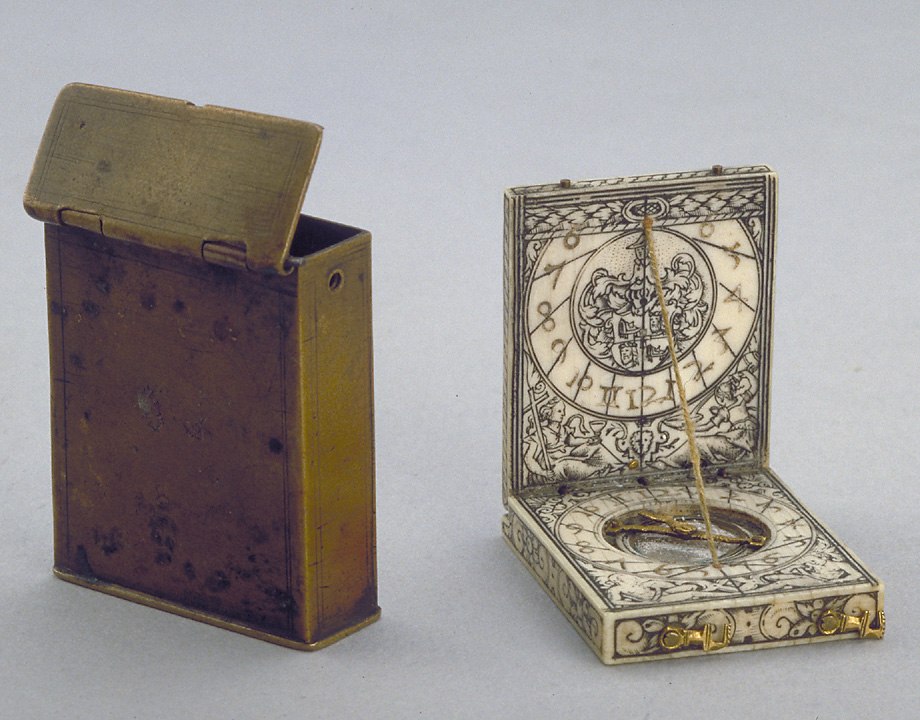
This diptych dial is attributed to the Nuremberg instrument maker Paul Reinmann based on initials 'P R' and a crown maker's mark. Dating to the later 16th century, the instrument is constructed from ivory and gilt brass, measuring 40 x 30 x 8 mm. The dial is held within a close-fitting brass container. Its surfaces are adorned with engravings of figures, fruit, and foliage with black pigment infill. The functional components include a volvelle on the upper exterior for converting common hours into Babylonian hours, a vertical string gnomon dial on the inner upper leaf, and a horizontal string gnomon dial with an inset compass on the inner lower leaf. The shield of arms of the Holzschuher family of Nuremberg is located on the inner upper leaf. The object was donated to the British Museum by A. W. Franks in 1871.

The diptych dial shown open with its brass container alongside, omitting mention of the Adoration of the Shepherds which is not visible or confirmed in the provided record description.
The diptych dial shown open with its brass container alongside, omitting mention of the Adoration of the Shepherds which is not visible or confirmed in the provided record description. — British Museum, London. Rights pending — permission not yet requested. Original source

Catalogue identity

Source
www.mhs.ox.ac.uk
Category
Tool · Nuremberg diptych dial
Maker / attribution
Paul Reinmann
Reference
MLA 1871,11-15.14
Catalogue / lot identifier
MLA 1871,11-15.14
Source-reported date
later 16th century
Source-reported place
Germany

Source-reported attribution and specifications are not independent authentication. A listing does not establish present ownership, current display, availability or permission to reproduce.

Object description

Construction and Decoration

The diptych dial is manufactured from ivory, measuring 40 by 30 by 8 mm, and is housed in a brass container with a hinged lid. The exterior and interior surfaces are covered with engravings featuring male and female figures, cherubs, fruit, leaves, and geometric patterns. In accordance with the manufacturing techniques of the period, the engraved lines and inscriptions are filled with black pigment to increase legibility against the ivory surface.

The instrument is accompanied by a brass container designed to fit the dial closely, protecting the ivory surfaces when not in use. The overall design features components made from gilt brass, including the volvelle disc and the compass bridge, which provide structural contrast to the ivory leaves.

Evidence for this section
  • “This very small dial is decorated all over with cherubs, female and male figures, fruit, leaves and geometric patterns.”
  • “The dial has a close fitting brass container with a hinged lid.”

Timekeeping Functions

The dial incorporates multiple timekeeping and calculation features. The outer surface of the upper leaf contains a volvelle consisting of a movable gilt brass disc. This disc allows the conversion of common hours into Babylonian hours based on the length of the day. A set of scales is used to cross-reference common and Babylonian hours via a central index.

Internal surfaces feature two string-gnomon dials. The upper leaf interior displays a vertical string gnomon dial with hours numbered 6 to 12 to 6. The lower leaf interior houses a horizontal string gnomon dial with hours numbered 5 to 12 to 7, incorporating an inset compass for orientation. The compass is bridged by a brass bar with a pivoted hand-shaped index.

Evidence for this section
  • “The outer surface of the upper leaf contains a volvelle for the conversion of common hours into Babylonian hours”
  • “The inner surface of the upper leaf contains a vertical string gnomon dial”
  • “The inner surface of the lower leaf contains a horizontal string gnomon dial (the hours numbered 5 to 12 to 7) with an inset compass.”

Identification and Provenance

The instrument is attributed to Paul Reinmann due to the presence of the initials 'P R' and a maker's mark consisting of a crown on the lower leaf near the hinges. The identification is supported by the engraving of the Holzschuher family shield of arms on the inner upper leaf, which serves as an indicator of the original owners.

The piece entered the British Museum collection in 1871 as a presentation from A. W. Franks. It is formally recorded in the museum under the registration number MLA 1871,11-15.14 and has been listed in academic catalogues concerning the scientific instrument collection.

Evidence for this section
  • “On the lower leaf near the hinges are the initials 'P R' and the maker's mark, a crown, which allow this instrument to be attributed to Paul Reinmann.”
  • “The instrument was presented by A. W. Franks in 1871”

Open research questions

  • What is the specific historical context of the Holzschuher family's commission of this specific small-scale dial?
  • Are there extant examples of similar 'unusually small' diptych dials by Reinmann that display identical decorative motifs?

Source evidence

Recorded claims and source quotations for Diptych Dial by Paul Reinmann
FieldSource-reported valueSource quotation
MakerPaul Reinmann“attributed to Paul Reinmann”
DateLater 16th century“Later 16th century”
MaterialsIvory and gilt brass“Ivory and gilt brass”
Dimensions40 x 30 x 8 mm“40 x 30 x 8 mm”
Maker's MarkP R with crown“signed 'P R' with the maker's mark of a crown”
Accession NumberMLA 1871,11-15.14“MLA 1871,11-15.14”
Original OwnershipHolzschuher family“The engraved shield of arms on the inner surface of the upper leaf allows the Holzschuher family of Nuremberg to be identified as the first owners.”

Visible details

  • Ivory construction with black-filled engravings throughout.
  • Internal horizontal compass with a brass bar index.
  • Holzschuher family armorial shield engraved on the upper inner leaf.
  • Hinged brass container provided for the instrument.

Research qualifications

  • Maker attribution is based on initials and mark rather than a full signature.
  • The dating to the later 16th century is an estimate.

Photograph identity and source facts were screened before import; rights clearance remains pending.

Consulted source

Diptych Dial

Reviewed 2026-10-26 · Record 1dec4c35d0

Terms in this record

Glossary explanations for terms named in this object’s record.