
Skip to content
The Encyclopedia of Horology

Tool · Italian quadrant

Declinatory Quadrant

Partially verified

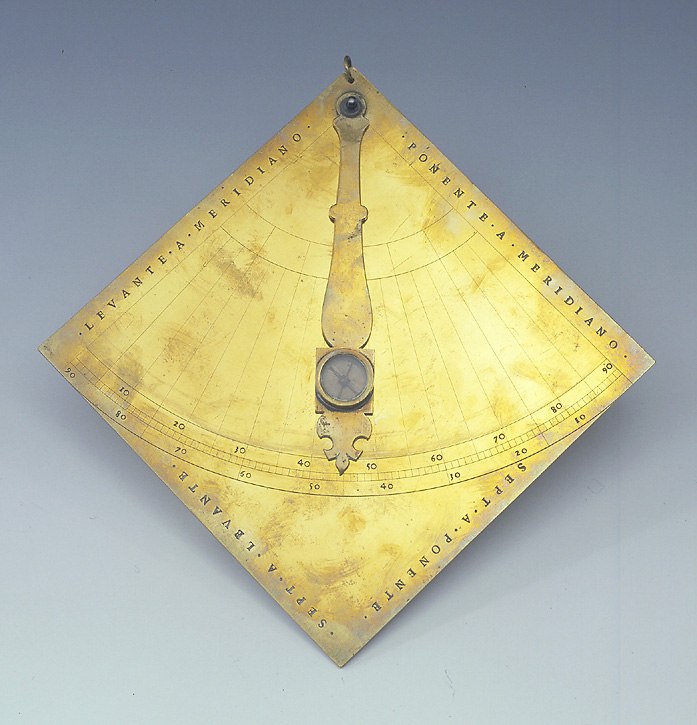
This brass declinatory quadrant, measuring 170 x 170 mm, is attributed to the Florentine maker Giovanni Battista Giusti. The device consists of a square brass plate engraved with cardinal directions and a quadrant scale divided into 90 degrees. A modelled alidade is pivoted at the vertex, allowing for rotational movement across the scale. Integrated into the lower portion of this alidade is a small compass with an intact glass cover and magnetic needle, having a diameter of 23 mm. The instrument functions as a specialized tool for sundial makers, enabling the design of vertical declining sundials by determining specific angles relative to the meridian. Its construction reflects the practices of 16th-century Florentine mathematical instrument workshops. The underside of the plate remains unadorned and lacks any inscriptions. The object is held in the collection of the Istituto e Museo di Storia della Scienza in Florence.

A 16th-century brass declinatory quadrant with an alidade and integrated compass.
A 16th-century brass declinatory quadrant with an alidade and integrated compass. — Istituto e Museo di Storia della Scienza, Firenze. Rights pending — permission not yet requested. Original source

Catalogue identity

Source
www.mhs.ox.ac.uk
Category
Tool · Italian quadrant
Maker / attribution
Giovanni Battista Giusti
Reference
Not recorded
Catalogue / lot identifier
3822
Source-reported date
16th century
Source-reported place
Italy

Source-reported attribution and specifications are not independent authentication. A listing does not establish present ownership, current display, availability or permission to reproduce.

Object description

Construction and Design

The instrument is fabricated from brass as a 170 x 170 mm square plate. At its vertex, a pivoted radial arm, or alidade, is secured, allowing it to traverse the arc of the quadrant. This arc is engraved with a numerical scale divided into 90 degrees, measured in both directions from the center point.

A small, circular compass, measuring 23 mm in diameter, is fixed to the lower portion of the alidade. The compass retains its original glass cover and magnetic needle. The four edges of the square plate are engraved with Italian inscriptions identifying the cardinal directions, providing the necessary orientation for its function as a surveying tool.

Evidence for this section
  • “Brass; 170 x 170 mm”
  • “Pivoted from one corner of the plate is a radial arm with a point.”
  • “The lower end of the radial arm contains a compass, which has remained intact (diameter 23 mm).”

Functionality and Use

This device serves as a declinatory, an essential tool for the design and construction of vertical declining sundials. When in use for vertical walls, the edge of the plate is held horizontally against the wall surface. The alidade is adjusted until the compass needle aligns with the meridian, allowing the designer to read the specific angle from the scale.

Beyond its primary role for vertical surfaces, the instrument is suited for the layout of inclining dials. By holding the plate vertically, the compass box acts as a weight, causing the pivoted alidade to hang in a vertical plane, which permits the measurement of the dial's inclination.

Evidence for this section
  • “This quadrant is a declinatory used by makers of sundials when designing a vertical declining sundial.”
  • “The instrument may also be used for inclining dials.”

Attribution and Provenance

The instrument does not carry a maker's mark or signature. The attribution to the workshop of Giovanni Battista Giusti is based on the technical characteristics observed in its construction and the specific style of its engravings. This identification aligns the object with the production of 16th-century Florentine instrument makers.

The object is currently part of the collection at the Istituto e Museo di Storia della Scienza in Florence. The provenance is documented under the inventory number 3822, which remains the primary reference for its identification within the museum's holdings.

Evidence for this section
  • “The instrument is unsigned, but the characteristics of construction and the types of engravings allow it to be attributed to Giovanni Battista Giusti”
  • “Inventory number: 3822”

Open research questions

  • Are there detectable tool marks on the reverse of the plate that might indicate the manufacturing process?
  • Does the current condition of the magnetic needle suggest it remains functional or has it lost its original calibration?

Source evidence

Recorded claims and source quotations for Declinatory Quadrant
FieldSource-reported valueSource quotation
MakerAttributed to Giovanni Battista Giusti“Attributed to Giovanni Battista Giusti”
Dimensions170 x 170 mm“170 x 170 mm”
Inventory Number3822“Inventory number: 3822”
InscriptionsItalian cardinal directions“The inscriptions are in Italian”
Compass diameter23 mm“diameter 23 mm”
Dating16th century“16th century”

Visible details

  • The quadrant features a central pivoted alidade with an integrated compass box.
  • Engraved degree scales are positioned along the lower curved edge.
  • Cardinal points are inscribed in Italian along the four outer edges of the square plate.
  • The instrument includes a suspension hole at the top vertex.

Research qualifications

  • The attribution to Giovanni Battista Giusti is based on stylistic construction and engraving rather than a signature.
  • The intended use for inclining dials is a functional possibility suggested by the source.

Photograph identity and source facts were screened before import; rights clearance remains pending.

Consulted source

Quadrant

Reviewed 2026-10-26 · Record af92c330af

Terms in this record

Glossary explanations for terms named in this object’s record.