
Skip to content
The Encyclopedia of Horology

Tool · Italian quadrant

Brass Quadrant by Camillo della Volpaia

Partially verified

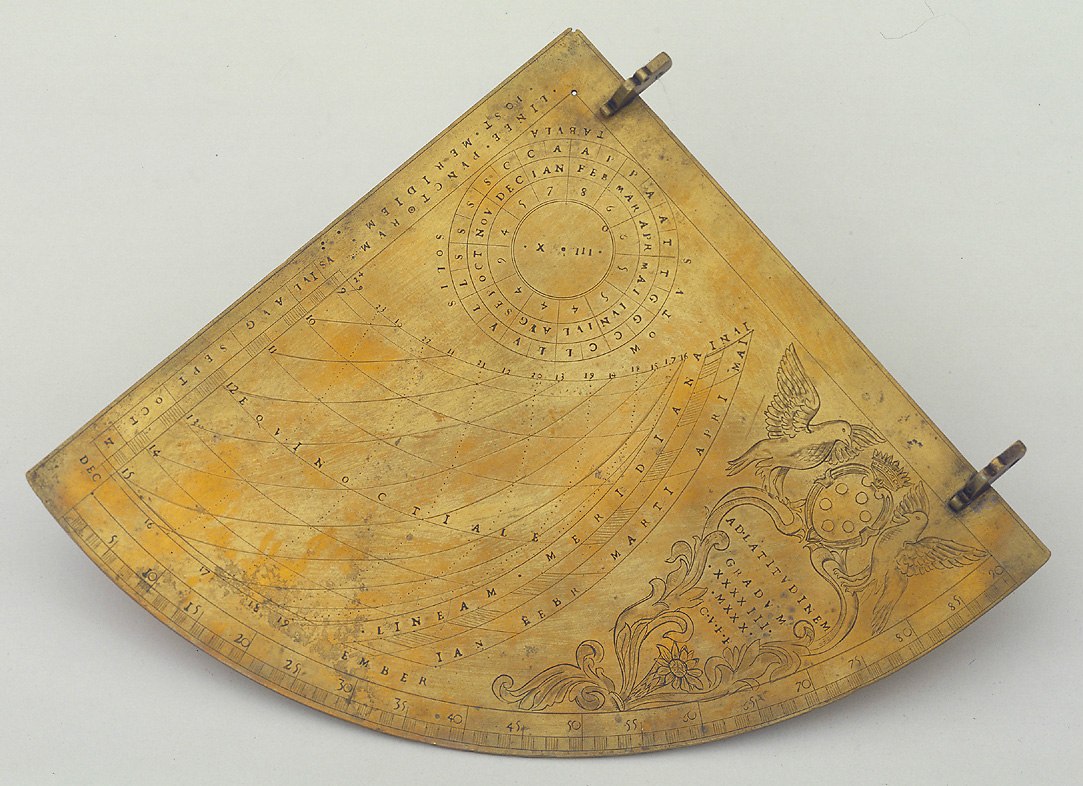
This 16th-century brass quadrant, measuring 190 mm in radius, is attributed to the Florentine instrument maker Camillo della Volpaia. The instrument is designed to determine time by observing the sun's height, calibrated specifically for the latitude of Florence (43° 30'). The face features a 90-degree limb, a diagram for an Italian hour dial, a calendar, and a circular table representing the sun's motion. It is marked with the monogram 'CVFF' and bears the Medici coat of arms. Two scrolled sights with double pinnules are mounted on the longer edge. The back displays a shadow square with divisions for 'VM. RECTA' and 'VM. VERSA'. The object is held in the collection of the Istituto e Museo di Storia della Scienza in Florence and includes a provenance record from an auction in 1982.

The face of the brass quadrant showing the Italian hours, calendar, and Medici emblem.
The face of the brass quadrant showing the Italian hours, calendar, and Medici emblem. — Istituto e Museo di Storia della Scienza, Firenze. Rights pending — permission not yet requested. Original source

Catalogue identity

Source
www.mhs.ox.ac.uk
Category
Tool · Italian quadrant
Maker / attribution
Camillo della Volpaia
Reference
Not recorded
Catalogue / lot identifier
3628
Source-reported date
16th century
Source-reported place
Italy (Florence)

Source-reported attribution and specifications are not independent authentication. A listing does not establish present ownership, current display, availability or permission to reproduce.

Object description

Face and Cosmological Functions

The quadrant is constructed from brass with a 190 mm radius. The primary face displays a 90-degree limb divided into five-unit increments. The central area contains a complex diagram for an Italian hours dial ranging from 9 to 24, differentiated by smooth lines for morning and dotted lines for afternoon hours. A circular table labeled 'TABVULA SOLIS MOTVS' is positioned above the hour diagram, intended to track the sun's motion. Two separate halves of a calendar, marked to ten-day intervals, frame the diagram on either side.

Two scrolled sights, each equipped with double pinnules, are attached to the instrument's longer edge to facilitate celestial observations. The face also features an inscription specifying the latitude of 43° 30' and a decorative escutcheon bearing the Medici emblem flanked by doves, which surmounts the floral frame containing the signature and the monogram 'CVFF'.

Evidence for this section
  • “The limb of the instrument carries a scale of 90? numbered by groups of five in a separate scale.”
  • “Above the hour diagram is a circular table 'TABVULA SOLIS MOTVS'”
  • “Along the longer edge of the instrument are two scrolled sights, with double pinnules.”

Reverse and Shadow Square

The back of the quadrant features a shadow square centered by a line marked '.VM. MEDIA.' which extends the full radius of the instrument. The two sides of this square are delineated as 'VM. RECTA' and 'VM. VERSA', with each side divided into twelve parts organized into four groups of three. This component allowed for basic trigonometric or surveying calculations.

Detailed observation indicates that while the instrument's main face is well stamped, the engraving is somewhat light. The hatching on the scales exhibits a casual character, which has led to suggestions that the shadow square on the reverse may have been added at a later time to a previously blank surface. Analysis by Gerard Turner links the punches used on the reverse to instruments attributed to G. B. Giusti, suggesting a date of approximately 1570 for these later additions.

Evidence for this section
  • “On the back of the instrument is a shadow square of which the centre line, marked '.VM. MEDIA.' Extends for the full radius of the instrument.”
  • “The punches used to label the shadow square, not the same as those used on the face, have been identified by Gerard Turner as being the same as those used on some instruments signed by G. B. Giusti and would correspond with a date of c. 1570.”

Attribution and Provenance

The instrument is attributed to Camillo della Volpaia based on the monogram 'CVFF' appearing on the face. The inclusion of the Medici coat of arms reflects the family's connections to the patrons of the period.

The current holding institution is the Istituto e Museo di Storia della Scienza in Florence, which catalogues the piece as inventory number 3628. The object’s history includes an appearance at the Auction Semenzato on November 6, 1982, where it was listed as lot 368. The piece is part of the Epact collection of scientific instruments of Medieval and Renaissance Europe.

Evidence for this section
  • “The monogram 'CVFF' allows the instrument to be attributed to Camillo, son of the head of the family Lorenzo”
  • “Provenance: Auction Semenzato 6th November 1982, lot 368.”
  • “Inventory number: 3628”

Open research questions

  • What specific solar observations were intended by the 'TABVULA SOLIS MOTVS' table?
  • Are there material differences in the alloy composition between the face and the reverse that would confirm a multi-stage construction?

Source evidence

Recorded claims and source quotations for Brass Quadrant by Camillo della Volpaia
FieldSource-reported valueSource quotation
Radius190 mm“190 mm in radius”
Latitude43° 30'“AD LATITVDINIEM POLI GRADVVM XXXXIII M{INUTA} XXX”
MakerCamillo della Volpaia“Signed by Camillo della Volpaia”
Inventory Number3628“Inventory number: 3628”
ProvenanceAuction Semenzato 1982“Auction Semenzato 6th November 1982, lot 368.”
Signature MonogramCVFF“The monogram 'CVFF' allows the instrument to be attributed to Camillo”

Visible details

  • Two scrolled sights with double pinnules on the long edge
  • Medici coat of arms with flanking doves
  • Italian hour lines represented by smooth and dotted lines
  • Calendar marked in ten-day increments

Research qualifications

  • The shadow square on the reverse may have been added after the original manufacture of the quadrant
  • The use of specific punches on the reverse suggests potential later intervention, potentially associated with G. B. Giusti

Photograph identity and source facts were screened before import; rights clearance remains pending.

Consulted source

Quadrant

Reviewed 2026-10-26 · Record 2ed6b636ec

Terms in this record

Glossary explanations for terms named in this object’s record.