
Skip to content
The Encyclopedia of Horology

Tool · Italian quadrant

Horary Quadrant by Giovanni Battista Giusti

Partially verified

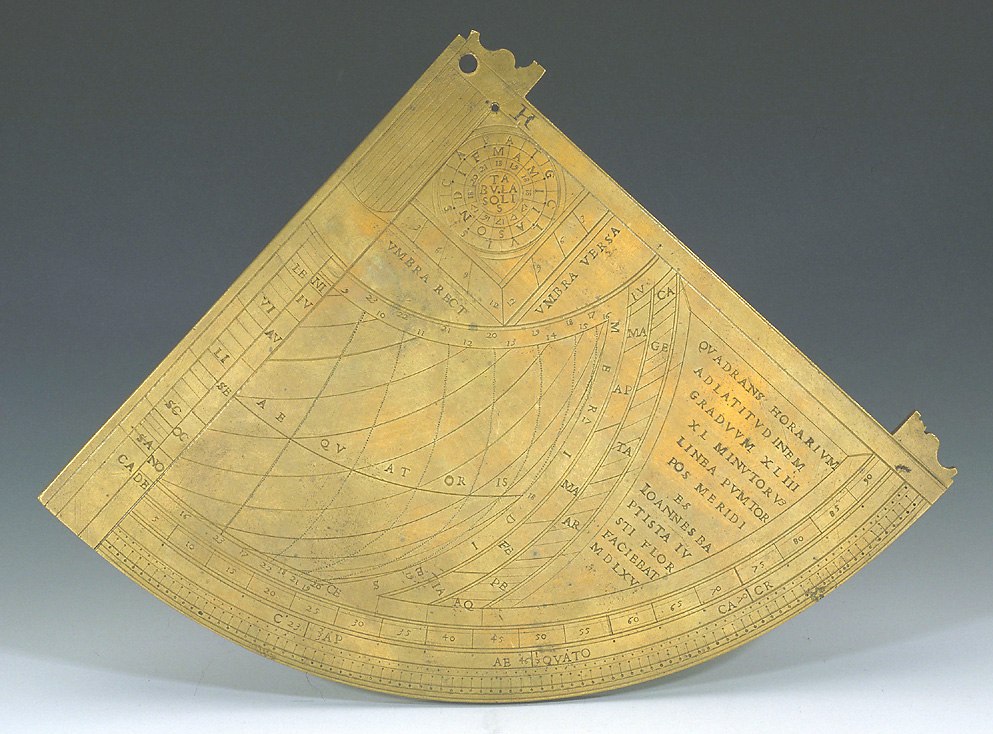
This brass horary quadrant, measuring 203 mm in radius, was produced by Giovanni Battista Giusti in 1565. The instrument is a specialized tool used for measuring height and time, specifically calibrated for the latitude of Florence at 43° 40'. The face features a complex layout including a 90-degree scale on the limb, a diagram for Italian hours, and a zodiacal calendar. It also incorporates a shadow square for topographical measurements and a circular solar table ('Tabula Solis') used to determine the entrance of the sun into zodiac signs. The instrument is signed by Giusti, who worked as an instrument maker in Florence during the 1560s, a period during which he was associated with the Medici metal workshop.

The obverse face of the brass quadrant, showing the Italian hour dial, zodiacal calendar, shadow square, and the signature of Giovanni Battista Giusti.
The obverse face of the brass quadrant, showing the Italian hour dial, zodiacal calendar, shadow square, and the signature of Giovanni Battista Giusti. — Istituto e Museo di Storia della Scienza, Firenze. Rights pending — permission not yet requested. Original source

Catalogue identity

Source
www.mhs.ox.ac.uk
Category
Tool · Italian quadrant
Maker / attribution
Giovanni Battista Giusti
Reference
Not recorded
Catalogue / lot identifier
2524
Source-reported date
1565
Source-reported place
Italy

Source-reported attribution and specifications are not independent authentication. A listing does not establish present ownership, current display, availability or permission to reproduce.

Object description

Front Face Configuration

The front face of the quadrant is densely engraved with multiple scales and diagrams for timekeeping and solar observation. The limb is divided into two concentric arcs; the outer arc contains unnumbered single degrees with dotted half-degree sub-divisions, while the inner arc provides numeric groupings of five. A third arc is positioned between these, marking the relative positions of the tropics and the equator.

The central portion of the face contains a diagram for an Italian hours dial, scaled from 9 to 23. Morning hours are indicated by solid lines, while afternoon hours are depicted with dotted lines. Above this diagram, a shadow square of 12 surrounds a circular solar table, which provides the Italian hour of Noon for each month alongside its respective zodiacal sign.

Evidence for this section
  • “On the face the limb is divided with a 90? scale marked in two concentric arcs”
  • “Between the two arcs is a third concentric arc marked with the relative positions of the tropics and the equator”
  • “the left and centre of the instrument are filled with the diagram for an Italian hours dial (9 to 23 without subdivisions)”

Reverse and Technical Features

The reverse of the quadrant is engraved with an eight-point wind rose. The sectors are divided to 45 degrees, with numerical groupings of 5 degrees. The wind directions are named in the local tradition, including Ostro, Tramontano, and others. The center of the wind rose contains a lead plug, though there is speculation that a compass was intended for or originally occupied this space.

For functionality as a surveying and measurement instrument, the side features two shaped, moulded sights with a fore pinnule. These components allow for the alignment of the quadrant to determine heights or topographical measurements using the shadow square engraved on the front.

Evidence for this section
  • “On the back of the quadrant is the wind rose , for indicating wind direction”
  • “A compass was perhaps originally set at the centre of this diagram (or intended to be), but the space is now filled by a lead plug”
  • “Two shaped moulded sights with a fore pinnule are set on the longer side of the instrument”

Historical Attribution

The instrument is dated 1565 and bears the signature of Giovanni Battista Giusti. Giusti was active as an instrument maker in Florence during the 1560s. Research suggests he operated within the context of the Medici metal workshop, though this connection is cited as probable.

The quadrant was specifically calibrated for the latitude of 43° 40', which corresponds to the location of Florence. The text on the face explicitly identifies the instrument as a horary quadrant for this specific latitude.

Evidence for this section
  • “The instrument is dated and signed by Giovanni Battista Giusti , an instrument maker in Florence around the 1560s, probably in the Medici metal workshop”
  • “the indication of the latitude for which the instrument is calibrated, in this case 43? 40' corresponding to the city of Florence”

Open research questions

  • What specific type of metal composition was utilized in the construction of the quadrant within the Medici workshop?
  • Does any evidence survive of the compass mechanism that may have been intended for the reverse side?

Source evidence

Recorded claims and source quotations for Horary Quadrant by Giovanni Battista Giusti
FieldSource-reported valueSource quotation
MakerGiovanni Battista Giusti“Signed by Giovanni Battista Giusti”
Date1565“Dated 1565”
MaterialBrass“Brass; 203 mm in radius”
Latitude43° 40'“latitude for which the instrument is calibrated, in this case 43? 40' corresponding to the city of Florence”
Inventory number2524“Inventory no. 2524”
InscriptionQVADRANS HORARIVM AD LATITVDINEM GRADVVM XLIII XL MINVTORV{M)} LINEA PVMTOR{UM} POS{T} MERIDIES“the inscription 'QVADRANS HORARIVM AD LATITVDINEM GRADVVM XLIII XL MINVTORV{M)} LINEA PVMTOR{UM} POS{T} MERIDIES'”

Visible details

  • The instrument features a 90-degree limb divided into two concentric arcs.
  • The front bears an engraved diagram for Italian hours from 9 to 23.
  • Two moulded sights with a fore pinnule are attached to the straight side.
  • A lead plug occupies the centre of the wind rose on the back.

Research qualifications

  • The purpose of the lead plug at the center of the reverse wind rose is uncertain, as it may have replaced or originally been intended for a compass.
  • The maker's association with the Medici metal workshop is described as probable rather than confirmed.

Photograph identity and source facts were screened before import; rights clearance remains pending.

Consulted source

Quadrant

Reviewed 2026-10-26 · Record cc9cc2b271