
Skip to content
The Encyclopedia of Horology

Tool · Italian quadrant

Iron and Gold Quadrant

Partially verified

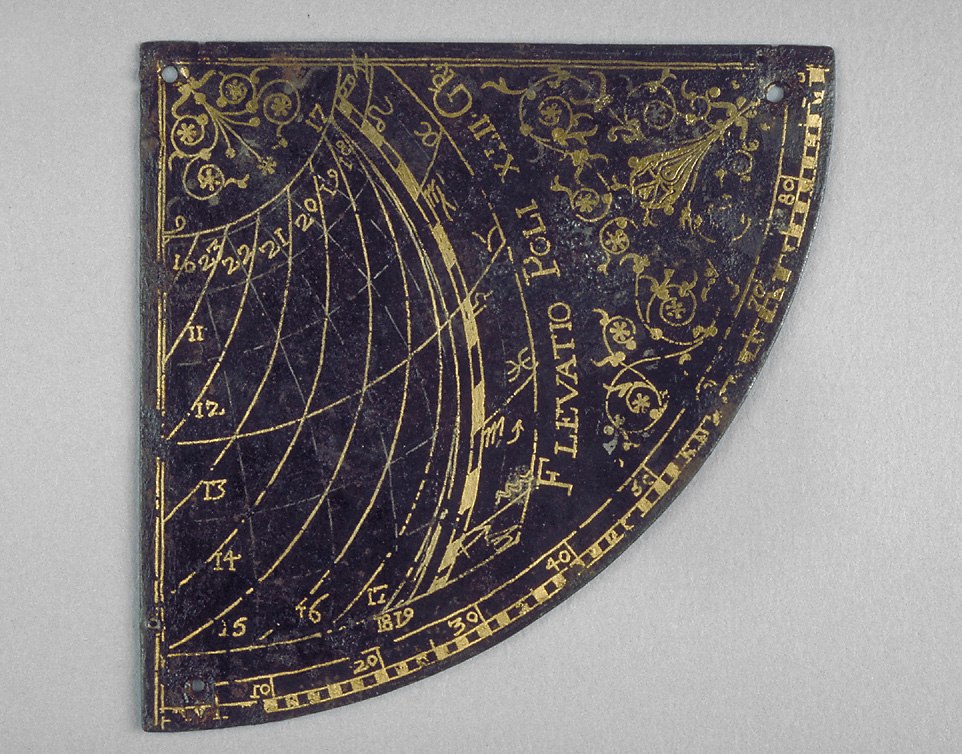
This unsigned iron quadrant, measuring 95 mm in radius, is attributed to Italy and dated to circa 1600. The instrument features intricate inlay work using gold and silver throughout its surfaces. Despite significant damage that has obscured some of the inscriptions and legibility of certain markings, the quadrant remains a distinct example of horological instrumentation. It was designed for a latitude of 42 degrees and utilizes Italian hours for timekeeping. Provenance records indicate the piece was formerly held in the Spitzer Collection before its acquisition by the British Museum in 1893. The physical state of the instrument reveals both the complexity of its original intended function and the effects of historical wear on the inlaid surfaces.

Detailed view of the iron quadrant showing the gold and silver inlay, including the zodiac scale and latitude inscription.
Detailed view of the iron quadrant showing the gold and silver inlay, including the zodiac scale and latitude inscription. — British Museum, London. Rights pending — permission not yet requested. Original source

Catalogue identity

Source
www.mhs.ox.ac.uk
Category
Tool · Italian quadrant
Maker / attribution
Not established
Reference
Not recorded
Catalogue / lot identifier
MLA 1893, 6-16.6
Source-reported date
circa 1600 ?
Source-reported place
Italy

Source-reported attribution and specifications are not independent authentication. A listing does not establish present ownership, current display, availability or permission to reproduce.

Object description

Design and Surface Decoration

The quadrant is constructed from iron, featuring elaborate decorative work achieved through gold and silver inlay. The instrument displays dense foliage motifs in the regions between the functional hour lines and the apex, as well as in the space adjacent to the latitude inscription. These decorative elements suggest a high level of ornamental detail applied to the primary functional surfaces of the tool.

Due to the reported damaged state of the object, much of the original inlay is affected, leading to limited legibility of several inscriptions and lines.

Evidence for this section
  • “The quadrant is inlaid with gold and silver, but is badly damaged.”
  • “The space between the inscription and the right edge is filled with foliage, as is the space between the hour lines and the apex.”

Functional Scales and Markings

The instrument is designed specifically for a latitude of 42 degrees, with the inscription 'ELEVATIO POLI XLII GR' prominently placed on the limb area. One side of the quadrant features a degree scale numbered by five, accompanied by a zodiac scale divided to ten degrees with alternate shading. Additionally, a shadow square is inlaid and marked with the labels 'VMBRA VERSA' and 'VMBRA MEDIA', though portions of this square have suffered damage.

The reverse side of the quadrant provides further astronomical utility, featuring a limb engraved with a degree scale numbered from ten to 90 by tens. Italian hour lines, numbered 10 to 24, are inlaid on this face. A corresponding zodiac scale is positioned on the right-hand side of this face, which matches the stylistic conventions and divisions observed on the primary side of the instrument.

Evidence for this section
  • “The quadrant is made for latitude 42? and marks Italian hours”
  • “Italian hour lines are inlaid and numbered from 10 to 24, and a zodiac scale is on the right hand side”

Provenance and Identification

The quadrant was acquired by the British Museum in 1893, carrying the registration number MLA 1893, 6-16.6. Before entering the museum's collection, the object was held in the Spitzer Collection, a notable repository of historical items. It has been formally identified and catalogued by F. A. B. Ward in his reference volume concerning European scientific instruments.

The object remains unsigned, and its date of origin is documented with an approximate attribution of circa 1600. The source categorizes the instrument as Italian, though it acknowledges the uncertainty inherent in the dating and attribution process by the inclusion of a question mark alongside the date. This documentation ensures the instrument's historical trajectory from the private Spitzer collection to its current institutional status.

Evidence for this section
  • “The instrument was purchased in 1893, and was formerly in the Spitzer Collection.”
  • “circa 1600 ?; Italian”

Open research questions

  • What is the nature of the missing inscriptions originally located within the damaged sections of the quadrant?
  • Could further analysis of the iron composition help refine the manufacturing origin beyond the general 'Italian' attribution?

Source evidence

Recorded claims and source quotations for Iron and Gold Quadrant
FieldSource-reported valueSource quotation
MaterialIron and gold“Iron and gold”
Radius95 mm“95 mm in radius”
Latitude42 degrees“made for latitude 42?”
Inventory NumberMLA 1893, 6-16.6“MLA 1893, 6-16.6”
Former CollectionSpitzer Collection“was formerly in the Spitzer Collection.”
PublicationA Catalogue of European Scientific Instruments in the Department of Medieval and Later Antiquities of the British Museum“described in F. A. B. Ward, A Catalogue of European Scientific Instruments in the Department of Medieval and Later Antiquities of the British Museum (London, 1981), p. 57, no.150.”

Visible details

  • Decorative foliage motifs in gold and silver filling the negative space
  • Italian hour lines numbered from 10 to 24
  • Inscription 'ELEVATIO POLI XLII GR' indicating the intended latitude
  • Double perforations located on all three edges

Research qualifications

  • Condition is noted as badly damaged, limiting the legibility of specific inscriptions
  • The exact date is uncertain, expressed with a question mark in source documentation

Photograph identity and source facts were screened before import; rights clearance remains pending.

Consulted source

Quadrant

Reviewed 2026-10-26 · Record a4d3069aa0

Terms in this record

Glossary explanations for terms named in this object’s record.