
Skip to content
The Encyclopedia of Horology

Clock · Longcase clock

Davison Month-going longcase clock

Partially verified

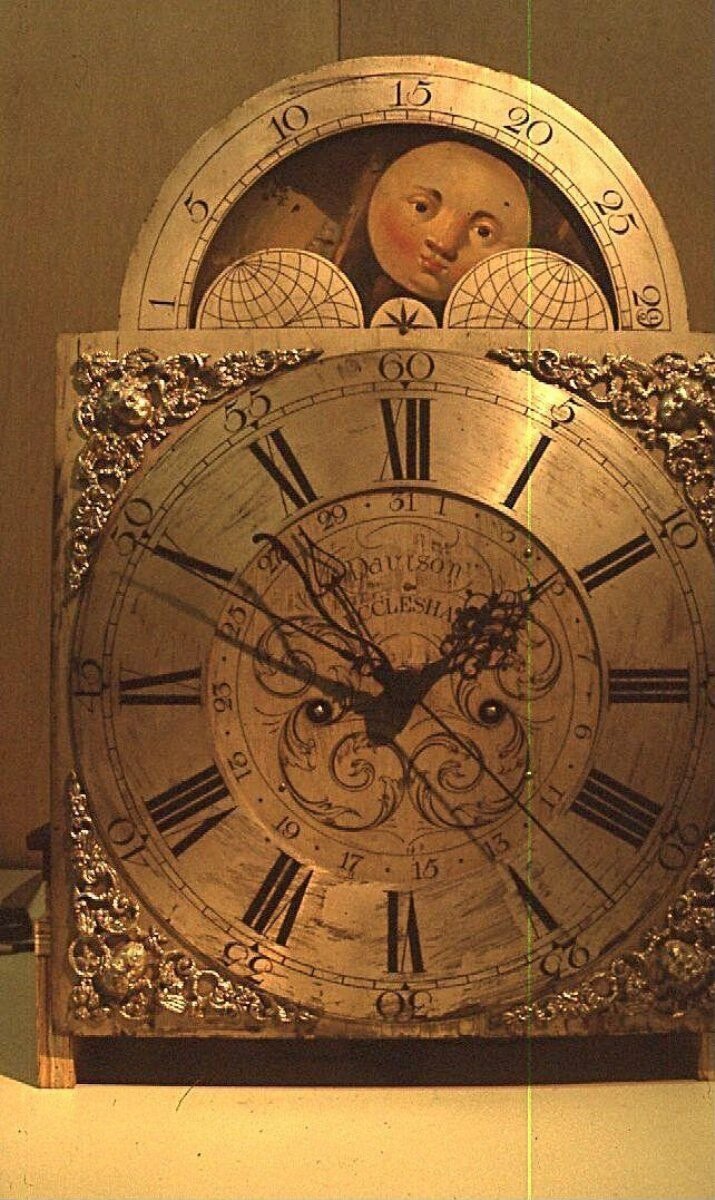
This month-going longcase clock, dating to approximately 1775, features a case constructed of mahogany and pine with gilt-brass and brass fittings. The base exhibits a bombé shape with bracket feet, while the trunk incorporates brickwork quoins and an escutcheon in the form of a bird. The brass dial is silvered and features foliage engraving, a moon phase display in the arch with painted discs, and large cherub head spandrels. It is signed "DAVISON / ECCLESHAM" on the dial plate. The clock was a gift from Eric Browett in 1937. The movement shows evidence of historic modifications, including various plugged holes, suggesting possible repositioning of the gear train.

Detail view of the silvered brass dial, showing the central moon phase display, cherub spandrels, and signature.
Detail view of the silvered brass dial, showing the central moon phase display, cherub spandrels, and signature. — Victoria and Albert Museum. Rights pending — permission not yet requested. Original source

Catalogue identity

Source
collections.vam.ac.uk
Category
Clock · Longcase clock
Maker / attribution
Davison
Reference
Not recorded
Catalogue / lot identifier
W.50:1to4-1937
Source-reported date
ca. 1775
Source-reported place
England

Source-reported attribution and specifications are not independent authentication. A listing does not establish present ownership, current display, availability or permission to reproduce.

Object description

Case Construction and Design

The case is crafted from mahogany and pinewood, displaying design elements attributed to the Lancashire style. The hood slides to provide access and features free-standing Corinthian fluted columns with brass capitals and inlay. The trunk door is distinguished by a bird-shaped escutcheon, while the base exhibits a bombé form commonly associated with continental influence, supported by bracket feet.

The pediment is of the swans neck variety, featuring painted wooden panels and a single central ball and spire finial. Decorative brickwork quoins are applied to the edges of the trunk and the sides of the base. The brass hardware, including columns and escutcheons, relates to metalworker's patterns documented in the museum's collections.

Evidence for this section
  • “Single Corinthian fluted column to each side of trunk with brass inlay and brass capitals mounted on bracket with brickwork quoins to edge.”
  • “The case is in the style of the so-called Lancashire Chippendale.”
  • “Unusually for an English case is the bombé base to the case”

Dial and Timekeeping Functions

The dial is a brass sheet of uniform thickness, silvered throughout. It features central foliage engraving and a break-arch containing a rolling moon mechanism. The moon disc itself is painted with circular stylised faces. Large cherub-head spandrels are fixed to the corners of the main plate.

A silvered brass chapter ring is mounted to the dial plate, providing Roman numerals for hours and Arabic numerals for minutes. Central seconds and a calendar date are integrated into the display. The maker's name is inscribed in black directly on the dial, possibly indicating a variation of the town Eccleshall.

Evidence for this section
  • “The silvered arched dial signed in black, 'DAVISON / ECCLESHAM', ca. 1775”
  • “Separate painted moon disc, pivoted at base of arch cut-out”
  • “Immediately within the chapter ring on dial plate are engraved Arabic numerals for the date (1-31) (centre calendar).”

Movement and Modifications

The movement is a weight-driven 8-day mechanism featuring a dead beat escapement. The movement is constructed with brass and steel, utilizing pillars with grooved knops. The train wheels are generally brass with semicircular crossings, though the third and escape wheels appear redder in colour compared to the rest of the train.

Examination of the plates reveals various vacant and plugged holes, indicating that the movement has undergone significant modification. It is possible that the gear train was repositioned or that the escapement was converted from a recoil to a dead beat type during a previous service, potentially to improve the precision of the centre seconds hand movement.

Evidence for this section
  • “Movement: Brass and steel, weight driven, centre seconds, hour striking, of 8-day duration with dead beat escapement, pendulum regulated.”
  • “It would seem that the movement has been modified at some time in its history, judging by the presence of plugged or vacant holes”
  • “The dead beat escapement does give a positive stop-start motion to the very obvious, centre seconds hand”

Open research questions

  • Is there definitive evidence confirming 'ECCLESHAM' was a misreading or misspelling of 'ECCLESHALL' by the maker?
  • Can the original gear configuration be reconstructed from the location of the vacant holes in the plates?

Source evidence

Recorded claims and source quotations for Davison Month-going longcase clock
FieldSource-reported valueSource quotation
MakerDavison“signed in black, 'DAVISON / ECCLESHAM'”
Dateca. 1775“ca. 1775”
Case MaterialsMahogany and pinewood“Month-going longcase clock of carved mahogany and pinewood”
DurationMonth-going“Month-going longcase clock”
Dial SpandrelsCherub heads“Large cherub heads spandrels each secured by a single screw”
Accession NumberW.50:1to4-1937“Accession number: W.50:1to4-1937”
EscapementDead beat“dead beat escapement”

Visible details

  • Silvered arched dial features moon phase display in the arch.
  • Trunk door includes a detailed bird-shaped escutcheon.
  • Dial indicates centre seconds and a calendar date function.
  • Case features a pronounced bombé shape at the base.

Research qualifications

  • The inscription 'ECCLESHAM' might be a misspelling of 'ECCLESHALL'.
  • Evidence of plugged holes suggests the movement underwent modifications.
  • The exact date of the brass fittings designs is unknown.

Photograph identity and source facts were screened before import; rights clearance remains pending.

Terms in this record

Glossary explanations for terms named in this object’s record.