
Skip to content
The Encyclopedia of Horology

Clock · Table clock

Claudius DuChesne Queen Anne basket top table clock

Partially verified

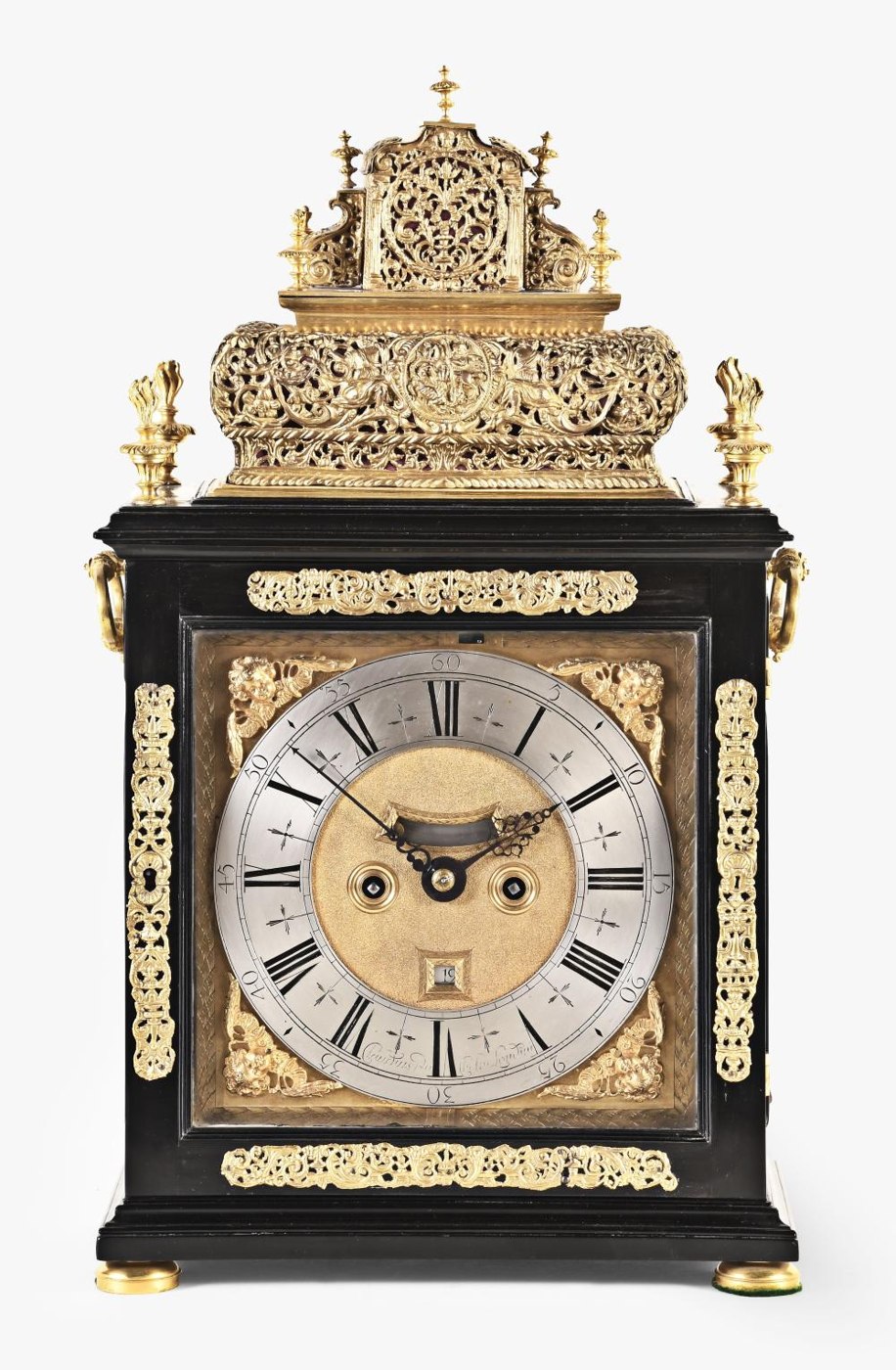
This Queen Anne basket top table clock is attributed to the maker Claudius DuChesne, London, dating to approximately 1700. The object is housed in an ebony veneered oak case, featuring a molded base and cornice, with glazed doors at the front and back. The case is detailed with cast carrying handles, short gilt feet, and is surmounted by four urn and flame finials alongside a repousse basket top. The decorative scheme includes repousse strapwork frets on the sides, with reserves depicting St. George and the dragon on the front and back, and images of Queen Anne on the sides. The dial is a nine-inch square composite example with a wheatear border, matted center, and gilt cherub spandrels. It features a silvered roman numeral chapter ring, a mock pendulum aperture, and a date aperture. The eight-day, three-train movement includes fusees and a knife-edge verge escapement.

Front view of the Claudius DuChesne basket top table clock with the front door closed.
Front view of the Claudius DuChesne basket top table clock with the front door closed. — Schmitt Horan & Co. (via Invaluable). Rights pending — permission not yet requested. Original source

Catalogue identity

Source
www.invaluable.com
Category
Clock · Table clock
Maker / attribution
Claudius DuChesne
Reference
Not recorded
Catalogue / lot identifier
447
Source-reported date
circa 1700
Source-reported place
London

Source-reported attribution and specifications are not independent authentication. A listing does not establish present ownership, current display, availability or permission to reproduce.

Object description

Case and Dial

The clock is housed in an ebony veneered oak case, characterized by a molded base and cornice. The aesthetic is defined by its basket top, which is decorated with repousse work. The case is raised on short, round gilt feet. Additional ornamentation includes four urn and flame finials at the corners and seven smaller urn finials associated with the top structure. Access to the interior is provided by glazed doors on both the front and rear faces.

The dial is a nine-inch square composite design featuring a matted center and gilt cherub spandrels. A silvered chapter ring displays roman numerals and is framed by a wheatear border. Functional apertures include a mock pendulum opening positioned below the 12 o'clock marker and a date window situated above the 6 o'clock position. The clock incorporates cast carrying handles on the sides, which also feature repousse strapwork frets containing naturalistic imagery.

Evidence for this section
  • “the ebony veneered oak case on short, round gilt feet and with molded base and cornice, glazed doors to the front and back, the sides with repousse strapwork frets with naturalistic ornament, and cast carrying handles”
  • “surmounted by four urn and flame finials and a repousse basket top”
  • “nine inch square composite dial with wheatear border, matted center, gilt cherub spandrels, roman numeral silvered chapter ring, mock pendulum aperture below 12:00, date aperture above 6:00”

Movement and Repeating Mechanism

The movement is an eight-day, three-train design utilizing fusees for both the time and strike functions. The escapement is a knife-edge verge type, operating with a bob pendulum. Power is transmitted through a configuration of five knopped pillars. The clock possesses a pull quarter repeating mechanism which operates on five bells.

The backplate features decorative engraving consistent with the period, incorporating a wheatear border and scrolling foliate ornamentation. Additional details on the backplate include a depiction of a bird located below the center, positioned above a grotesque mask. According to the auction description, while the movement is reported as running and striking, the quarter repeating function is noted to be inconsistent, as the quarters frequently strike incorrectly.

Evidence for this section
  • “eight day, three train movement with fusees for the time and strike trains, knife edge verge escapement with bob pendulum, five knopped pillars, pull quarter repeating on five bells”
  • “engraved backplate with wheatear border, scrolling foliate ornament, a bird just below center, and above a grotesque mask”
  • “movement running and striking, repeating functional, but quarters frequently strike incorrectly”

Condition and Reported Replacements

The auction description reports the clock is in good condition overall, though it notes several areas of wear and subsequent intervention. The case has been polished and displays minor losses to the gilding, alongside minor deformations and splits, including a small loss at the rear left section. The original door glasses have been replaced.

Regarding the internal components, the minute hand has been replaced, as have the back cock and the guard. The pinned ends of the pillars show signs of filing, and the movement is currently lacking one mounting screw. The dial remains in good condition.

Evidence for this section
  • “case polished, minor losses to gilding, case top with minor deformation, a few splits, and small loss at rear left, door glasses replaced, dial good, minute hand replaced”
  • “back cock and guard replaced, pinned ends of pillars with filing, lacking one movement mounting screw”

Open research questions

  • What is the specific nature of the filing on the pillar ends?
  • What is the current mechanical cause for the incorrect quarter striking?

Source evidence

Recorded claims and source quotations for Claudius DuChesne Queen Anne basket top table clock
FieldSource-reported valueSource quotation
MakerClaudius DuChesne“Claudius DuChesne, London”
Datecirca 1700“circa 1700”
Case materialEbony veneered oak“ebony veneered oak case”
Dial size9 inch“nine inch square composite dial”
Movement trainsThree train“eight day, three train movement”
EscapementKnife edge verge“knife edge verge escapement”
Dimensions21.5in x 12.25in x 6.5in“21.5in x 12.25in x 6.5in”
ConditionMinor losses and replacements reported“case polished, minor losses to gilding, case top with minor deformation, a few splits, and small loss at rear left, door glasses replaced, dial good, minute hand replaced”

Visible details

  • Case features repousse strapwork side frets
  • Silvered chapter ring with roman numerals
  • Clock is surmounted by four urn and flame finials
  • Repousse basket top design

Research qualifications

  • Quarters strike incorrectly
  • One movement mounting screw is missing

Photograph identity and source facts were screened before import; rights clearance remains pending.

Terms in this record

Glossary explanations for terms named in this object’s record.