
Skip to content
The Encyclopedia of Horology

Clock · Desk clock

Cartier Paris Desk Clock with Manual Triple Calendar

Partially verified

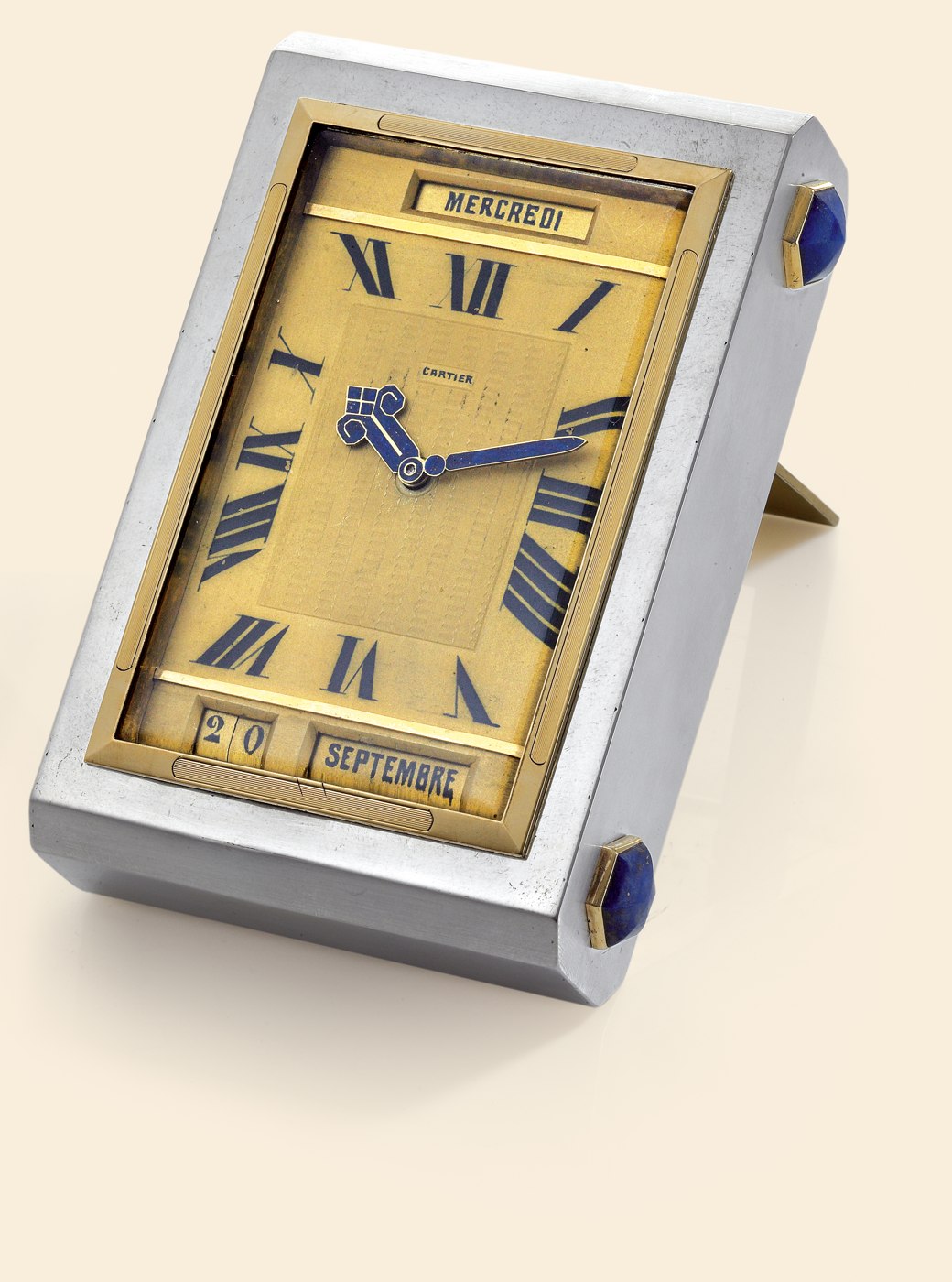
This Cartier Paris desk clock, numbered 1884 and dating to circa 1930, is a Pendule de bureau calendrier with an eight-day going movement. The clock is constructed from sterling silver and 18K yellow gold, featuring a shaped rectangular silver case with gold engine-turned bezel. The lateral panels are decorated with a pair of pyramidal lapis lazuli cabochons. The champagne dial includes Roman numerals, an engine-turned center, and three apertures for displaying the day of the week, month, and date. The time is indicated by blue champlevé enameled gold hands. The movement is a gilt brass design with 15 jewels, a straight-line lever escapement, and a cut bimetallic compensation balance adjusted to three positions, equipped with a Breguet balance spring. The movement is signed by the European Watch & Clock Co., and the case and dial are signed by Cartier.

A front view of the Cartier desk clock showing the champagne dial, calendar apertures, lapis lazuli accents, and the easel stand.
A front view of the Cartier desk clock showing the champagne dial, calendar apertures, lapis lazuli accents, and the easel stand. — Antiquorum. Rights pending — permission not yet requested. Original source

Catalogue identity

Source
catalog.antiquorum.swiss
Category
Clock · Desk clock
Maker / attribution
Cartier
Reference
Not recorded
Catalogue / lot identifier
112
Source-reported date
circa 1930
Source-reported place
Not established
Source-reported serial
1884

Source-reported attribution and specifications are not independent authentication. A listing does not establish present ownership, current display, availability or permission to reproduce.

Object description

Case and Dial Construction

The clock is housed in a shaped rectangular case composed of sterling silver and 18K yellow gold. The primary structure is sterling silver, complemented by a gold engine-turned bezel framing the dial. On the lateral panels, the case is accented with a pair of pyramidal lapis lazuli cabochons. A folding easel stand is attached to the rear to allow the clock to stand on a flat surface.

The dial is champagne-colored with a central engine-turned texture and applied Roman numerals. It features three separate apertures to provide the calendar information: the day of the week is shown at the top, while the date and the month are indicated at the bottom. The time is displayed via blue champlevé enameled gold hands, which match the decorative aesthetic of the dial.

Evidence for this section
  • “Shaped rectangular, silver, a pair of pyramidal lapis lazuli cabochons set on the lateral panels, gold engine-turned bezel.”
  • “Champagne with Roman numerals, engine-turned center and apertures for the days of the week, months and dates.”

Movement and Escapement

The internal mechanism is an eight-day going movement of gilt brass construction. The movement is comprised of 15 jewels and utilizes a straight-line lever escapement. The timekeeping regulation is maintained by a cut bimetallic compensation balance, which has been adjusted to three positions, working in conjunction with a Breguet balance spring.

The movement is identified by the source as being manufactured by the European Watch & Clock Co., a detail indicated by a signature on the movement itself. The auction house reports the condition of the movement as requiring repair.

Evidence for this section
  • “gilt brass, 15 jewels, straight line lever escapement, cut bimetallic compensation balance adjusted to 3 positions, Breguet balance spring.”
  • “movement signed ?European Watch & Clock Co.?”

Signatures and Condition

The clock is signed by Cartier on both the dial and the case, with the case also bearing its individual serial number, 1884. The movement bears the signature of the European Watch & Clock Co.

In terms of its condition, the auction description classifies the dial as good, though noting that it is oxidized.

Evidence for this section
  • “Case and dial signed, movement signed ?European Watch & Clock Co.?, case numbered.”
  • “Movement: 3** Good Repair required, at buyer's expense”
  • “Dial: 3-7-01 Good Oxidized”

Open research questions

  • To what extent was the European Watch & Clock Co. involved in the production of internal movements for Cartier desk clocks of this period?
  • Are there other examples of this specific 'Pendule de bureau calendrier' reference found in Cartier archives or historical sales?

Source evidence

Recorded claims and source quotations for Cartier Paris Desk Clock with Manual Triple Calendar
FieldSource-reported valueSource quotation
MakerCartier“Cartier Paris”
Serial Number1884“No. 1884”
Movement MakerEuropean Watch & Clock Co.“movement signed ?European Watch & Clock Co.?”
Dimensions11 x 7 cm“Dim. 11 x 7 cm”
Movement Jewels15 jewels“15 jewels”
Dial HandsBlue champlevé enameled gold“Blue champlevé enameled gold hands”
Balance TypeCut bimetallic compensation balance“cut bimetallic compensation balance adjusted to 3 positions”

Visible details

  • The dial features apertures displaying 'MERCREDI' for the day and 'SEPTEMBRE' for the month.
  • Pyramidal lapis lazuli cabochons are set on the lateral sides of the silver case.
  • The champagne dial center has an engine-turned pattern.
  • The clock is supported by a hinged rear easel stand.

Research qualifications

  • The auction description reports the movement is in need of repair.
  • The dial is noted by the auction house as being oxidized.

Photograph identity and source facts were screened before import; rights clearance remains pending.

Terms in this record

Glossary explanations for terms named in this object’s record.