
Skip to content
The Encyclopedia of Horology

Clock · Desk clock

British United Clock Company Gilt Brass Desk Timepiece with Calendar

Partially verified

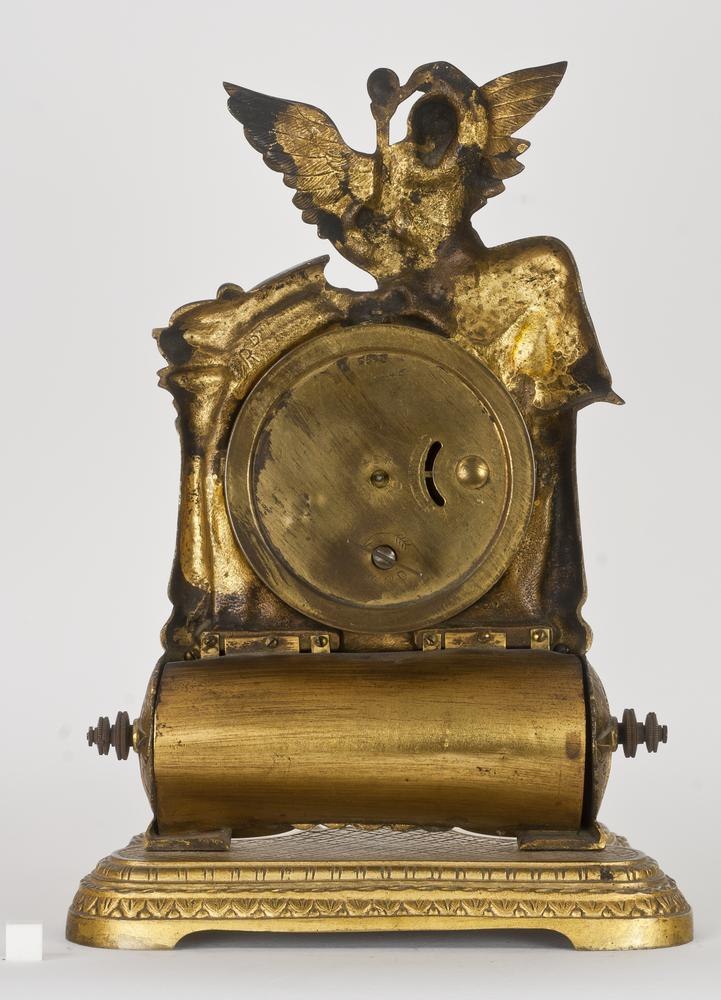
This desk timepiece in a cast gilt brass case features a manual calendar cylinder and was produced by the British United Clock Company in Birmingham, dated tentatively to between 1890 and 1909. According to the British Museum, the case front incorporates cut-outs for inkwells, pen hooks, and an upper surmounting winged female figure with an anchor. It houses a 30-hour movement with an open spring, pin-pallet lever escapement, and strip-construction balance wheel. The rear view shows the circular movement cover plate featuring a curved regulation aperture alongside a lower cylindrical calendar assembly with lateral knobs.

Rear view of the British United Clock Company gilt brass desk timepiece showing the case back and calendar cylinder
Rear view of the British United Clock Company gilt brass desk timepiece showing the case back and calendar cylinder — British Museum. Rights pending — permission not yet requested. Original source

Catalogue identity

Source
www.britishmuseum.org
Category
Clock · Desk clock
Maker / attribution
British United Clock Company
Reference
Not recorded
Catalogue / lot identifier
Source URL identifies the listing
Source-reported date
1890 - 1909 (?)
Country
United Kingdom

Source-reported attribution and specifications are not independent authentication. A listing does not establish present ownership, current display, availability or permission to reproduce.

Object description

Case Construction and Features

The timepiece is housed in a gilt brass case featuring a shaped base with two circular cut-outs intended for inkwells. The upright section incorporates a manual rotary calendar at the base, comprising a wooden disc with paper or celluloid numerals, which is manually advanced by knobs on the sides.

The upper structure includes two hooks for use as pen rests and is surmounted by a figure of a winged female holding an anchor. The lower rim of the base displays decorative ornamentation. Note that the front inkwell cut-outs and pen hooks are not visible in the provided rear-facing photograph.

Evidence for this section
  • “Gilt brass case, shaped base section with two circular cut outs to front (for inkwells).”
  • “manual rotary calendar at base (wooden disc with paper/celluloid numeral, manually advanced by knobs to sides)”
  • “Above this are two hooks either side (pen rest)”
  • “surmounted by winged female figure holding anchor.”

Movement and Technical Specifications

The clock utilizes a 30-hour timepiece movement with plates featuring cut-outs, resulting in an X-shaped configuration. The mechanism employs an open spring, a pin-pallet lever escapement, and a strip-construction balance wheel.

The rear of the movement case features a circular brass cover with a curved aperture for rate regulation. Documentation indicates the hand-set button is missing and the winding key is not original.

Evidence for this section
  • “30hr timepiece movement, plates with cut-outs, remaining plate forming x-shape with border. Open spring. Pin pallet escapement, strip-construction balance wheel.”
  • “Rear of clock movement case having arc aperture for rate adjustment”
  • “winding key (not original), hand set button is missing.”

Dial Description

The dial is composed of a circular pressed brass element with a central scene depicting a castle, sea, ship, moon, trees, and a male figure holding a lyre. The chapter ring is made of cream-colored uranium-glass enamel with Gothic-style Arabic numerals (1-12), paired with blued steel spade hands.

The specific dial features described are not visible in the available photographic evidence.

Evidence for this section
  • “Circular pressed brass dial with cream uranium-glass enamel chapter ring with gothic style arabic hour numerals (1-12).”
  • “Central pressed brass section having castle, sea, ship, moon and trees with male figure holding lyre.”

Open research questions

  • What criteria were used to establish the production date range of 1890-1909?
  • Are there extant examples of the paper or celluloid calendar numerals showing their original state?

Source evidence

Recorded claims and source quotations for British United Clock Company Gilt Brass Desk Timepiece with Calendar
FieldSource-reported valueSource quotation
Museum Number2017,8031.29“Museum number 2017,8031.29”
ManufacturerBritish United Clock Company“Producer name Factory of: British United Clock Company”
Production PlaceBirmingham, West Midlands“Production place Factory in: Birmingham (West Midlands)”
EscapementPin-pallet lever“Escapement pin-pallet lever”
DimensionsHeight: 255 mm, Width: 190 mm, Depth: 130 mm“Height: 255 millimetres (max) Width: 190 millimetres Depth: 130 millimetres”
Condition NoteHand setter missing, winding key not original“Hand setter missing, winding key not original.”
ManufacturerBritish United Clock Company“Producer name Factory of: British United Clock Company”
Production LocationBirmingham (West Midlands)“Production place Factory in: Birmingham (West Midlands)”
Dimensions255mm x 190mm x 130mm“Height: 255 millimetres (max) Width: 190 millimetres Depth: 130 millimetres”
TrademarkLarge BUCC trademark on base“Unusually large and hence clear example of BUCC trademark on underside of base.”

Visible details

  • Rear of the cast gilt brass case shows a winged figure surmounting the structure above a circular movement housing.
  • A circular brass dust cover displays a central arbor aperture, a screw head, and a curved regulation slot.
  • Horizontal cylindrical calendar assembly is mounted across the lower case above the stepped base, terminated by knurled side knobs.
  • Stepped base displays cast leaf/palmette border ornamentation along its lower rim.

Research qualifications

  • The front dial, pen hooks, and inkwell cut-outs described by the source are not visible in this rear photograph.
  • Source notes the hand-set button is missing and the winding key is not original (neither key nor handset knob is installed in this photograph).

Photograph identity and source facts were screened before import; rights clearance remains pending.

Consulted source

clock | British Museum

Reviewed 2026-10-25 · Record 5c2771085d

Terms in this record

Glossary explanations for terms named in this object’s record.