
Skip to content
The Encyclopedia of Horology

Clock · Bracket clock

Cartel d'applique and matching console

Partially verified

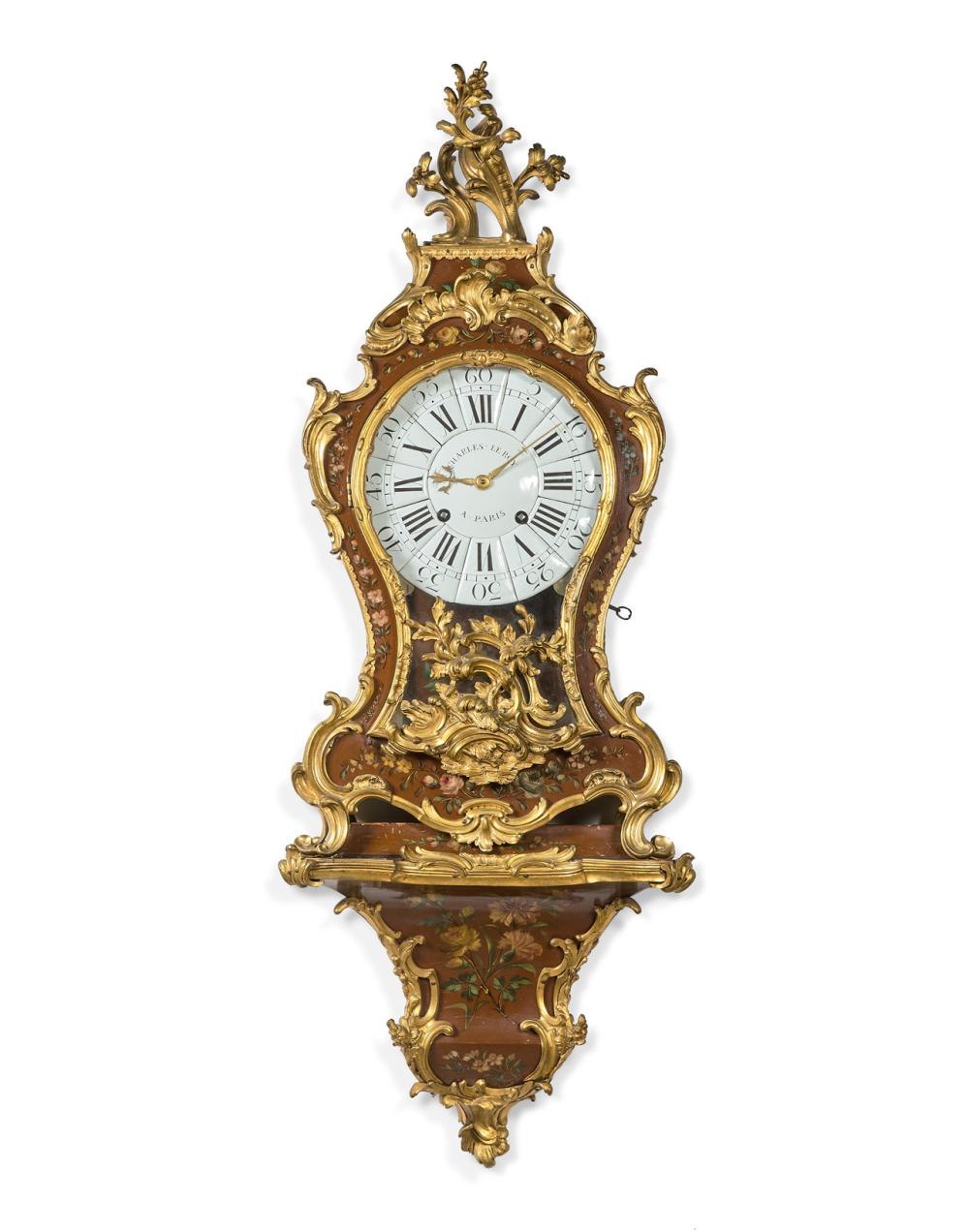
This cartel d'applique with its matching console is a bracket clock attributed to the second quarter of the 18th century and signed by the Parisian horologist Charles Le Roy. The clock features a violoné-shaped case decorated with polychrome floral motifs on a brown background, executed in vernis martin. The case is enhanced with gilded brass rocaille-style mounts, including foliage and flower appliques. The white enamel dial consists of thirteen individual pieces and displays Roman numerals for the hours and Arabic numerals for the minutes, with brass hands. The movement is rectangular, featuring an anchor escapement, a count wheel numbered on the exterior, and a pendulum with a rear-mounted spring suspension. Both the dial and the movement backplate bear the signature 'Charles Le Roy à Paris'. The clock measures 110 by 39 by 19 centimeters.

Wall bracket clock with matching console, featuring floral vernis martin decoration and gilded brass rocaille mounts.
Wall bracket clock with matching console, featuring floral vernis martin decoration and gilded brass rocaille mounts. — Tajan (via Invaluable). Rights pending — permission not yet requested. Original source

Catalogue identity

Source
www.invaluable.com
Category
Clock · Bracket clock
Maker / attribution
Charles Le Roy
Reference
Not recorded
Catalogue / lot identifier
170
Source-reported date
Second quarter of the 18th century
Source-reported place
France

Source-reported attribution and specifications are not independent authentication. A listing does not establish present ownership, current display, availability or permission to reproduce.

Object description

Case and Aesthetic Features

The clock is presented as a cartel d'applique, incorporating both the clock housing and its matching console. The exterior finish utilizes a vernis martin technique, which displays a decorative scheme of pink floral branches against a tobacco-colored base.

The visual impact is heightened by extensive use of gilded brass mounts. These elements are executed in a rocaille style, featuring intricate depictions of flowers and foliage that frame the clock body and the console. The assembly of these mounts provides a contrast against the dark background of the vernis martin surface.

Evidence for this section
  • “caisse violonée avec décor de fleurs polychrome peint sur fond marron avec appliques fleurs et de feuillage en laiton doré”
  • “Il présente une riche ornementation de bronze en rocaille.”

Movement and Dial

The clock dial is constructed from thirteen distinct pieces of white enamel. It features Roman numerals to track the hours and Arabic numerals to indicate the minutes, with brass hands used for time indication. The signature of the maker, 'Charles Le Roy à Paris', is placed directly on the dial.

Internally, the movement is housed in a rectangular frame. It operates via an anchor escapement and includes a count wheel located on the exterior. The pendulum system currently utilizes a spring suspension, which the documentation specifies as a posterior addition. The backplate of the movement is signed consistent with the dial.

Evidence for this section
  • “Cadran en émail blanc en treize pièces, chiffres romains pour les heures, arabes pour les minutes, aiguilles en laiton”
  • “mouvement rectangulaire, échappement à ancre, roue de compte numérotée à l'extérieur”
  • “signé Charles Leroy à Paris comme la platine arrière.”

Maker and Attribution

Charles Le Roy was an active Parisian horologist during the reign of Louis XV, having achieved mastery in August 1733. His workshops were located on the rue des Prêcheurs and later on the rue Saint-Denis.

Following his death in 1771, the workshop's activities were continued by his son, Étienne-Augustin Le Roy, who eventually secured the title of Horloger du Roi. The signature found on this particular clock serves as a marker of the output from the family establishment during the middle of the century.

Evidence for this section
  • “Après son accession à la maîtrise, le 16 août 1733, il installe son atelier rue des Prêcheurs, puis vers 1745 rue Saint-Denis”
  • “Après son décès en 1771, son fils, Étienne-Augustin, continuera l'activité de l'atelier paternel”

Open research questions

  • What is the specific nature of the 'small wear' noted in the condition report?
  • Are there any identifiable marks on the brass mounts indicating a specific bronzier?

Source evidence

Recorded claims and source quotations for Cartel d'applique and matching console
FieldSource-reported valueSource quotation
MakerCharles Le Roy“SIGNÉ CHARLES LE ROY”
DatingSecond quarter of the 18th century“DEUXIÈME QUART DU XVIIIe SIÈCLE”
Case DecorationVernis martin with floral motifs“vernis martin à décor de branchages de fleurs roses sur fond tabac”
Dial CompositionThirteen-piece enamel dial“Cadran en émail blanc en treize pièces”
Movement FeaturesAnchor escapement“échappement à ancre”
Dimensions110 x 39 x 19 cm“110 x 39 x 19 CM - 43,3 x 15,4 x 7,5 IN”
SuspensionPosterior spring suspension“suspension à ressort (postérieur)”

Visible details

  • Polychrome floral painting on a brown ground
  • Gilded brass rocaille mounts throughout the case
  • White enamel dial composed of thirteen pieces
  • Numbered count wheel visible on the exterior of the movement

Research qualifications

  • The spring suspension for the pendulum is identified as a later modification
  • Small signs of wear are mentioned by the auction description

Photograph identity and source facts were screened before import; rights clearance remains pending.

Terms in this record

Glossary explanations for terms named in this object’s record.