
Skip to content
The Encyclopedia of Horology

Pocket watch · Carriage watch

Carriage watch by Nicolas Lemaindre

Partially verified

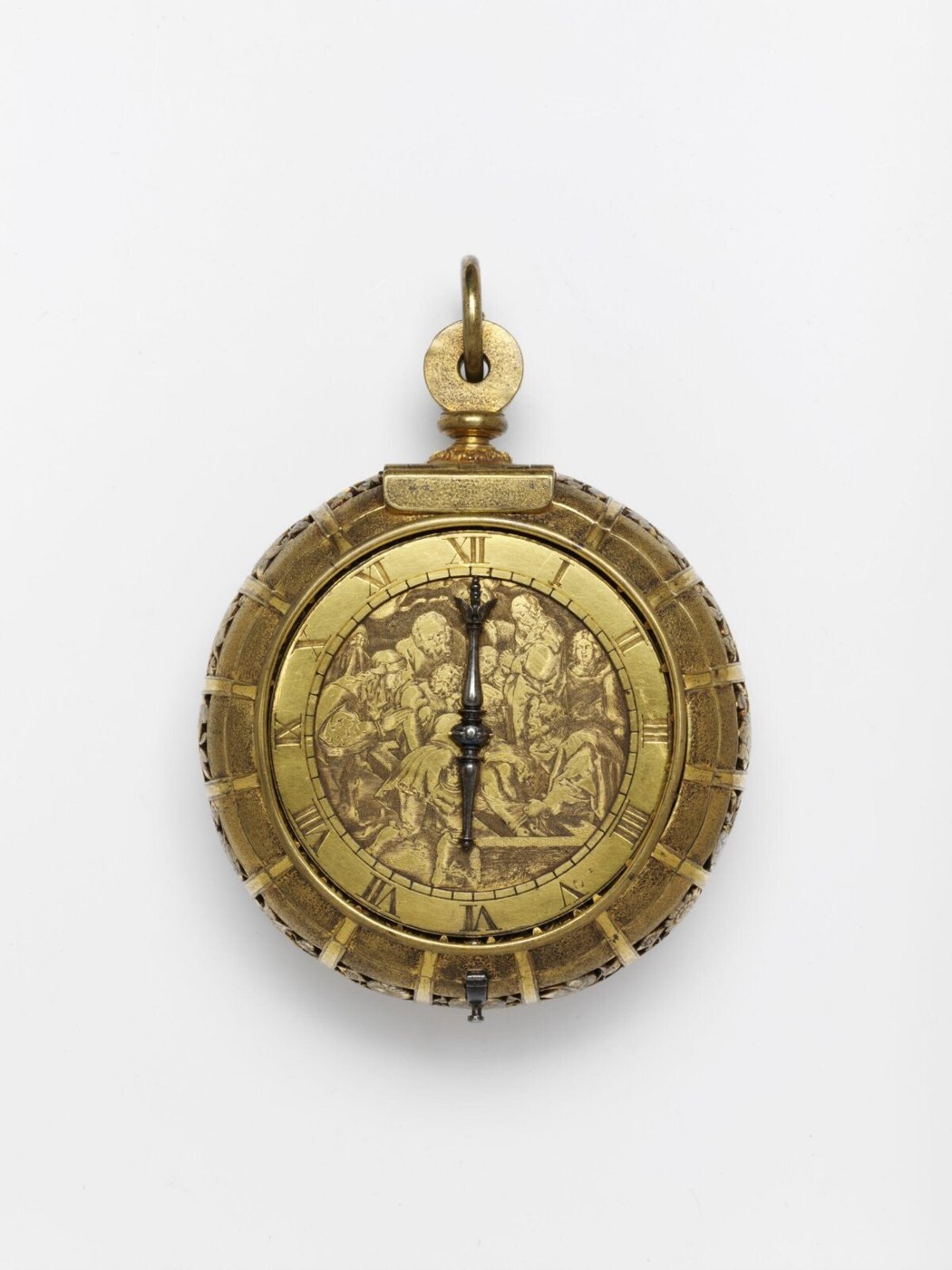
This carriage watch, dating to 1630, is attributed to the Blois-based watchmaker Nicolas Lemaindre. The timepiece features a circular gilt-brass case, with its side adorned with pierced and engraved floral motifs set between 16 radial flutes. The gilt-brass dial displays Roman numerals for hours and an inner track for quarter-hours, while the center is engraved with a scene depicting The Entombment. A single steel hand with foliage detailing indicates the time. Internally, the movement utilizes Egyptian pillars, a fusee and chain, and a verge escapement. The striking train includes a count wheel numbered 1 to 12 and a silver bell. The case front has been modified at a later date to allow viewing of the dial.

A view of the gilt-brass carriage watch, highlighting the engraved dial with 'The Entombment' scene and the pierced case side.
A view of the gilt-brass carriage watch, highlighting the engraved dial with 'The Entombment' scene and the pierced case side. — Victoria and Albert Museum, London. Rights pending — permission not yet requested. Original source

Catalogue identity

Source
collections.vam.ac.uk
Category
Pocket watch · Carriage watch
Maker / attribution
Nicolas Lemaindre
Reference
Not recorded
Catalogue / lot identifier
2366-1855
Source-reported date
1630
Source-reported place
France

Source-reported attribution and specifications are not independent authentication. A listing does not establish present ownership, current display, availability or permission to reproduce.

Object description

Case and Dial Construction

The watch is housed in a circular gilt-brass case characterized by a pierced side decorated with panels of foliage and flowers, segmented by 16 radial flutes. The base of the case is soldered to the sides, and the bezel, back, and rim are matted using a circular tool. The front of the case was cut out at some point after its production to expose the dial.

The gilt-brass dial features an applied chapter ring with Roman numerals I through XII and a corresponding inner ring for quarter-hours. The center of the dial depicts an engraving of The Entombment. Surrounding the chapter ring is a band of engraved foliage. The time is indicated by a single steel hand with a foliage-decorated head and an extended tail.

Evidence for this section
  • “the side pierced and engraved with panels of flowers and foliage between 16 radial flutes.”
  • “The gilt-brass dial has an applied gilt-brass chapter ring with Roman hours, I - XII, and inner ring of quarter-hour marks.”
  • “The centre of the dial is engraved with The Entombment .”
  • “The front case has been cut out at a later date to reveal the dial face through the glass.”

Movement and Striking Train

The brass movement plates are supported by Egyptian-style pillars. The going train is powered by a fusee and chain and controlled by a verge escapement. The single-foot balance cock is pierced and engraved with floral motifs, though the balance-wheel and steel spring are later additions. The regulator system includes a lever that moves between markers for fast and slow.

A striking train is integrated into the watch, featuring a resting barrel pierced and engraved with foliage. A count wheel, marked 1 through 12 and possessing an engraved center, is mounted atop the top plate. An internal silver bell provides the striking sound, complemented by a steel index with a tail.

Evidence for this section
  • “Brass movement plates separated by Egyptian pillars.”
  • “The going train has a fusee and chain, and a verge escapement.”
  • “Later balance-wheel and steel spring.”
  • “Silver bell mounted inside case.”

Provenance and Marks

The watch bears an inscription on the top plate reading, 'A Blois Nicolas Lemaindre 1630', which associates the piece with the Blois watchmaker Nicolas Lemaindre. The object was later included in the Bernal Sale held at Christie's, London, in 1855, where it was sold as lot 3913.

Additional records indicate the object was part of the Grand Palais Exhibition under reference RF.2001/297. The manufacturing location is attributed to Blois, a center known for its horological production during the seventeenth century, where makers such as the Lemaindre family maintained significant professional status.

Evidence for this section
  • “Engraved on top plate”
  • “Bought at the Bernal Sale, Christie's, London, 1855, lot 3913.”
  • “Grand Palais Exhibition RF.2001/297”

Open research questions

  • What specific archival evidence links Nicolas Lemaindre to the commission of this particular carriage watch?
  • When exactly was the front of the case modified, and what were the historical circumstances necessitating this change?

Source evidence

Recorded claims and source quotations for Carriage watch by Nicolas Lemaindre
FieldSource-reported valueSource quotation
MakerNicolas Lemaindre“Nicolas Lemaindre”
Accession Number2366-1855“2366-1855”
Dial DecorationThe Entombment engraving“The centre of the dial is engraved with The Entombment”
EscapementVerge escapement“The going train has a fusee and chain, and a verge escapement.”
InscriptionA Blois Nicolas Lemaindre 1630“'A Blois Nicolas Lemaindre 1630'”
ProvenanceBernal Sale, 1855, lot 3913“Bought at the Bernal Sale, Christie's, London, 1855, lot 3913.”

Visible details

  • Pierced and engraved gilt-brass side with 16 radial flutes.
  • Single steel hour hand with foliage-form head.
  • Count wheel numbered 1 through 12 mounted on the top plate.
  • Silver bell housed internally within the case.

Research qualifications

  • Dial glass is noted as lacking.
  • The balance-wheel and steel spring are later replacements.
  • The front case was modified at an unspecified later date.

Photograph identity and source facts were screened before import; rights clearance remains pending.

Consulted source

Carriage watch

Reviewed 2026-11-02 · Record 0304c119c6

Terms in this record

Glossary explanations for terms named in this object’s record.