
Skip to content
The Encyclopedia of Horology

Clock · Carriage clock

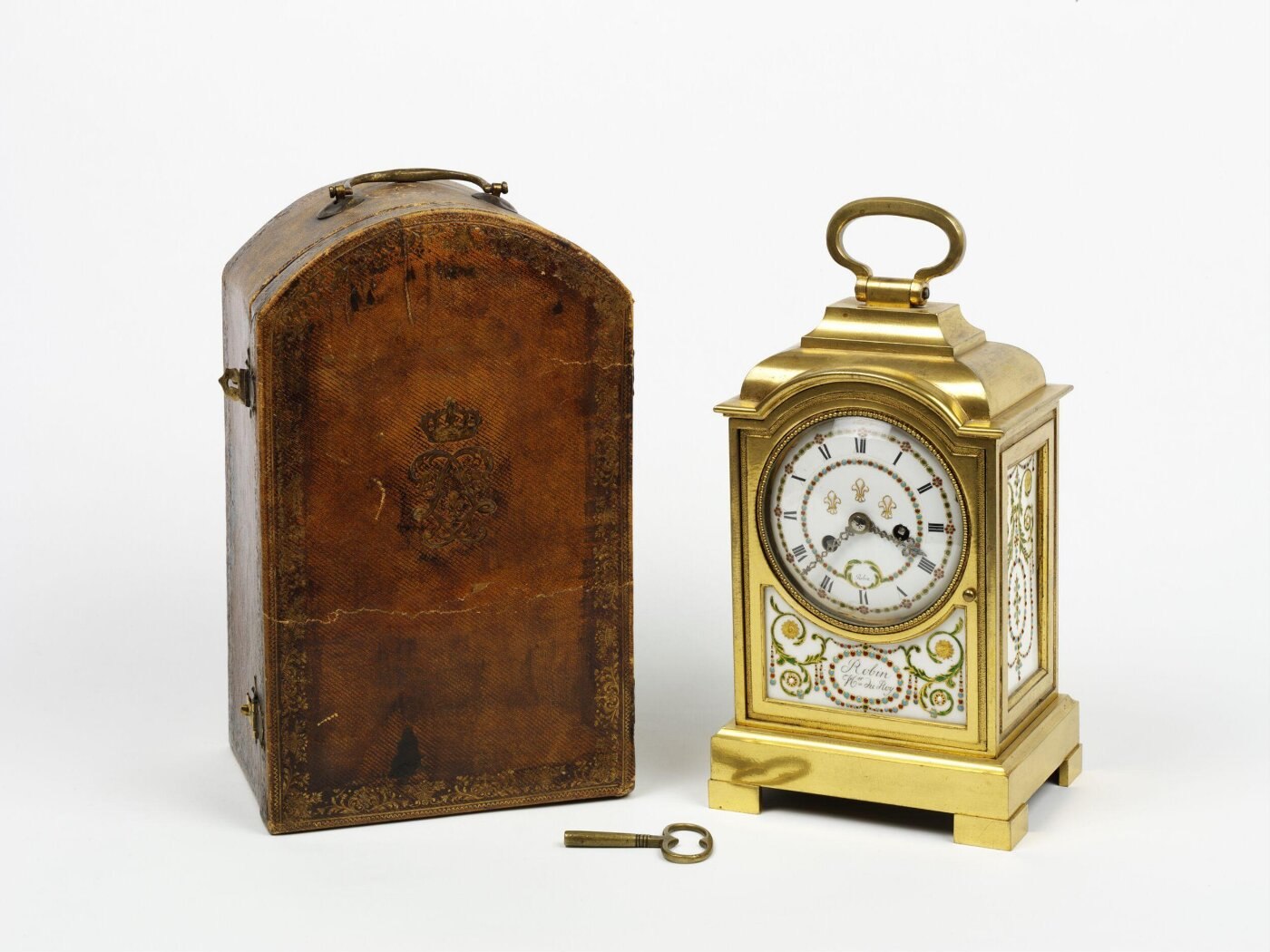
Carriage clock with case and key

Partially verified

This French carriage clock, standing nine inches tall, dates to 1780-1785 and features a rectangular brass or ormolu case topped with a carrying ring. The clock is fitted with rectangular hard-paste porcelain plaques on all four sides, decorated with stamped gold-leaf foils and jewelled ornament in translucent red, green, and opaque turquoise and white enamels. The enamel dial is signed by the clockmaker Robert Robin, who served as clockmaker to King Louis XVI. The movement is a platform cylinder escapement with a count-wheel striking train. This clock was bequeathed to the museum by John Jones in 1882.

The carriage clock and its leather carrying case, accompanied by a winding key.
The carriage clock and its leather carrying case, accompanied by a winding key. — V&A Museum. Rights pending — permission not yet requested. Original source

Catalogue identity

Source
collections.vam.ac.uk
Category
Clock · Carriage clock
Maker / attribution
Robert Robin
Reference
Not recorded
Catalogue / lot identifier
1001-1882
Source-reported date
1780-1785
Source-reported place
Paris

Source-reported attribution and specifications are not independent authentication. A listing does not establish present ownership, current display, availability or permission to reproduce.

Object description

Case and Dial

The clock is housed in a rectangular brass or ormolu case featuring a fold-down carrying handle. The four sides are inset with rectangular plaques of white hard-paste porcelain, adorned with symmetrical designs featuring stamped gold-leaf foils enriched with translucent red and green, and opaque turquoise and white enamels. The internal surfaces of these plaques are lined with pale green watered silk, trimmed with metallic braid.

The enamel dial, approximately 8.6cm in diameter, is mounted on a brass plate and features Roman numerals with unnumbered minute markers. The design incorporates three jewelled white enamel fleur de lys in the center and a laurel wreath-style cartouche. The hands are crafted from pierced silver and embellished with applied white stones.

Evidence for this section
  • “The four sides fitted with rectangular plaques of white hard paste porcelain”
  • “the symmetrical designs in neo-classical taste”
  • “The enamel dial, 8.6cm diameter, is on a brass dial-plate”
  • “three jewelled white enamel fleur de lys”

Movement and Construction

The clock's movement features plates measuring 6cm in diameter, with both trains utilizing going barrels. The going train is equipped with a platform cylinder escapement using a steel cylinder. The striking train is of the locking-plate type and utilizes a count-wheel to facilitate a single stroke at every half-hour.

The museum notes that the movement currently housed within the case is a complete replacement. Additionally, both the pendulum and the escapement mechanism are later additions that do not match the original construction of the piece.

Evidence for this section
  • “The movement plates are 6.cm diameter. Both trains are fit with going barrels.”
  • “The going train to the right has a platform cylinder escapement (steel cylinder).”
  • “The pendulum and escapement (the device to regulate the motion of the pendulum) are later replacements.”
  • “The movement itself has been completely replaced.”

Provenance and History

Robert Robin, the clockmaker, was active during the reigns of Louis XV and Louis XVI. The clock is accompanied by a fine-tooled leather carrying case featuring a padded interior and the royal monogram of Louis XVI—an interlaced 'L'—topped by a crown. The clock entered the collection via a bequest from John Jones in 1882. The object includes an original fine-tooled leather carrying case stamped with the royal monogram of Louis XVI.

Historical records include a note from the Metalwork Section register suggesting the clock once belonged to Queen Marie-Antoinette.

Evidence for this section
  • “The clock is accompanied by a fine leather case stamped with the royal monogram of Louis XVI”
  • “The Museum was bequeathed the clock in 1882 by John Jones”
  • “a note in the Metalwork Section register made when the clock entered the Museum observes that it had once belonged to Marie Antoinette herself.”

Open research questions

  • Could metallurgical analysis of the metallic braid lining confirm its material composition?
  • Does the current movement contain identifiable components from specific historical repair workshops?

Source evidence

Recorded claims and source quotations for Carriage clock with case and key
FieldSource-reported valueSource quotation
MakerRobert Robin“Maker: Robert Robin (clockmaker)”
Date1780-1785“Date: 1780-1785”
Accession number1001-1882“Accession number: 1001-1882”
Dimensions9 in“Height: 9 in”
Case constructionRectangular brass or ormolu“Rectangular brass or ormolu case surmounted by a fold-down carrying ring.”
Dial signatureRobin“the dial is signed inside the scroll above VI "Robin”
ProvenanceJohn Jones bequest“The Museum was bequeathed the clock in 1882 by John Jones”

Visible details

  • The dial features three white enamel fleur de lys in the center
  • The leather carrying case is embossed with a royal crown and monogram
  • Pierced silver hands are fitted with small white stones

Research qualifications

  • The movement has been completely replaced
  • The pendulum and escapement are later replacements

Photograph identity and source facts were screened before import; rights clearance remains pending.

Consulted source

Carriage clock

Reviewed 2026-10-26 · Record 918845ddfd

Terms in this record

Glossary explanations for terms named in this object’s record.