
Skip to content
The Encyclopedia of Horology

Pocket watch · Tourbillon deck watch

Carley & Clémence Tourbillon Centre-Seconds Deck Watch

Partially verified

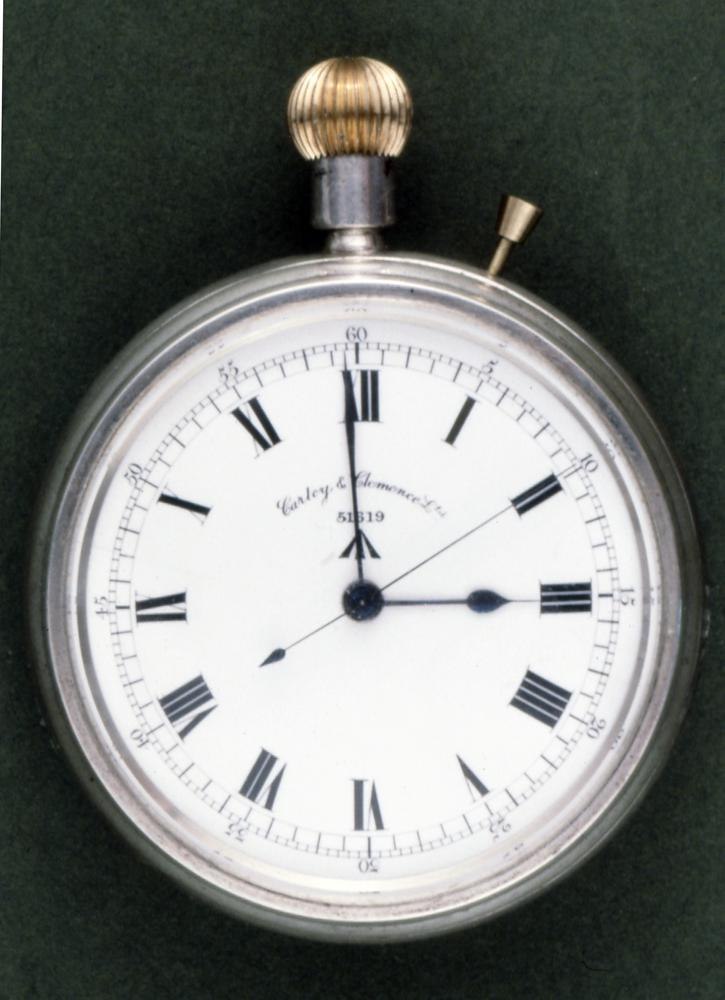
This 1903 open-face silver deck watch by Carley & Clémence features an annular tourbillon mechanism based on an ébauche by Andrew Taylor of Coventry. Housed in a hallmarked silver case with a rolled gold winding button and setting push-piece, the watch incorporates a white enamel dial with Roman numerals, fine outer graduations, and a centre-seconds hand. The movement is fitted with an Earnshaw-type spring detent escapement, a Guillaume bimetallic balance with gold and platinum screws, and a blued steel overcoil balance spring. The brass carriage completes one rotation every ten minutes. Both the dial and the movement bear the British Government broad arrow property mark.

Dial view of the Carley & Clémence open-face centre-seconds deck watch showing the enamel dial and blued steel hands
Dial view of the Carley & Clémence open-face centre-seconds deck watch showing the enamel dial and blued steel hands — British Museum. Rights pending — permission not yet requested. Original source

Catalogue identity

Source
www.britishmuseum.org
Category
Pocket watch · Tourbillon deck watch
Maker / attribution
Carley & Clémence
Reference
Not recorded
Catalogue / lot identifier
1958,1201.1724
Source-reported date
1903
Country
United Kingdom
Source-reported serial
51619

Source-reported attribution and specifications are not independent authentication. A listing does not establish present ownership, current display, availability or permission to reproduce.

Object description

Construction and Identity

This 1903 open-face deck watch is signed by Carley & Clémence Ltd. It features an ébauche from Andrew Taylor of Coventry, marked with the serial number 51619. The silver case includes an inner dome, a hand-setting push-piece, and a rolled gold winding button, but is noted to lack a pendant ring.

The watch is housed in a brass drum and a wooden box, which contains an ivory disc marked with the company name, serial number, and a British Government property mark.

Evidence for this section
  • “Signature: Carley & Clemence Ltd 30 Ely Place London E.C. No 51619'”
  • “Ebauche marks on the front plate under the dial A.T in a rectangle and the number 51619.”
  • “The glazed silver deck watch case with large hand-set push-piece, no pendant ring (or provision for one) and rolled gold winding button”
  • “The box has an inlaid ivory disc 'CARLEY & CLEMENCE LTD (with the British Govern¬ment property mark) 51619 P.C.'”

Dial and Mechanism

The enamel dial displays Roman numerals and a centre-seconds hand. It is marked with 0.4-second intervals. Both the dial and the internal mechanism bear the British Government broad arrow property mark.

The movement utilizes an Earnshaw-type spring detent escapement and a Guillaume bimetallic balance with gold and platinum screws. The tourbillon carriage is composed of various brass parts and completes one rotation every ten minutes.

Evidence for this section
  • “The dial marked with 04 second intervals as well as seconds.”
  • “The dial inscribed 'Carley & Clemence Ltd 51619' and the British Government property mark.”
  • “Earnshaw type of spring detent escapement, the escape wheel of gold”
  • “Guillaume nickel steel and brass 'integral' bimetallic balance”
  • “The brass carriage turns once in ten minutes”

Historical and Technical Notes

Museum records note that the movement is based on an ébauche by Andrew Taylor who patented a tourbillon mechanism in 1895, though the specific execution in this watch differs from the patent description.

Documentation highlights ambiguity in the categorization of the revolving carriage, with official descriptions referring to it variably as a karussel or tourbillon mechanism.

Evidence for this section
  • “That contained in this watch is similar but not the same as the one described in the patent.”
  • “karussel watch (?) ; centre-seconds watch ; tourbillon watch (?)”

Open research questions

  • What are the specific technical distinctions required to classify this mechanism as a tourbillon versus a karussel?
  • Does the 0.4-second dial graduation serve a specific timing or navigational purpose for a deck watch?
  • Are there other examples of 51619 series instruments that carry the British Government broad arrow mark?

Source evidence

Recorded claims and source quotations for Carley & Clémence Tourbillon Centre-Seconds Deck Watch
FieldSource-reported valueSource quotation
Hallmark Date1903“London hallmark for 1903, the number 4, and the casemaker's mark c & CLD (for Carley and Clemence Ltd) in an oval cartouche.”
Ébauche MakerAndrew Taylor“The watch is based on an ebouche made by Andrew Taylor who took out a patent number 16623 on 5th September 1895 for a tourbillon mechanism.”
EscapementEarnshaw type spring detent“Earnshaw type of spring detent escapement, the escape wheel of gold, the steel impulse roller not jewelled but polished all over.”
BalanceGuillaume bimetallic balance“Guillaume nickel steel and brass 'integral' bimetallic balance with gold and platinum screws, the four quarter screws gold.”
Carriage Rotation10 minutes“The brass carriage turns once in ten minutes and is made up of a number of brass parts.”
ProvenanceIlbert Collection“Ilbert Collection, purchased by Ilbert from Malcolm Gardner in 1948.”
Escapement Frequency18,000 beats per hour“Beats per hour: 18,000”
Hallmark1903 London“London hallmark for 1903, the number 4, and the casemaker's mark c & CLD”

Visible details

  • White enamel dial inscribed 'Carley & Clemence Ltd 51619' with black Roman numerals and the British Government broad arrow property mark.
  • Outer seconds track calibrated with 0.25-second subdivisions.
  • Blued steel centre seconds, hour, and minute hands.
  • Glazed silver open-face case without a pendant bow.
  • Fluted rolled-gold winding button and adjacent cylindrical hand-setting push-piece at the shoulder.

Research qualifications

  • The accompanying brass drum and altered wooden deck box described in the catalogue are not visible in the photograph.
  • The source title questions whether the carriage mechanism is strictly a tourbillon or a karussel.

Photograph identity and source facts were screened before import; rights clearance remains pending.

Consulted source

karussel watch (?); centre-seconds watch; tourbillon watch (?) | British Museum

Reviewed 2026-10-25 · Record b211a5ee13

Terms in this record

Glossary explanations for terms named in this object’s record.