
Skip to content
The Encyclopedia of Horology

Tool · Arabic-inscribed astrolabe

Brass Astrolabe by Sayyid ’Abd al-Baqi

Partially verified

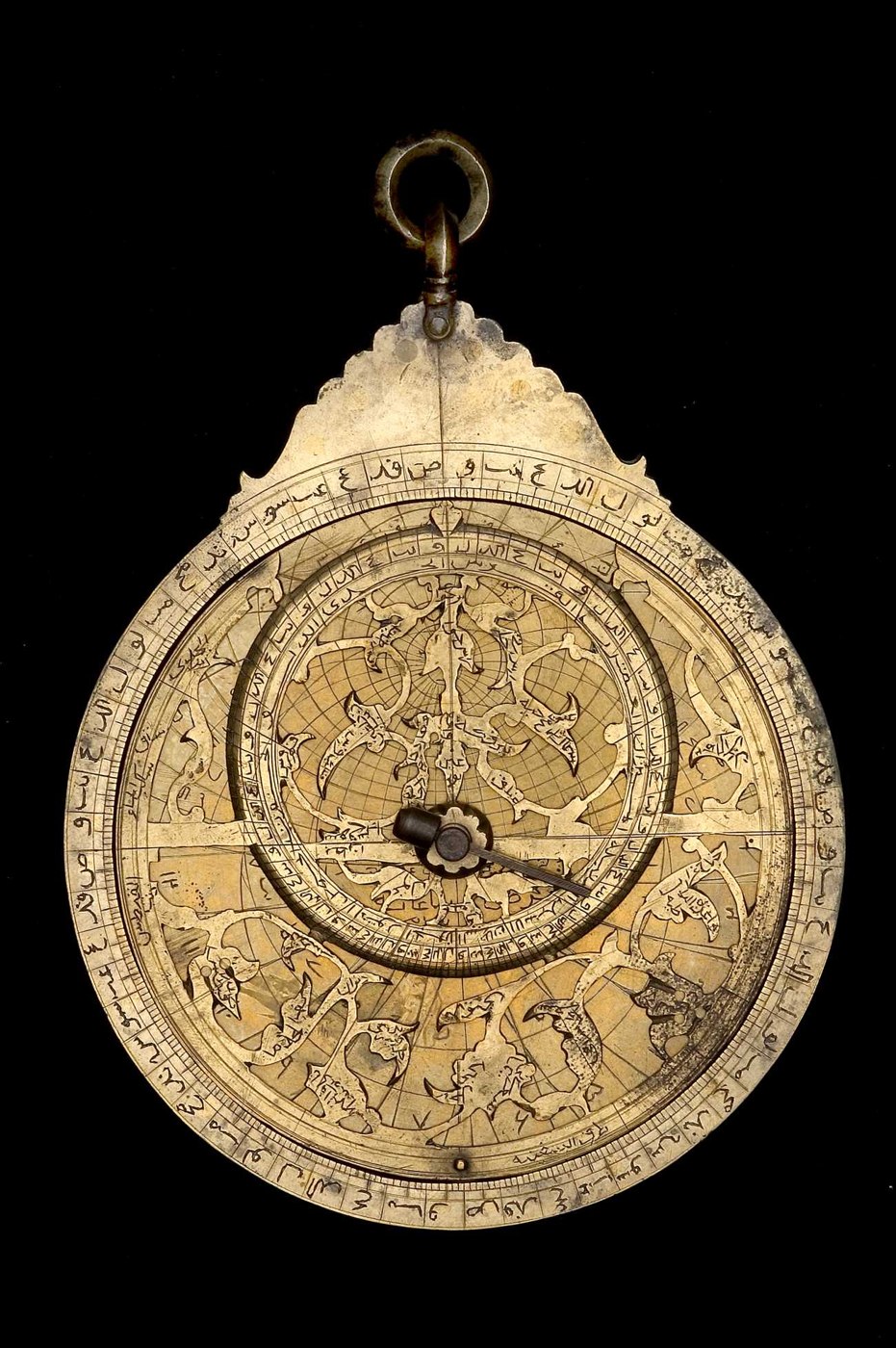
This brass astrolabe is signed by the maker Sayyid ’Abd al-Baqi and dated 1789/90 (A.H. 1204). It features a five-lobed throne with integrated supports and an omega-type shackle. The instrument is constructed with a soldered and riveted mater and limb assembly, incorporating a tab system on the limb to secure the tympans. The rete is of the foliate type, containing 38 stars marked with foliate pointers and a single rotation knob at the bottom. The instrument includes a gazetteer on the womb listing coordinates for 45 cities. The back of the astrolabe is engraved with three scales for altitude and cotangent measurements; however, the upper right quadrant is blank, suggesting an incomplete state. This instrument was formerly part of the Henri Michel collection and was acquired by the History of Science Museum, University of Oxford, through a presentation by J. A. Billmeir in 1957.

Front view of the brass astrolabe showing the rete, throne, and circular scales.
Front view of the brass astrolabe showing the rete, throne, and circular scales. — History of Science Museum, University of Oxford. Rights pending — permission not yet requested. Original source

Catalogue identity

Source
www.mhs.ox.ac.uk
Category
Tool · Arabic-inscribed astrolabe
Maker / attribution
Sayyid ’Abd al-Baqi
Reference
50059
Catalogue / lot identifier
1957-84/12
Source-reported date
1789/90
Source-reported place
Persia

Source-reported attribution and specifications are not independent authentication. A listing does not establish present ownership, current display, availability or permission to reproduce.

Object description

Construction and Layout

The astrolabe is manufactured from brass and follows a traditional design comprising a mater, a rete, and tympans. The mater and limb are joined via a soldered and riveted construction. A functional tab on the limb serves to hold the tympans, diverging from the more common practice of using notches in the mater and tabs on the plates.

The throne features a five-lobed form with integrated supports and an omega-shaped shackle, facilitating suspension. The rete is of the foliate type, featuring a rotation knob on the tropic of capricorn and a counter-changed east-west line at the ecliptic.

Evidence for this section
  • “The mater and limb are of two pieces, soldered and riveted construction.”
  • “This instrument has a tab on the limb, inside the mater, to hold the tympans in place”
  • “The rete is of the foliate (single knob) type.”
  • “The rete is attached using a pin & wedge. Most likely a replacement.”

Engravings and Scales

The back of the instrument contains three distinct scales, including altitude and cotangent markings in the various quadrants. The upper right quadrant, traditionally reserved for qibla lines on instruments of this type, remains blank, indicating that the piece was not finished to the maker's intended scope.

The instrument includes a comprehensive gazetteer on the inner womb containing geographical coordinates, inhiraf, and jihat for 45 cities, including Mecca, Baghdad, and Tabriz. The rete displays 38 star markers, all of which are rendered with foliate pointers.

Evidence for this section
  • “The upper right quadrant, where one would expect to find the qibla lines, is blank, suggesting that this instrument was not completed.”
  • “The back contains 3 scales of the following types: Altitude; Cotangent.”
  • “The womb contains a gazetteer with coordinates for 45 cities”
  • “There are 38 stars on the rete marked with foliate pointers.”

Provenance and Acquisition

This astrolabe (inventory number 50059) was acquired by the History of Science Museum, University of Oxford, in 1957. It was presented to the museum by J. A. Billmeir. The object had previously been part of the collection of Henri Michel based in Brussels, which Billmeir acquired circa 1950.

The object is attributed to the maker Sayyid ’Abd al-Baqi and dated to 1789/90 (A.H. 1204). The source provides a qualified geographical attribution of Persia.

Evidence for this section
  • “Presented by J. A. Billmeir in 1957”
  • “Billmeir acquired it with the collection of Henri Michel, of Brussels, which he purchased about 1950.”
  • “Maker Sayyid ’Abd al-Baqi”
  • “Place Persia (?)”

Open research questions

  • What specific archival or stylistic evidence suggests the astrolabe is of Persian origin?
  • Why was the qibla section left blank on an otherwise precisely inscribed instrument?

Source evidence

Recorded claims and source quotations for Brass Astrolabe by Sayyid ’Abd al-Baqi
FieldSource-reported valueSource quotation
MakerSayyid ’Abd al-Baqi“Maker Sayyid ’Abd al-Baqi”
Date1789/90 (A.H. 1204)“Date 1789/90 (A.H. 1204)”
MaterialBrass“Material Brass”
Inventory Number50059“Inventory no. 50059”
ProvenanceBillmeir collection via Henri Michel“Billmeir acquired it with the collection of Henri Michel, of Brussels, which he purchased about 1950.”
Throne TypeFive-lobed“The throne is of the five-lobed type”
Rete Stars38“The rete contains 38 stars.”

Visible details

  • Foliate style rete with 38 labeled stars
  • Five-lobed throne design with integrated base
  • Blank upper-right quadrant on the back of the instrument
  • Gazetteer on the interior womb for 45 cities

Research qualifications

  • The pin and wedge assembly is identified as a likely replacement
  • The attribution of manufacture to Persia is provided with a qualification/hedging (Persia (?))

Photograph identity and source facts were screened before import; rights clearance remains pending.

Consulted source

Astrolabe, inventory 50059 (Persia (?), 1789/90 (A.H.)

Reviewed 2026-10-26 · Record b1497aca8e

Terms in this record

Glossary explanations for terms named in this object’s record.