
Skip to content
The Encyclopedia of Horology

Clock · Bracket clock

Bracket clock by Thomas Weeks

Partially verified

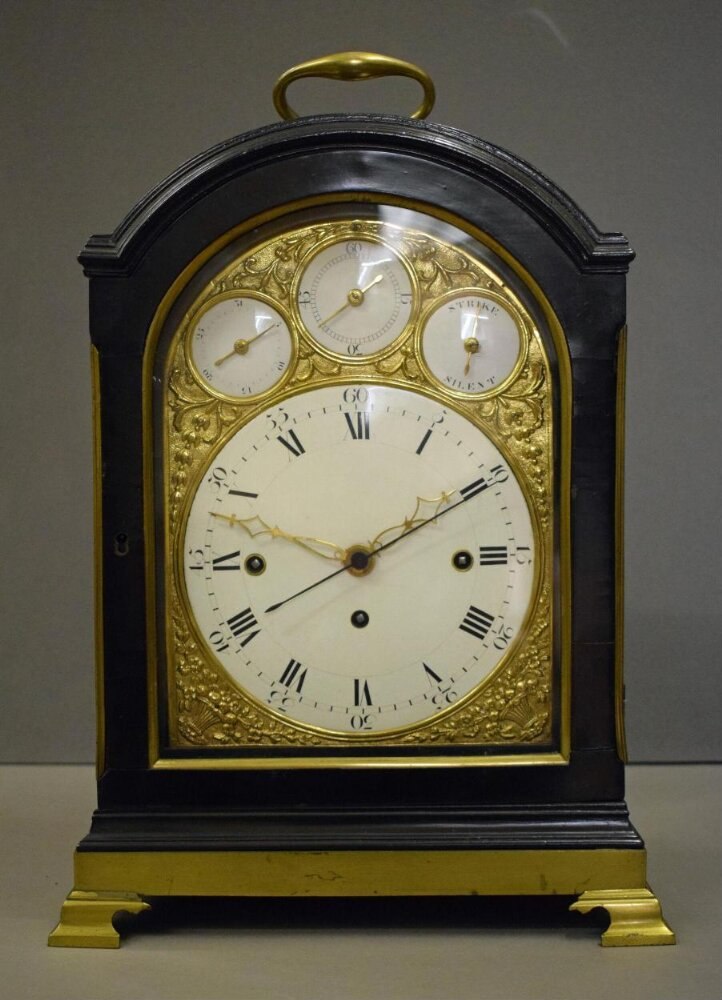
This English bracket clock, catalogued with accession number W.100-1962, dates to the period 1780-1790. The movement is attributed to Thomas Weeks. The clock is housed in an ebonised oak case featuring inset brass fillets and is supported by a brass base with bracket feet. A brass loop handle is mounted at the top. The dial configuration includes a primary enamelled hour dial accompanied by three subsidiary dials, all set within a brass field. The brass field is ornamented with decorative elements, including baskets of flowers in the lower spandrels and honeysuckle motifs in the upper section. The clock includes a chiming mechanism utilizing eight bells. Measuring approximately 44 cm in height, 30.5 cm in width, and 22 cm in depth, the piece was bequeathed to the museum collection by C. D. Rotch.

Front view of the ebonised oak bracket clock, showing the dial, subsidiary dials, and decorative brass spandrels.
Front view of the ebonised oak bracket clock, showing the dial, subsidiary dials, and decorative brass spandrels. — Victoria and Albert Museum, London. Rights pending — permission not yet requested. Original source

Catalogue identity

Source
collections.vam.ac.uk
Category
Clock · Bracket clock
Maker / attribution
Thomas Weeks
Reference
Not recorded
Catalogue / lot identifier
W.100-1962
Source-reported date
1780-1790
Source-reported place
England

Source-reported attribution and specifications are not independent authentication. A listing does not establish present ownership, current display, availability or permission to reproduce.

Object description

Case Construction

The timepiece is contained within an ebonised oak case, which is enriched with inset brass fillets. The base of the clock is formed of brass and rests upon brass bracket feet. The design includes an arched panel of brass scaly fretwork positioned at each side of the case.

A brass loop handle is secured at the top, facilitating the movement of the clock. Access for inspection or adjustment is provided by an arched glass panel installed at the rear of the cabinet.

Evidence for this section
  • “The ebonised oak case is inset with brass fillets and stands on a brass base with brass bracket feet, the whole surrmounted by a brass loop handle.”
  • “An arched panel of brass scaly fret at each side and an arched pane of glass at the back.”

Dial and Ornamentation

The front of the clock features an enamelled hour dial integrated into a brass field. This field is detailed with specific decorative castings; the lower spandrels feature motifs of flower baskets, while the upper portion contains honeysuckle ornament.

In addition to the primary hour dial, three subsidiary dials are incorporated into the brass plate. One of these, visible on the right, provides a 'STRIKE/SILENT' function for the movement.

Evidence for this section
  • “The enamelled hour dial is overset by three subsidiary dials, all incorporated into a brass field, the lower spandrels of which are decorated with baskets of flowers and the upper section consisting of honeysuckle ornament.”

Movement and Origin

The movement is attributed to Thomas Weeks, a maker active in England during the late 18th century. The clock system includes a chime powered by eight bells.

The object was acquired by the museum as a bequest from C. D. Rotch, entering the collection under the accession number W.100-1962.

Evidence for this section
  • “movement made by Weeks”
  • “The chime is of eight bells and the movement is by Weekes.”
  • “Bequeathed by C. D. Rotch”

Open research questions

  • Are there any internal maker's marks on the movement plates to confirm the attribution to Thomas Weeks?
  • Does the internal mechanism retain its original components or have modifications occurred over its history?

Source evidence

Recorded claims and source quotations for Bracket clock by Thomas Weeks
FieldSource-reported valueSource quotation
Accession numberW.100-1962“Accession number: W.100-1962”
MakerThomas Weeks“movement made by Weeks”
Place of originEngland“England, 1780-1790”
Case materialEbonised oak“The ebonised oak case is inset with brass fillets”
ChimeEight bells“The chime is of eight bells”

Visible details

  • The clock face includes a 'STRIKE/SILENT' subsidiary dial.
  • The case is topped with a brass loop handle.
  • The dial is fitted with pierced, decorative metal hands.
  • The brass base sits on four distinct bracket-style feet.

Research qualifications

  • The source attributes the movement to Weeks, but provides no specific serial or production record.
  • The precise manufacturing method of the individual components remains unverified.

Photograph identity and source facts were screened before import; rights clearance remains pending.

Consulted source

Bracket clock, Weeks, Thomas, England, 1780-1790

Reviewed 2026-11-02 · Record 202772098f

Terms in this record

Glossary explanations for terms named in this object’s record.