
Skip to content
The Encyclopedia of Horology

Clock · Bracket clock

Bracket clock by Thomas Chantler

Partially verified

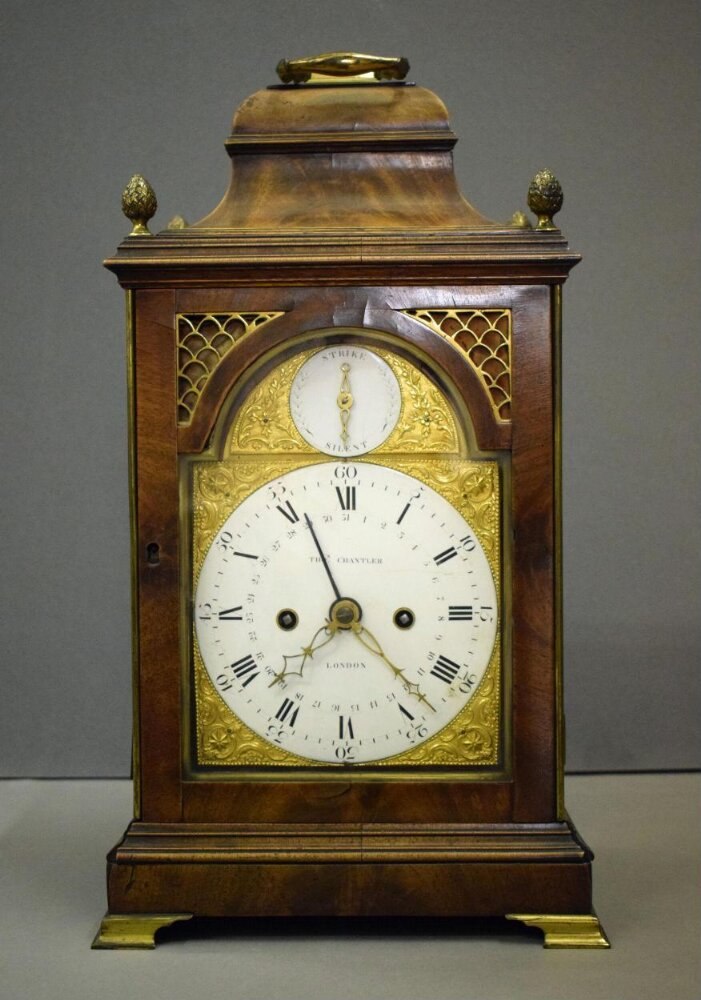
The clock is housed in a domed mahogany-veneered case that stands approximately 40.6 cm tall and 25.4 cm wide. The dial is white enamel and incorporates an indicator for days of the week alongside standard timekeeping functions. The movement is constructed with an anchor escapement and includes a striking mechanism on a single bell. Decorative elements include stamped gilt-brass spandrels, gilt-brass frets situated at the sides of the case, and pineapple-shaped finials at the corners. The clock is supported by bracket feet and is fitted with gilt-brass lifting handles for transport. The rear of the movement is protected by a glass back, with the backplate exhibiting an engraved design of the Prince of Wales's feathers framed by neoclassical scrolls.

Front view of the bracket clock showing the white enamel dial, gilt spandrels, and mahogany case.
Front view of the bracket clock showing the white enamel dial, gilt spandrels, and mahogany case. — Victoria and Albert Museum, London. Rights pending — permission not yet requested. Original source

Catalogue identity

Source
collections.vam.ac.uk
Category
Clock · Bracket clock
Maker / attribution
Thomas Chantler
Reference
Not recorded
Catalogue / lot identifier
W.19-1959
Source-reported date
1760-1770
Source-reported place
England

Source-reported attribution and specifications are not independent authentication. A listing does not establish present ownership, current display, availability or permission to reproduce.

Object description

Case and Aesthetic Details

The clock is encased in a domed mahogany veneer, reflecting the construction techniques associated with English clockmaking of the mid-18th century. The design incorporates multiple gilt-brass fixtures, including functional lifting handles for the clock's portability and decorative elements such as the pineapple finials situated at the corners.

The side profiles of the case are accented by gilt-brass frets, which provide visual detail to the mahogany structure. The dial is complemented by stamped gilt-brass spandrels surrounding the enamel face, integrating the metalwork with the mahogany casing.

Evidence for this section
  • “Domed case veneered with mahogany with giltbrass frets at sides, glass back.”
  • “Pineapple finials at corners, gilt-brass lifting handles and bracket feet.”

Movement and Dial Functionality

The clock includes a striking train that sounds on a single bell. The white enamel dial provides time information and includes a specific indicator for the days of the week, adding a calendar function to the primary timekeeping display.

An additional complication is present in the form of an arched top on the dial, which features a roundel acting as a strike or silence indicator. This allows the user to disengage the striking train as required. The internal technical components are further documented by an engraving on the backplate, which depicts the Prince of Wales's feathers surrounded by neoclassical scrolls.

Evidence for this section
  • “Spring movement with anchor escapement. Striking on one bell.”
  • “White enamel dial with indicator for days of the week. Arched top with white enamel roundel and indicator for striking or silence.”
  • “The backplate engraved in the centre with the Prince of Wales's feathers within neoclassical scrolls.”

Provenance and Documentation

The object was acquired by the Victoria and Albert Museum as a bequest from Miss M.T. Ready. It was formally accessioned into the collection under the number W.19-1959. The technical information provided in the institutional record is derived from a 1959 register, which serves as the primary source for the clock's physical characteristics and construction methods.

This identification is maintained alongside the geographical attribution to England, consistent with the identified manufacturing origin for this style of domestic horological instrument.

Evidence for this section
  • “Bequeathed by Miss M.T. Ready”
  • “Accession number: W.19-1959”
  • “The following description is transcribed from the original resiter of 1959”

Open research questions

  • Does the movement contain specific hallmarks or secondary signatures beyond the main signature?
  • Are there archival records verifying the specific production period of Thomas Chantler?

Source evidence

Recorded claims and source quotations for Bracket clock by Thomas Chantler
FieldSource-reported valueSource quotation
MakerThomas Chantler“movement by Thomas Chantler”
Date1760-1770“1760-1770”
MovementSpring-driven with anchor escapement“Spring movement with anchor escapement”
DecorationPrince of Wales's feathers engraving“The backplate engraved in the centre with the Prince of Wales's feathers within neoclassical scrolls.”
Accession NumberW.19-1959“W.19-1959”

Visible details

  • White enamel dial with Roman and Arabic numerals
  • Gilt-brass pineapple finials
  • Side panels with gilt-brass frets
  • Arch dial includes strike/silent indicator

Research qualifications

  • The specific date range 1760-1770 is a general attribution
  • The transcription of the 1959 register may contain archaic terminology

Photograph identity and source facts were screened before import; rights clearance remains pending.

Consulted source

Bracket clock, England, 1760-1770

Reviewed 2026-11-02 · Record c8f72a0c81

Terms in this record

Glossary explanations for terms named in this object’s record.