
Skip to content
The Encyclopedia of Horology

Clock · Bracket clock

Bracket Clock by Jeremie Gregory

Partially verified

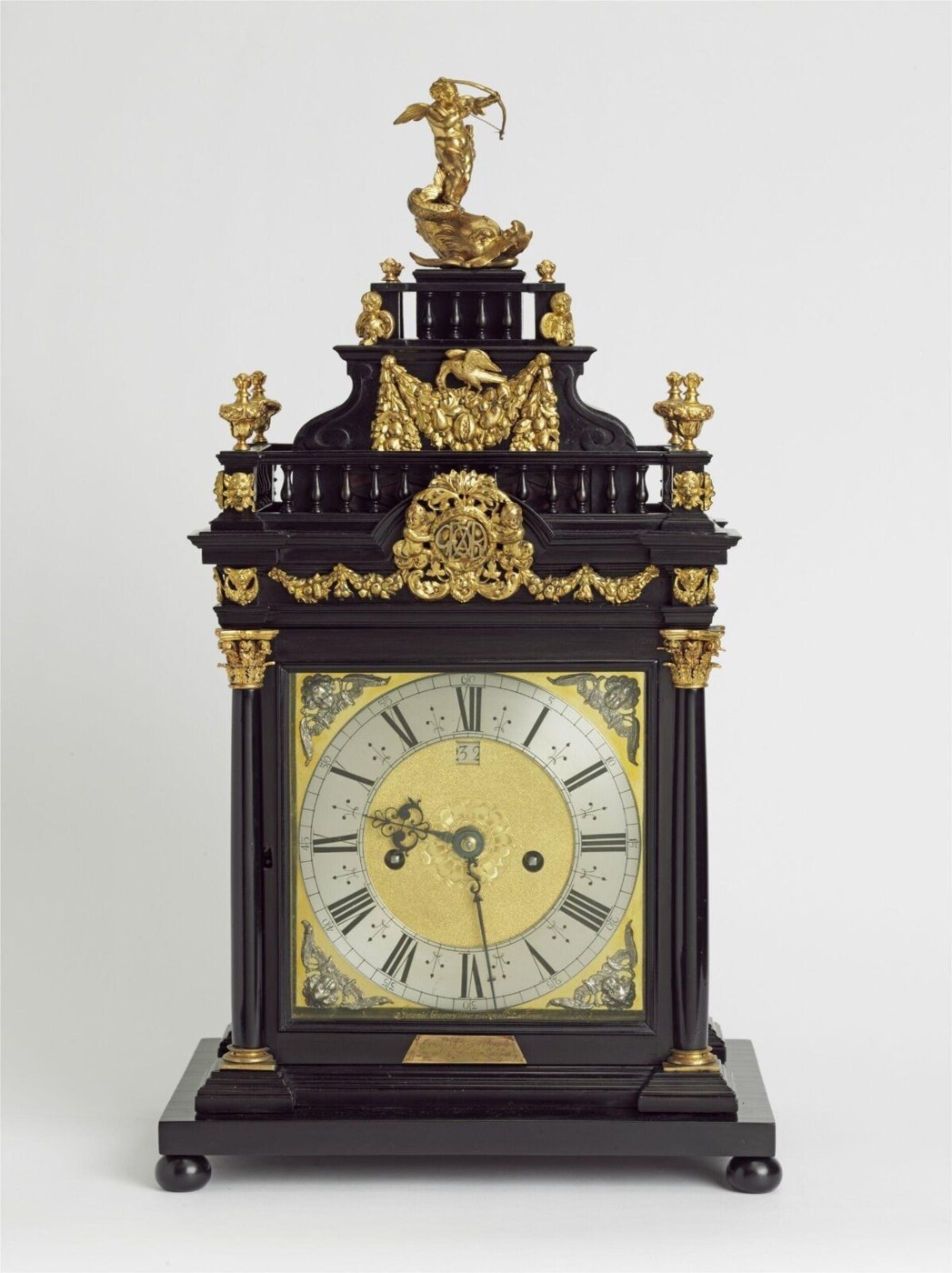
This bracket clock, attributed to London maker Jeremie Gregory circa 1685, features an oak carcass veneered in ebony and decorated with gilt-brass mounts. The case displays an architectural form with four Corinthian columns, standing on a rectangular plinth with ball feet. It is topped by a multi-tiered superstructure culminating in a cast figure of Cupid riding a dolphin. The silvered dial includes a central engraved rose and winged cherub spandrels. The movement is an 8-day striking type, originally with an anchor escapement that was later reconverted to a verge. Its current form reflects historical alterations and potential assembly from disparate components, commonly referred to as a 'marriage'.

Front view of the bracket clock, showing the ebony-veneered case, the silvered dial, and the gilt-bronze Cupid and dolphin figure.
Front view of the bracket clock, showing the ebony-veneered case, the silvered dial, and the gilt-bronze Cupid and dolphin figure. — Victoria and Albert Museum, London. Rights pending — permission not yet requested. Original source

Catalogue identity

Source
collections.vam.ac.uk
Category
Clock · Bracket clock
Maker / attribution
Jeremie Gregory
Reference
W.35-1976
Catalogue / lot identifier
W.35-1976
Source-reported date
c.1685
Source-reported place
London

Source-reported attribution and specifications are not independent authentication. A listing does not establish present ownership, current display, availability or permission to reproduce.

Object description

Case and Superstructure

The clock features an oak carcass veneered in ebony, supported by four ball feet. The exterior is architectural, defined by Corinthian columns with gilt-brass capitals at each corner. The upper section comprises four tiers of gilt-brass mounts, including swags of fruit and grotesque masks. The entire structure is topped by a cast-metal group depicting a blindfolded Cupid riding a dolphin.

The clock has undergone extensive alterations over time. Notable modifications include the addition of a modern turntable plinth and the replacement of various mounts, such as the Cupid’s bow and several decorative finials. Analysis suggests some mounts, particularly those on the side pedestals, were added later and are of varying quality compared to the original Corinthian capitals.

Evidence for this section
  • “The rectangular clock case, glazed on all four sides, is articulated by four Corinthian columns with gilt brass capitals and bases”
  • “The figure of cupid on a dolphin was made in two parts, soldered together at the feet and the dolphin's tail.”
  • “The plinth forming the turntable was a modern replacement copied from a contemporary example.”

Dial and Movement

The clock face consists of a silvered dial ring with an engraved rose at the center and winged cherub spandrels at the corners. It is signed by the maker near the bottom edge. Behind the face, the brass backplate displays detailed engraving of tulips emerging from a Neoclassical urn.

The 8-day striking movement originally utilized an anchor escapement but was converted to a verge. The dial plate appears to have been cut down, as the engraved signature is partially obscured, and the chapter ring sits close to the plate edges. These observations suggest the dial and movement may not have been original to the current case.

Evidence for this section
  • “The movement (a striking 8-day movement with a verge escapement), the bell, the chapter ring and calendar ring are all correct for the period.”
  • “the signature engraved along the bottom edge of the dial plate has been cut through its lower loops”

Historical Alterations and Attribution

Attributed to Jeremie Gregory, a goldsmith and clockmaker active in London, the clock bears his signature as being located 'Near ye royall Exchange'. While the case structure is considered 17th-century, the presence of a royal cypher relating to George I is noted as a later addition. The brass alloy of the nameplate, containing 20% zinc, is consistent with 19th-century standards rather than 17th-century practices.

These include the reconversion of the escapement and the replacement of several damaged elements.

Evidence for this section
  • “Analysis shows that the brass used for the name plate is 20% zinc to 80% copper, a ratio usually associated with 19th century brass”
  • “often extensively repaired and improved his clocks.”

Open research questions

  • What is the specific date of the later-added royal cipher?
  • Can the provenance of the individual components confirm if the dial and movement were once housed in a larger case?

Source evidence

Recorded claims and source quotations for Bracket Clock by Jeremie Gregory
FieldSource-reported valueSource quotation
MakerJeremie Gregory“Jeremie Gregory (worked 1652-1685)”
Datec.1685“about 1685”
Accession numberW.35-1976“W.35-1976”
MaterialsOak, ebony, gilt-brass, glass“Ebony veneer on an oak carcase, with gilt bronze and glass”
Movement8-day striking, verge escapement“a striking 8-day movement with a verge escapement”
SignatureJeremie Gregory Near The Royall Exchange“Jeremie Gregory Near The Royall Exchange”

Visible details

  • Gilt-brass royal cypher mounted above the clock dial
  • Ebony-veneered case with four Corinthian columns at corners
  • Engraved backplate featuring tulips and a Neoclassical urn
  • Cupid and dolphin figure atop the clock superstructure

Research qualifications

  • The royal cypher is considered a later addition of uncertain date
  • The clock may be a 'marriage' of components from different origins

Photograph identity and source facts were screened before import; rights clearance remains pending.

Consulted source

Clock, bracket, London, 1685

Reviewed 2026-11-02 · Record 5a72325085

Terms in this record

Glossary explanations for terms named in this object’s record.