
Skip to content
The Encyclopedia of Horology

Clock · Bracket clock

Bracket Clock by Francis Holland

Partially verified

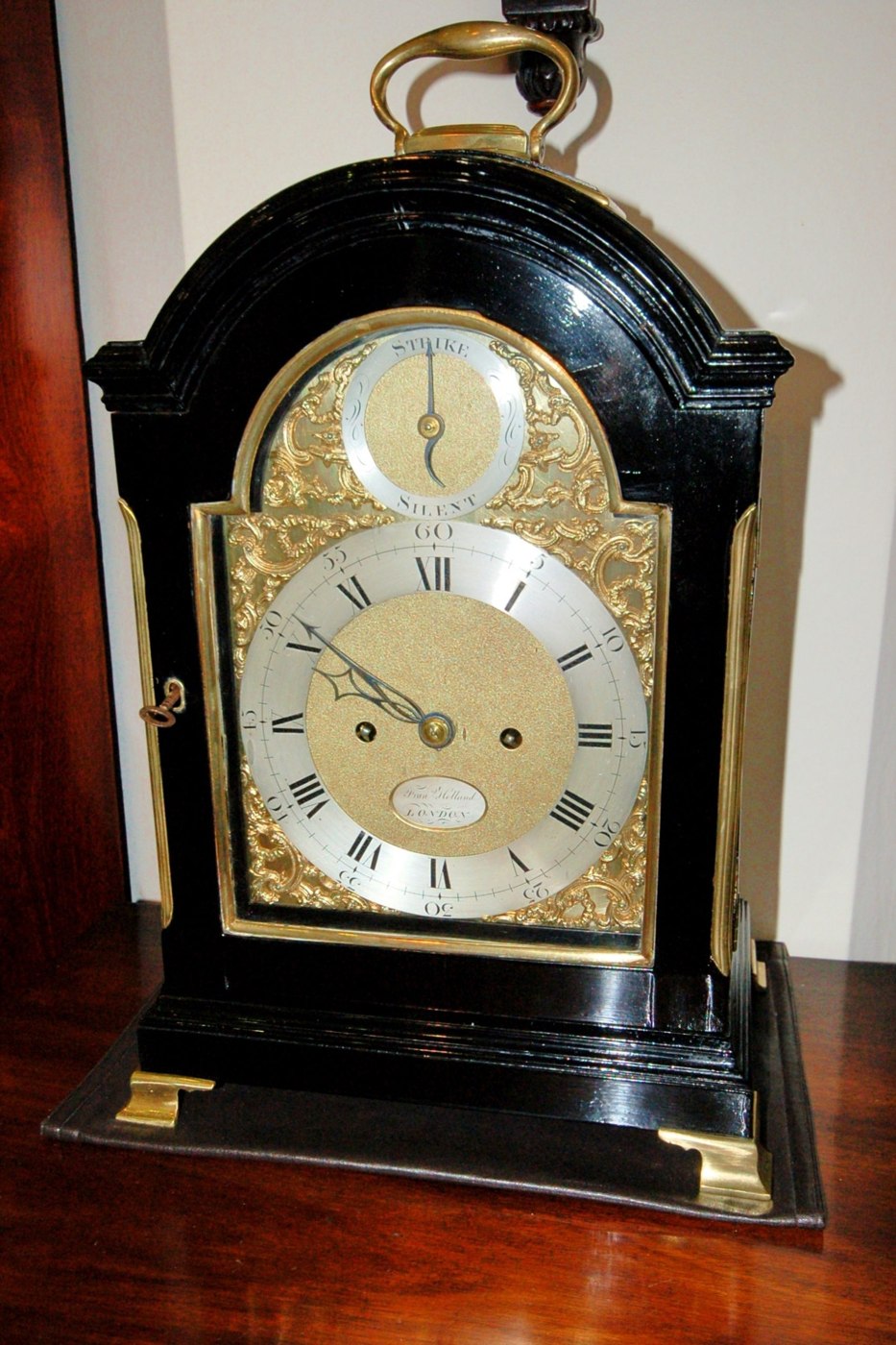
This antique bracket clock is attributed to the London-based maker Francis Holland, dating to the late eighteenth century, approximately 1795. The clock features a pad-top design with a black ebonized wooden case, accented by brass moldings on the corners and upper section. It is supported by four molded brass feet and includes a hinged brass carrying handle. The movement is a mechanical twin-fusee design, intended to provide uniform power transmission. The brass dial is arched, featuring cast spandrels, a matted center, and a silvered chapter ring with Roman numerals and Arabic minute markers. An arched aperture includes a strike/silent selector. The maker's name, Francis Holland, is engraved on a silvered oval plaque in the center of the dial. The rear plate of the movement is plain, incorporating a pendulum holdfast for secure transport. The strike mechanism operates against a bell mounted above the movement.

Front view of the Francis Holland bracket clock showing the arched dial, strike/silent indicator, and ebonized case.
Front view of the Francis Holland bracket clock showing the arched dial, strike/silent indicator, and ebonized case. — Pendulum of Mayfair. Rights pending — permission not yet requested. Original source

Catalogue identity

Source
zamanito.com
Category
Clock · Bracket clock
Maker / attribution
Francis Holland
Reference
Not recorded
Catalogue / lot identifier
Source URL identifies the listing
Source-reported date
circa 1795
Source-reported place
England

Source-reported attribution and specifications are not independent authentication. A listing does not establish present ownership, current display, availability or permission to reproduce.

Object description

Case Construction

The clock is housed in an ebonized wooden case characterized by its compact dimensions and a pad-top profile. The exterior is refined with brass decorative moldings along the roof and corners, providing contrast against the black finish. A brass carrying handle is mounted to the top of the case to facilitate movement.

The case includes glass side panels, which permit visual inspection of the internal components. The assembly rests upon four molded brass feet. The physical proportions are described as compact and proportionate, though specific measurements are not provided.

Evidence for this section
  • “بدنه چوبی آبنوس‌کاری‌شده به رنگ مشکی براق”
  • “جعبه ساعت با زه‌کشی‌های ظریف برنجی در بخش سقف و گوشه‌ها تزیین شده”
  • “پنجره‌های کناری شیشه‌ای این امکان را فراهم می‌کنند که ساختار داخلی و جزئیات موتور از طرفین قابل مشاهده باشد”

Dial and Indication

The dial is crafted from brass and features an arched upper section. The display is composed of a silvered chapter ring with Roman hour numerals and Arabic minute indicators, surrounding a matted center. Decorative cast spandrels surround the main chapter ring.

A silvered oval plaque centered on the dial bears the inscription of the maker, Francis Holland. In the arch, a subsidiary dial and hand indicate the strike/silent setting, allowing the user to manage the clock's auditory output.

Evidence for this section
  • “صفحه ساعت از برنج با قوس بالایی (قوس‌دار) ساخته شده”
  • “نام سازنده درون یک کتیبه بیضی‌شکل نقره‌اندود در مرکز صفحه حک شده است”
  • “در بخش بالایی قوس، عقربه و صفحه فرعی تنظیم وضعیت نواختن یا سکوت (Strike/Silent) قرار دارد”

Movement and Mechanism

The clock is powered by a mechanical twin-fusee movement, designed to maintain constant force to the gear train. The strike system engages a hammer against a metal bell situated at the top of the movement.

The rear of the movement features a plain, undecorated backplate. It includes a pendulum holdfast designed to secure the pendulum during transit. The auction description reports the clock as being in original condition, though it lacks documentation regarding its most recent service or operational precision.

Evidence for this section
  • “موتور ساعت از نوع مکانیکی کوکی با سازوکار فیوزی دوقلو (twin fusee)”
  • “صفحه پشتی موتور (backplate) به‌صورت ساده و بدون قلم‌زنی اجرا شده و مجهز به بست مهار پاندول (pendulum holdfast) برای جابه‌جایی ایمن است”
  • “سیستم زنگ ساعت با چکش بر روی زنگ کاسه‌ای فلزی در بالای موتور ضربه می‌”

Open research questions

  • What is the specific movement serial number, if present?
  • Are there any identifiable hallmarks on the brass components?

Source evidence

Recorded claims and source quotations for Bracket Clock by Francis Holland
FieldSource-reported valueSource quotation
MakerFrancis Holland“Francis Holland”
OriginLondon, England“London”
Datecirca 1795“حدود ۱۷۹۵”
Case materialEbonised wood“بدنه چوبی آبنوس‌کاری‌شده”
Dial typeArched brass“از برنج با قوس بالایی (قوس‌دار) ساخته شده”
Movement typeTwin fusee“موتور ساعت از نوع مکانیکی کوکی با سازوکار فیوزی دوقلو (twin fusee)”
SignaturesEngraved silvered oval plaque“نام سازنده درون یک کتیبه بیضی‌شکل نقره‌اندود در مرکز صفحه حک شده است”

Visible details

  • Strike/Silent selector located in the arch of the dial
  • Movement backplate features a pendulum holdfast
  • Case features side glass panels allowing view of the movement
  • Dial contains a silvered oval plaque with engraved signature

Research qualifications

  • Condition of fusee springs, chains, or lines remains unverified
  • Internal mounting integrity of the movement within the case has not been independently examined

Photograph identity and source facts were screened before import; rights clearance remains pending.

Consulted source

Antique Bracket Clock by Francis Holland-London C1795

Reviewed 2026-11-02 · Record 787ad7cc10

Terms in this record

Glossary explanations for terms named in this object’s record.