
Skip to content
The Encyclopedia of Horology

Tool · Augsburg astronomical compendium

Astronomical Compendium by Tobias Klieber

Partially verified

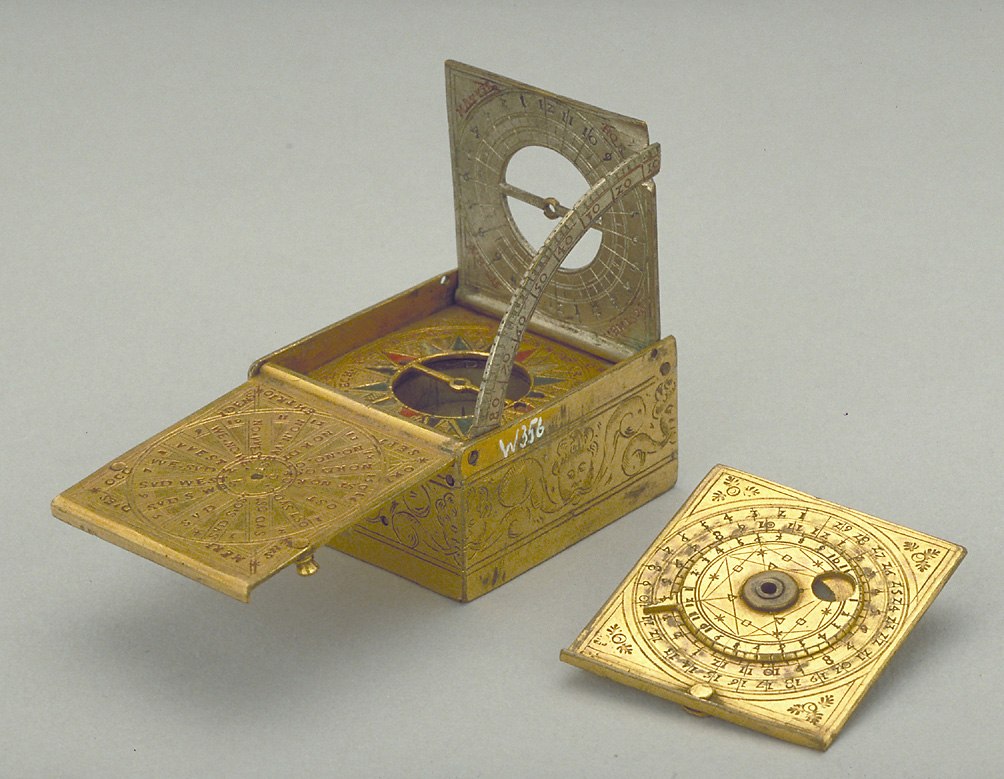
This 1595 astronomical compendium is signed by Tobias Klieber and manufactured in Augsburg. The instrument is constructed from gilt brass, measuring 41 x 46 x 24 mm. It features a main box with an engraved lid depicting a coat-of-arms. Inside, the device includes a universal equinoctial dial mounted on a silver plate, a compass with magnetic deviation, and a wind rose with 32 directions. The underside of the base contains a sliding gilt brass plate revealing a nocturnal and a lunar volvelle with an aspectarium. A separate silver plate hidden beneath the sliding leaf carries the maker’s signature and the date. The sides of the main box are decorated with engravings of blowing cherubs. The instrument functions as a multifaceted timekeeping and navigational tool, incorporating multiple horological and astronomical features within a compact, portable format.

Astronomical compendium by Tobias Klieber, 1595, showing the equinoctial dial and the underside of the sliding nocturnal plate.
Astronomical compendium by Tobias Klieber, 1595, showing the equinoctial dial and the underside of the sliding nocturnal plate. — British Museum, London. Rights pending — permission not yet requested. Original source

Catalogue identity

Source
www.mhs.ox.ac.uk
Category
Tool · Augsburg astronomical compendium
Maker / attribution
Tobias Klieber
Reference
MLA 1867, 7-5.24
Catalogue / lot identifier
MLA 1867, 7-5.24
Source-reported date
1595
Source-reported place
Augsburg

Source-reported attribution and specifications are not independent authentication. A listing does not establish present ownership, current display, availability or permission to reproduce.

Object description

Construction and Design

The astronomical compendium is housed in a gilt brass box measuring 41 x 46 x 24 mm. The lid exterior is engraved with a coat-of-arms featuring a shield, a band, two flowers, and a helmeted crest. The box sides are adorned with engravings of blowing cherubs.

The interior mechanisms include a silver plate for a universal equinoctial dial and a wind rose with 32 directions colored in red, blue, and green. A sliding gilt brass plate at the base incorporates a nocturnal and a lunar volvelle with an aspectarium on its outer surface.

Evidence for this section
  • “Gilt brass; 41 x 46 x 24 mm”
  • “All the four sides of the main box are engraved with blowing cherubs.”
  • “The brass plate underneath is engraved with a wind rose with 32 directions, the pointers coloured in red, blue and green”

Horological and Astronomical Features

The compendium integrates several distinct scientific functions. The equinoctial dial includes hour scales for morning and afternoon times, although the pin gnomon is currently missing. An internal compass provides directional orientation and magnetic deviation.

The nocturnal, located on the inside of the sliding brass plate, features an alidade and a silver revolving plate with cardinal directions and an hour scale. The lunar volvelle on the exterior of this plate tracks lunar days and hours.

Evidence for this section
  • “In the main box is a silver plate with a universal equinoctial dial”
  • “The nocturnal on the inner side of the sliding leaf has a folding handle.”
  • “On the outer side of the plate is a pierced lunar volvelle with aspectarium.”

Signature and Documentation

The maker's mark is located on a silver plate concealed beneath the sliding leaf on the underside of the box. The inscription identifies the maker as Tobias Klieber and states the date of manufacture as 1595.

The instrument is held by the British Museum and was donated by A.W. Franks in 1867. It is catalogued in F. A. B. Ward's 1981 work on European scientific instruments.

Evidence for this section
  • “Underneath the brass plate is a removable silver plate, inscribed with the signature 'THOBIAS KLIEBER AVGVSTV FACIEBAT AN:<NO> DOMINI 1595'”
  • “The instrument was presented by A.W. Franks in 1867”
  • “described in F. A. B. Ward, A Catalogue of European Scientific Instruments in the Department of Medieval and Later Antiquities of the British Museum (London, 1981), p.123, no.356.”

Open research questions

  • What is the identification of the coat-of-arms engraved on the lid?
  • Was the original compass intended to be permanently mounted or removable?

Source evidence

Recorded claims and source quotations for Astronomical Compendium by Tobias Klieber
FieldSource-reported valueSource quotation
MakerTobias Klieber“Signed by Tobias Klieber”
Date1595“Dated 1595”
Dimensions41 x 46 x 24 mm“41 x 46 x 24 mm”
Place of originAugsburg“Augsburg”
SignatureTHOBIAS KLIEBER AVGVSTV FACIEBAT AN:DOMINI 1595“THOBIAS KLIEBER AVGVSTV FACIEBAT AN:<NO> DOMINI 1595”
Inventory numberMLA 1867, 7-5.24“Registration no. MLA 1867, 7-5.24”

Visible details

  • Engravings of blowing cherubs on the box sides
  • Missing gnomon pin on the equinoctial dial
  • Nocturnal alidade appears fractured
  • Red, blue, and green coloration on the wind rose

Research qualifications

  • The compass is described as detached
  • The gnomon pin for the equinoctial dial is missing

Photograph identity and source facts were screened before import; rights clearance remains pending.

Consulted source

Astronomical Compendium

Reviewed 2026-10-26 · Record 799b079b0d

Terms in this record

Glossary explanations for terms named in this object’s record.