
Skip to content
The Encyclopedia of Horology

Tool · German astronomical compendium

Astronomical Compendium

Partially verified

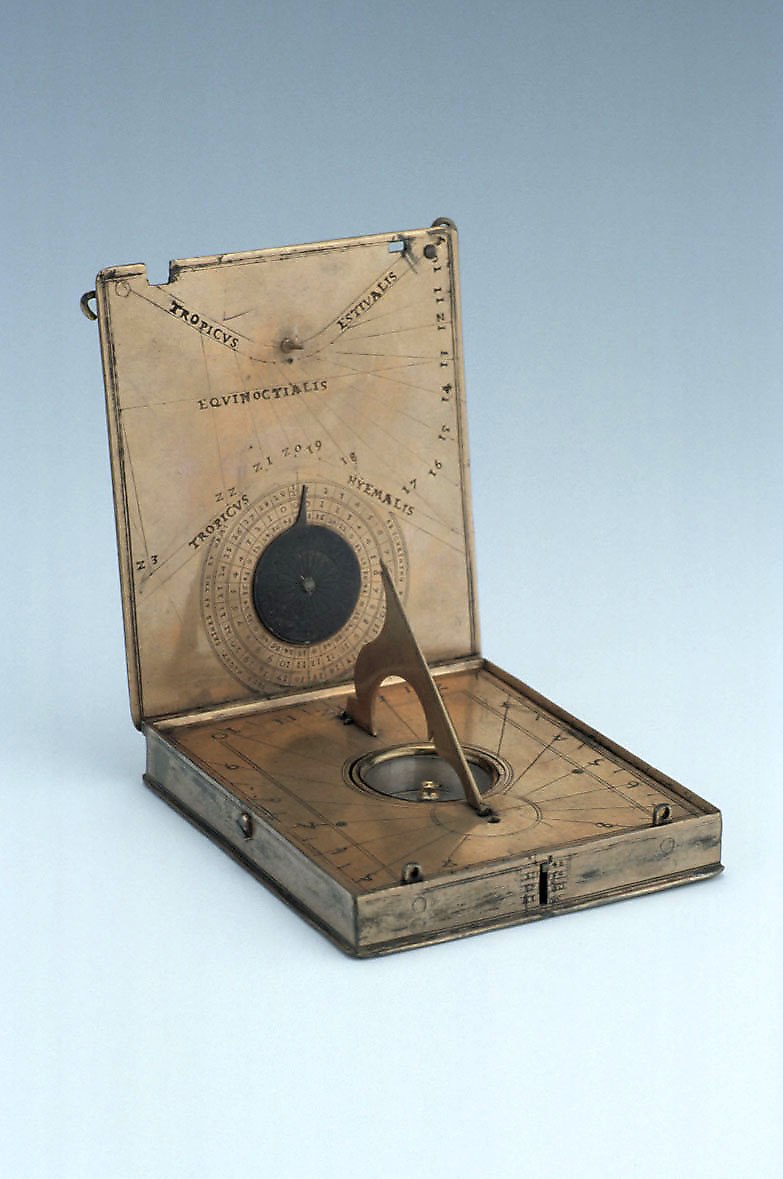
This unsigned astronomical compendium, dated to the late 16th century and of German origin, is constructed from gilt brass with dimensions of 76 x 67 x 11 mm. The object comprises a single cover plate and a main box, connected by hinges and secured by two clasps. It incorporates a horizontal pin-gnomon sundial for Italian hours, a lunar volvelle, and an inclining dial within the main box. An astronomical table detailing sunrise, sunset, and daylight duration for the entire year is divided between the front cover and back plate. The design is described as austere and undecorated. The device functions as a multi-purpose tool for timekeeping and astronomical calculation, utilizing an internal compass to orient the sundials correctly.

An open view of the gilt brass astronomical compendium, showing the internal sundial, compass, and lunar volvelle.
An open view of the gilt brass astronomical compendium, showing the internal sundial, compass, and lunar volvelle. — Museum of the History of Science, Oxford. Rights pending — permission not yet requested. Original source

Catalogue identity

Source
www.mhs.ox.ac.uk
Category
Tool · German astronomical compendium
Maker / attribution
Not established
Reference
Not recorded
Catalogue / lot identifier
42767
Source-reported date
Late 16th century
Source-reported place
Germany

Source-reported attribution and specifications are not independent authentication. A listing does not establish present ownership, current display, availability or permission to reproduce.

Object description

Construction and Exterior

The compendium is housed in a gilt brass case measuring 76 x 67 x 11 mm, consisting of a box and a single cover plate. The overall aesthetic is notably austere, featuring a lack of engraved decoration on its exterior surfaces. The cover is secured to the main box using two functional clasps.

External information is provided by an astronomical table distributed across the front cover and the back plate of the instrument. This table provides data for every second day of each month, detailing the times of sunrise and sunset, alongside the calculated lengths of both day and night. January through June are etched onto the front cover, with the remaining months occupying the back plate.

Evidence for this section
  • “Gilt brass; 76 x 67 x 11 mm”
  • “It is in unadorned style, with no engraved decoration.”
  • “The front cover and the back plate contain the two halves of a table”

Sundials and Timekeeping

The instrument distinguishes itself from standard diptych dials by utilizing two horizontal sundials. The reverse of the cover plate features a pin-gnomon sundial calibrated for Italian hours ranging from 10 to 23. This surface includes markings for the Tropic of Cancer, the equator, and the Tropic of Capricorn.

Inside the main box, the instrument features an inclining dial. The inclination of this dial is controlled by an index sliding within a graduated slot positioned on the forward outer edge of the box. The latitude scale allows for adjustments between 45 and 66 degrees, with divisions marked in increments of three degrees. A folding gnomon is provided, designed to be sprung into a perpendicular position for use.

Evidence for this section
  • “the two sundials of this compendium are both for horizontal use.”
  • “The compendium's main box carries an inclining dial”
  • “The slot's latitude scale of degrees runs 45 to 66, divided and numbered by 3.”

Lunar and Navigation Features

Positioned beneath the horizontal sundial on the cover is a circular lunar volvelle. It is inscribed with a title indicating its function in tracking the moon's phases. The outer scale represents the age of the moon from 1 to 29.5, while two interior rings indicate the moon's distance from the sun in hours and minutes. A pointer at 12 accompanies a radiating hour scale with half-hour graduations.

The main box houses a compass bowl situated beneath the folding gnomon. The base plate of this compass is silvered and features a cross marking the four cardinal points. These points are identified by the inscriptions 'SE', 'OR', 'ME', and 'OC'.

Evidence for this section
  • “Under the dial is a circular lunar volvelle”
  • “The compass bowl lies under the gnomon, with a silvered base plate cross-marked for the four cardinal points”

Open research questions

  • What specific regional German workshop or city was most associated with this particular style of austere, unsigned astronomical compendia in the late 16th century?
  • Do the variations in the lunar volvelle's hour-tracking mechanism correspond to specific known navigational or astrological requirements of the period?

Source evidence

Recorded claims and source quotations for Astronomical Compendium
FieldSource-reported valueSource quotation
MaterialGilt brass“Gilt brass”
Dimensions76 x 67 x 11 mm“76 x 67 x 11 mm”
OriginGerman“German”
DateLate 16th century“Late 16th century”
Compass directionsSE, OR, ME, OC“marked 'SE', 'OR', 'ME' and 'OC'”
Lunar volvelle titleBESCHEINVNG DES MONS EIN JEDE NACHT SEINES AB VND ZV NEM:“BESCHEINVNG DES MONS EIN JEDE NACHT SEINES AB VND ZV NEM:”
Latitude scale range45 to 66 degrees“45 to 66”
Sundial typeHorizontal pin-gnomon sundial“horizontal pin-gnomon sundial for Italian hours 10 to 23”

Visible details

  • Gilt brass construction with an austere, undecorated surface finish
  • Internal compass with a silvered base plate marked with cardinal directions
  • Lunar volvelle featuring a radiating hour scale and moon-age rings
  • Inclining dial with latitude adjustment on the box edge

Research qualifications

  • The instrument is unsigned, precluding identification of the specific maker
  • The exact place of manufacture is attributed to Germany based on historical provenance rather than an explicit maker's mark

Photograph identity and source facts were screened before import; rights clearance remains pending.

Consulted source

Astronomical Compendium

Reviewed 2026-10-26 · Record 63544d8a07

Terms in this record

Glossary explanations for terms named in this object’s record.