
Skip to content
The Encyclopedia of Horology

Tool · Arabic-inscribed astrolabe, Indian subcontinent

Astrolabe (Inventory 54063)

Partially verified

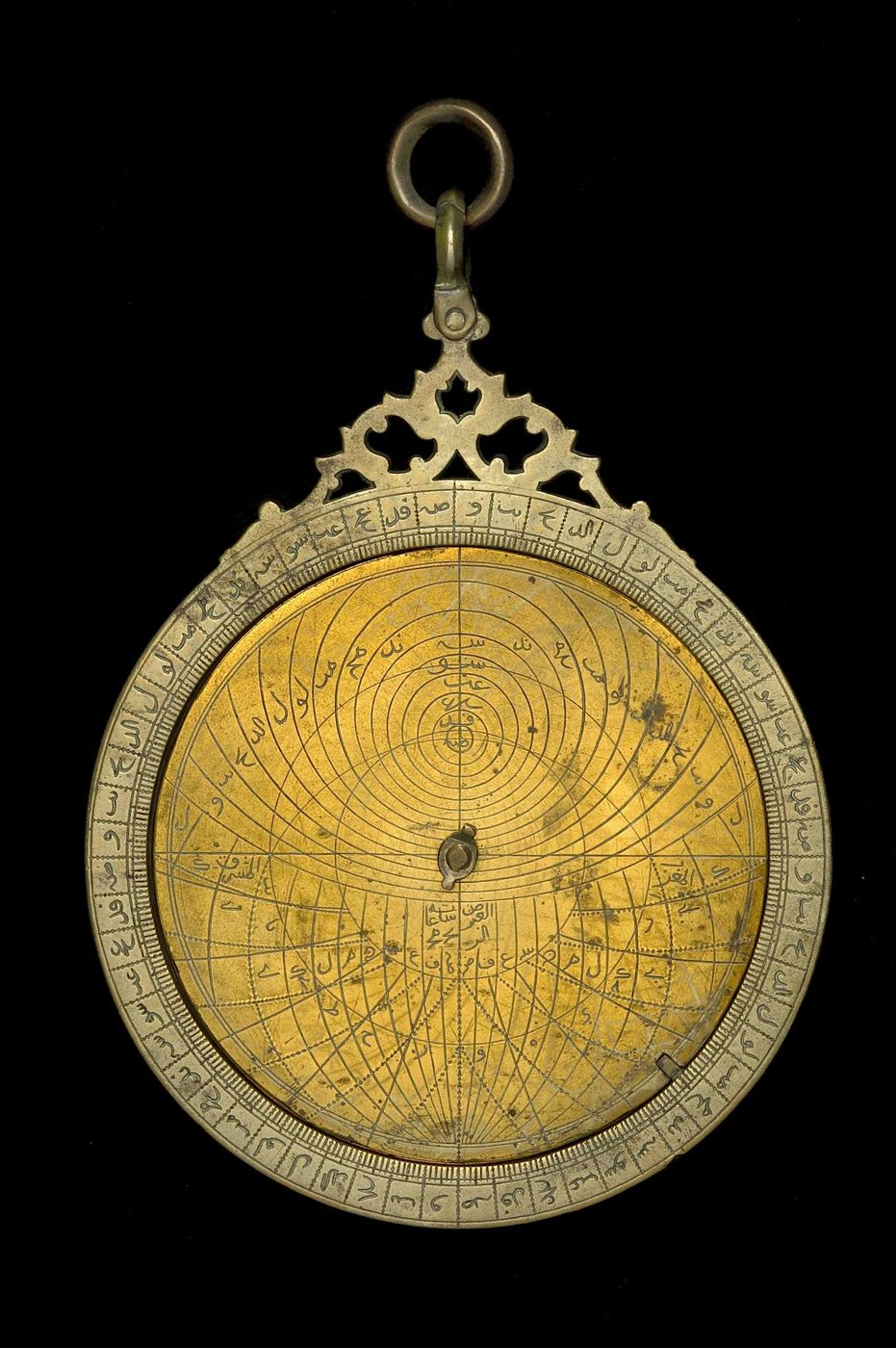
It features an Indo-Persian pierced throne with an integrated base and a trefoil-shaped shackle attached via a pivoting pin. The instrument consists of a one-piece mater and limb construction. The back is engraved with twelve distinct scales, including altitude, cotangent, shadow squares, sine/cosine, declination, prayer lines, lunar mansions, and zodiacal signs. It includes four internal plates with latitudes ranging from 27° to 66°. The womb contains a gazetteer documenting coordinates for 68 cities. The instrument was acquired by the History of Science Museum in Oxford through a 1957 gift from J. A. Billmeir, who had previously purchased it from the Henri Michel collection in Brussels.

Front view of the brass astrolabe showing the mater, limb degree scale, and pierced throne.
Front view of the brass astrolabe showing the mater, limb degree scale, and pierced throne. — History of Science Museum, University of Oxford. Rights pending — permission not yet requested. Original source

Catalogue identity

Source
www.mhs.ox.ac.uk
Category
Tool · Arabic-inscribed astrolabe, Indian subcontinent
Maker / attribution
Not established
Reference
Not recorded
Catalogue / lot identifier
54063
Source-reported date
ca. 1650
Source-reported place
India

Source-reported attribution and specifications are not independent authentication. A listing does not establish present ownership, current display, availability or permission to reproduce.

Object description

Construction and Design

The astrolabe is manufactured from brass and follows an Indo-Persian design tradition. The throne is a pierced, integrated component that terminates in a trefoil-shaped tab, which facilitates the attachment of the shackle via a pivoting pin. The mater and limb of the instrument are fashioned from a single piece of metal, a construction method that provides structural integrity to the main body.

The assembly accommodates four internal plates, which are held in place by a tab positioned 36 degrees from the throne, a notable departure from the conventional 180-degree placement found in many other astrolabe designs.

Evidence for this section
  • “The throne is of the indo-persian, pierced type made of brass attached with integrated base made of brass”
  • “The mater and limb are of one-piece construction.”
  • “The tab that holds the tympans in place is located 36° from the throne, rather than the more typical 180°.”

Astronomical Scales and Functions

The reverse side of the astrolabe is densely engraved with twelve specific astronomical and mathematical scales. These include altitude scales, cotangent scales measured in fingers and feet, and shadow squares. The upper quadrants also contain arcs for sine/cosine, declination, and prayer lines.

Centralized within the shadow squares are circular scales for zodiacal signs and lunar mansions. The instrument also functions as a terrestrial reference, featuring a womb-side gazetteer that lists coordinates for 68 distinct cities, including locations such as Baghdad, Delhi, and Samarkand, providing latitude, longitude, and other navigational parameters.

Evidence for this section
  • “The back contains 12 scales of the following types: Altitude; Cotangent; Shadow square; Sine/Cosine; Declination; Prayer lines; Lunar Mansions; Zodiacal signs.”
  • “The womb contains a gazetteer with coordinates for 68 cities”

Provenance and History

The instrument was accessioned by the History of Science Museum in Oxford under the number 1957-84/4. It was donated to the institution by J. A. Billmeir in 1957.

Records indicate that Billmeir acquired the object through the collection of Henri Michel of Brussels, a significant acquisition made by Billmeir around 1950.

Evidence for this section
  • “Presented by J. A. Billmeir in 1957”
  • “Billmeir acquired it with the collection of Henri Michel, of Brussels, which he purchased about 1950.”

Open research questions

  • What is the significance of the 36-degree placement of the tab in relation to the instrument's regional calibration?
  • Are the specific coordinates for the 68 cities consistent with a single geographical survey or compiled from multiple historical sources?

Source evidence

Recorded claims and source quotations for Astrolabe (Inventory 54063)
FieldSource-reported valueSource quotation
Inventory Number54063“Inventory number: 54063”
MaterialBrass“Material Brass”
Dateca. 1650“Date ca. 1650”
Place of ManufactureIndia“Place India”
AcquisitionPresented by J. A. Billmeir in 1957“Presented by J. A. Billmeir in 1957”
Throne TypeIndo-Persian pierced“The throne is of the indo-persian, pierced type”
Womb Gazetteer68 cities“The womb contains a gazetteer with coordinates for 68 cities”

Visible details

  • Throne features an Indo-Persian pierced design
  • Mater and limb are constructed as a single piece
  • Back incorporates both fingers and feet units on the shadow square
  • Gazetteer tab is positioned at 36 degrees from the throne

Research qualifications

  • Latitude range and specific scale subdivisions are verified by the source but internal plate condition is not documented
  • Attribution of origin to India and date circa 1650 are museum-supplied estimates

Photograph identity and source facts were screened before import; rights clearance remains pending.

Consulted source

Astrolabe, inventory 54063 (India, ca. 1650)

Reviewed 2026-10-26 · Record 913114099f

Terms in this record

Glossary explanations for terms named in this object’s record.