
Skip to content
The Encyclopedia of Horology

Tool · Arabic-inscribed astrolabe, Iran

Astrolabe by Muḥammad Mahdī

Partially verified

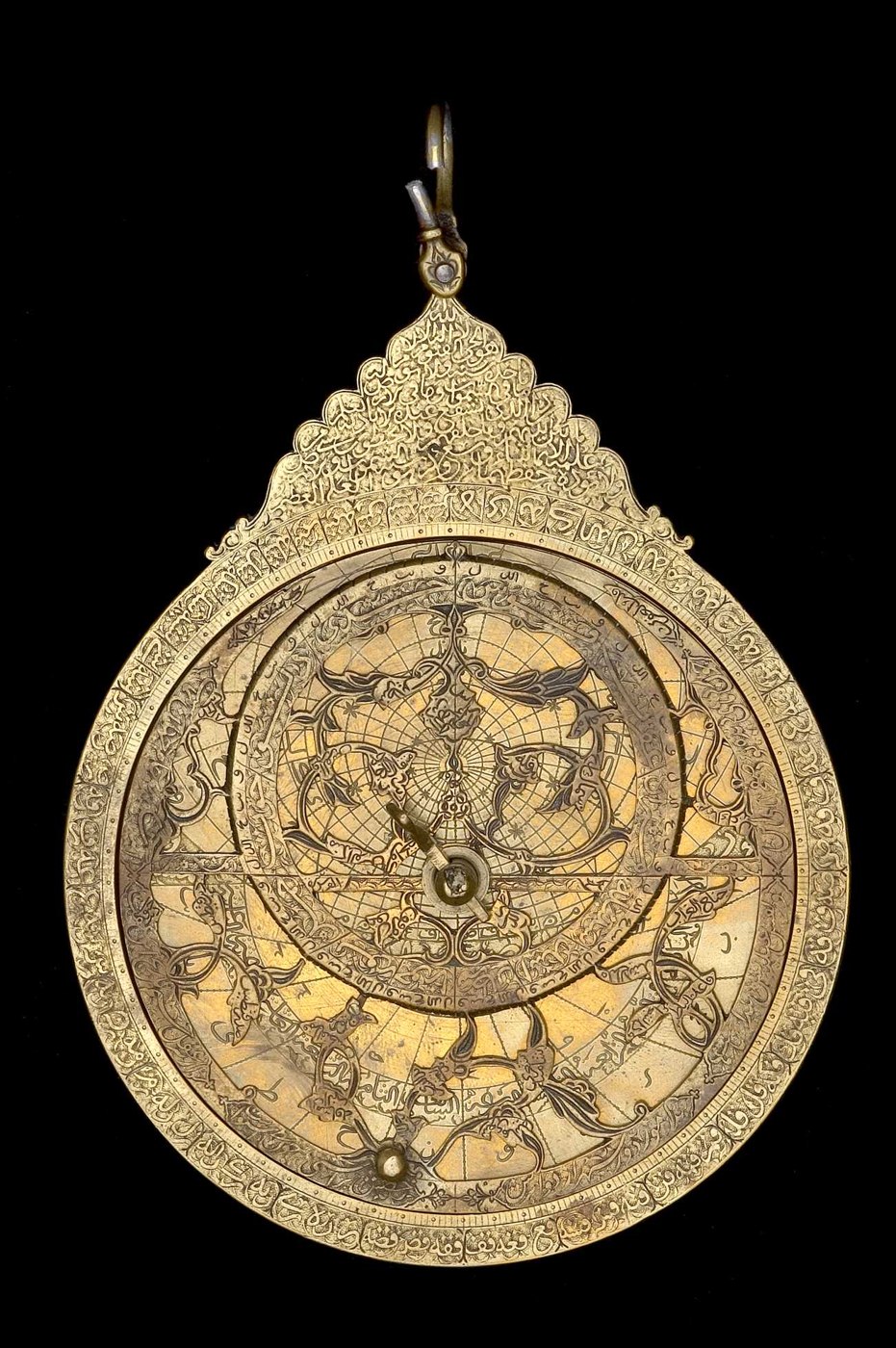
This Persian astrolabe, dating to approximately 1650 and signed by the maker Muḥammad Mahdī, is constructed primarily of brass. The instrument features an Indo-Persian style engraved throne, attached to the mater via an integrated base, with an associated copper ring and an omega-type shackle. The rete is of a foliate design, featuring thirty-four stars marked with foliate pointers. The mater includes a five-plate set with latitudes ranging from 22° to 45°. The back of the instrument is densely engraved with seventeen scales, including altitude, sine/cosine, and a shadow square. A gazetteer listing coordinates for forty-five cities is located in the womb. The instrument is further inscribed with a list of the twelve Shiite Imams around the limb and a Qur'anic verse on the front of the throne. It was presented to the History of Science Museum by J. A. Billmeir in 1957.

Front view of the astrolabe showing the rete, throne, and limb inscriptions.
Front view of the astrolabe showing the rete, throne, and limb inscriptions. — History of Science Museum, University of Oxford. Rights pending — permission not yet requested. Original source

Catalogue identity

Source
www.mhs.ox.ac.uk
Category
Tool · Arabic-inscribed astrolabe, Iran
Maker / attribution
Muḥammad Mahdī
Reference
41763
Catalogue / lot identifier
1957-84/5
Source-reported date
ca. 1650
Source-reported place
Persia

Source-reported attribution and specifications are not independent authentication. A listing does not establish present ownership, current display, availability or permission to reproduce.

Object description

Construction and Design

The astrolabe is a brass instrument of one-piece construction regarding its mater and limb. It incorporates an Indo-Persian type engraved throne with an integrated base, supporting a copper ring and an omega-shaped shackle, the latter of which is reported as broken. The rete, attached via a pin and horse mechanism featuring a small spacer and floral-patterned pin head, is designed in a foliate style.

Five plates are included, offering latitudes from 22° to 45°. A tab at the bottom of the mater serves to prevent tympan rotation. The back displays seventeen distinct scales, including complex arrangements for trigonometric functions, timekeeping, and astrological data such as lunar mansions and triplicities, all engraved within concentric arcs and boxes.

Evidence for this section
  • “The throne is of the indo-persian, engraved type made of brass attached with integrated base”
  • “The rete is of the foliate (single knob) type.”
  • “The mater and limb are of one-piece construction.”
  • “The back contains 17 scales of the following types”

Inscriptions and Data

The instrument is highly decorative and scholarly, featuring extensive textual inscriptions. The limb is adorned with a list of the twelve Shiite Imams, serving as a primary identifier of its cultural context. Furthermore, the front of the throne is inscribed with a Qur'anic quotation.

The womb contains a comprehensive gazetteer providing latitude, longitude, and directional data (inhiraf and jihat) for forty-five locations, ranging from Mecca and Medina to Samarqand and Agra. The rete includes thirty-four star pointers, each designated with names and specific astronomical coordinates including mediation and declination, confirming the instrument's functional intent for celestial observation.

Evidence for this section
  • “The front of the throne is filled with a Qur'anic quotation.”
  • “The womb contains a gazetteer with coordinates for 45 cities”

Provenance and Acquisition

The astrolabe was accessioned into the History of Science Museum, University of Oxford, in 1957. It was part of a larger gift presented by J. A. Billmeir.

The history of the object prior to its inclusion in the museum collection is linked to the collection of Henri Michel of Brussels, which was purchased by Billmeir around 1950. The object is catalogued under the inventory number 41763 and carries the accession number 1957-84/5.

Evidence for this section
  • “Presented by J. A. Billmeir in 1957”
  • “Billmeir acquired it with the collection of Henri Michel, of Brussels, which he purchased about 1950.”
  • “Accession 1957-84/5”

Open research questions

  • What is the specific significance of the families inscription on the limb beyond the list of Shiite Imams?
  • How does the presence of specific cities in the gazetteer compare to other known Persian astrolabes from the mid-17th century?

Source evidence

Recorded claims and source quotations for Astrolabe by Muḥammad Mahdī
FieldSource-reported valueSource quotation
MakerMuḥammad Mahdī“Maker Muḥammad Mahdī”
MaterialBrass“Material Brass”
Dateca. 1650“Date ca. 1650”
Inventory number41763“Inventory no. 41763”
ProvenancePresented by J. A. Billmeir in 1957“Presented by J. A. Billmeir in 1957”
Star count34“The rete contains 34 stars.”
City count45“The womb contains a gazetteer with coordinates for 45 cities”

Visible details

  • The shackle is broken.
  • The limb is inscribed with a list of the twelve Shiite Imams.
  • The instrument includes a gazetteer for 45 cities.

Research qualifications

  • The exact identification of the families mentioned in the limb inscription is uncertain as indicated by a question mark in the source.
  • The completeness of the original set of components is not explicitly stated beyond the mention of five plates.

Photograph identity and source facts were screened before import; rights clearance remains pending.

Consulted source

Astrolabe, inventory 41763 (Persia, ca. 1650)

Reviewed 2026-10-26 · Record f679f39774

Terms in this record

Glossary explanations for terms named in this object’s record.