
Skip to content
The Encyclopedia of Horology

Tool · Arabic-inscribed astrolabe, Iberia

Astrolabe by Ibrāhīm ibn Saʿīd as-Sahlī

Partially verified

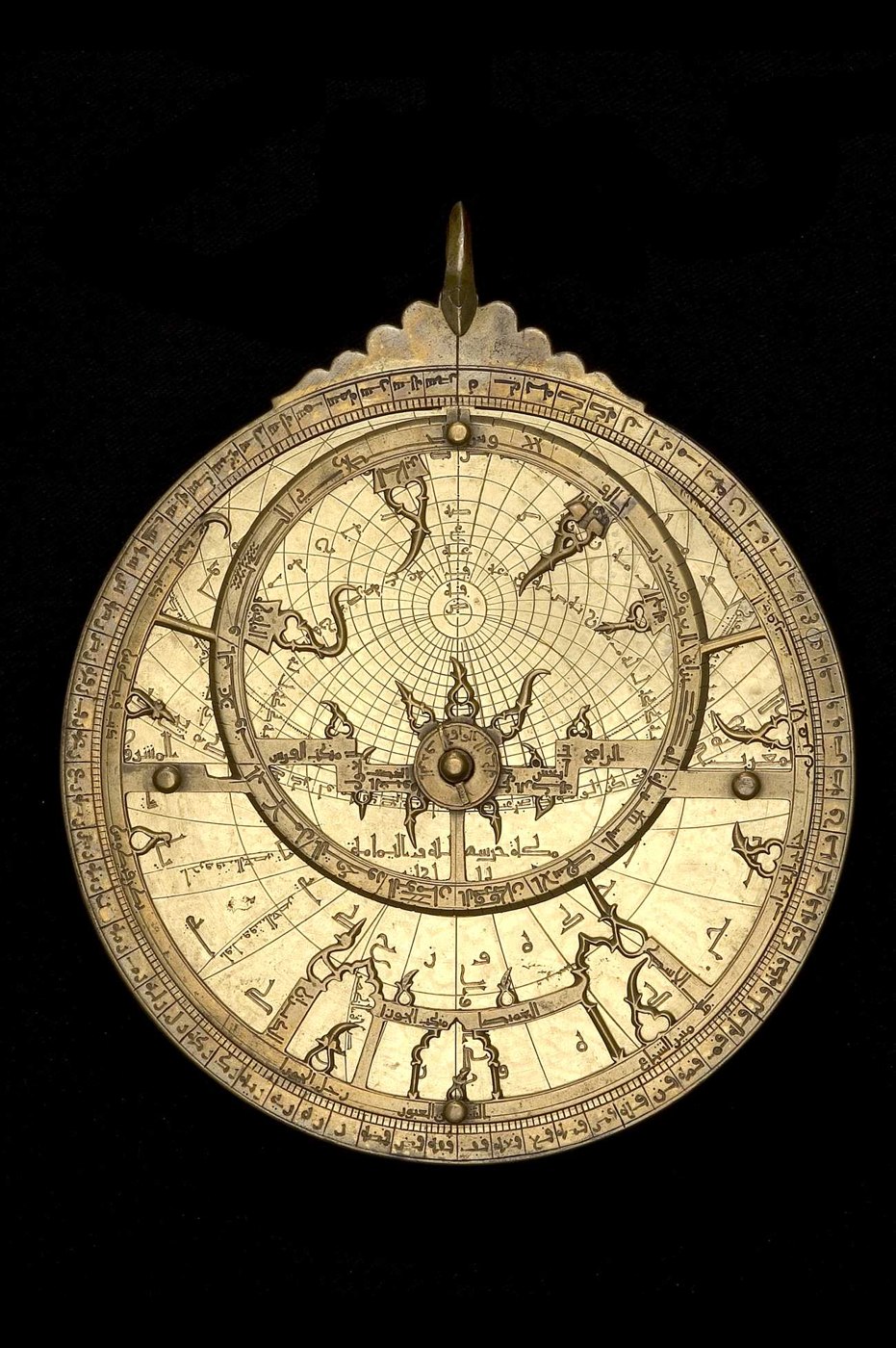
This brass astrolabe, designated inventory number 55331, was crafted by Ibrāhīm ibn Saʿīd as-Sahlī in Toledo in 1068 (A.H. 460). The instrument features a one-piece mater and limb construction with a nine-lobed, simple-type throne and an omega-shaped shackle. The back of the device includes six distinct scales, covering degrees, zodiacal signs, a calendar, a solar cycle, and a shadow square. The rete displays influences of Moorish-arch design, with trefoil-shaped bases for its star pointers, including a bird-profile pointer for Aldebaran. The instrument is accompanied by six plates with latitudes ranging from 21° to 49° and a double-ended, counter-changed alidade. It was presented to the museum by Lewis Evans in 1924, having been acquired from a Milanese dealer in 1899.

The front of the brass astrolabe (inventory 55331) showing the rete, pin, and underlying plate.
The front of the brass astrolabe (inventory 55331) showing the rete, pin, and underlying plate. — History of Science Museum, University of Oxford. Rights pending — permission not yet requested. Original source

Catalogue identity

Source
www.mhs.ox.ac.uk
Category
Tool · Arabic-inscribed astrolabe, Iberia
Maker / attribution
Ibrāhīm ibn Saʿīd as-Sahlī
Reference
Not recorded
Catalogue / lot identifier
55331
Source-reported date
1068 (A.H. 460)
Source-reported place
Toledo

Source-reported attribution and specifications are not independent authentication. A listing does not establish present ownership, current display, availability or permission to reproduce.

Object description

Construction and Design

The astrolabe is constructed of brass and features a one-piece mater and limb. Unusually, the limb is formed by a thin metal plate cut to fit precisely between the mater ring and the throne. The throne itself is a simple type integrated with the base and characterized by a broad shape featuring nine lobes, to which an omega-shaped shackle is attached.

The rete follows an indicator-line style showing Moorish-arch design influences. Most star pointers are set on bases resembling trefoils. The instrument includes six plates for varying latitudes and a double-ended, counter-changed alidade. One sighting vane on the alidade is currently reported as loose.

Evidence for this section
  • “The mater and limb are of one-piece construction”
  • “This broad, undecorated throne has nine lobes”
  • “The rete is of the indicator-line (simple) type. This rete shows much influence from the Moorish-arch design.”

Scales and Inscriptions

The back of the astrolabe is densely engraved with six scales: degrees, zodiacal signs, a calendar, a solar cycle, and a shadow square. The zodiacal scale integrates the names of months in both Arabic transliteration and Latin. The instrument includes a specific maker's signature inscribed on the back, confirming the location and date of manufacture as Toledo in 1068.

The womb contains inscriptions related to various locations including Qolzum, Madyan, and Kabul, alongside latitude and hour data. The meridian line on the front is engraved in Kufic script.

Evidence for this section
  • “The back contains 6 scales of the following types: Degree; Zodiacal signs; Calendar; Solar cycle; Shadow square.”
  • “The work of Ibrāhīm ibn Saʿīd as-Sahlī in the city of Toledo in Shawwāl in A.H. 460.”
  • “It is appropriate that the zodiacal calendar on the back of this astrolabe has the names of the Christian months both in Arabic transliteration and in Latin.”

Provenance and History

This astrolabe was presented to the History of Science Museum, University of Oxford, in 1924 by collector Lewis Evans. Documentary records indicate that Evans originally purchased the piece in 1899 from a Milanese dealer named Cantoni. It is recognized within the collection as the earliest astrolabe manufactured in Europe.

The instrument has undergone minor repairs, including the addition of four rotational knobs to the rete and the stabilization of one star pointer, which resulted in the loss of its original label.

Evidence for this section
  • “Presented by Lewis Evans in 1924”
  • “Evans bought it from Cantoni, a dealer of Milan, in 1899.”
  • “This makes this astrolabe the earliest in the collection to have been made in Europe.”

Open research questions

  • The original name of the star pointer identified as 'Al-Hawa' prior to repair
  • The specific function and original intended use of the four rotational knobs added to the rete post-engraving

Source evidence

Recorded claims and source quotations for Astrolabe by Ibrāhīm ibn Saʿīd as-Sahlī
FieldSource-reported valueSource quotation
MakerIbrāhīm ibn Saʿīd as-Sahlī“The work of Ibrāhīm ibn Saʿīd as-Sahlī in the city of Toledo in Shawwāl in A.H. 460.”
Date1068 (A.H. 460)“made ‘in the city of Toledo in Shawwal in the year 460 of the Hijra’”
MaterialBrass“Material Brass”
ProvenanceLewis Evans“Presented by Lewis Evans in 1924”
Dealer provenanceCantoni“Evans bought it from Cantoni, a dealer of Milan, in 1899.”
Inventory number55331“Inventory number: 55331”
Plate latitudes21°0' to 49°0'“latitudes ranging from 21°0' to 49°0'”
Throne styleNine lobes“This broad, undecorated throne has nine lobes.”

Visible details

  • Nine-lobed throne design
  • Zoomorphic star pointer for Aldebaran
  • Double-ended counter-changed alidade
  • Six circular scales on the back plate

Research qualifications

  • The repair of the star pointer for the star labelled 'Al-Hawa' has obscured its original name
  • One of the alidade sighting vanes is currently loose

Photograph identity and source facts were screened before import; rights clearance remains pending.

Consulted source

Astrolabe, inventory 55331 (Toledo, 1068 (A.H. 460))

Reviewed 2026-10-26 · Record 6a9cd1fbb3

Terms in this record

Glossary explanations for terms named in this object’s record.