
Skip to content
The Encyclopedia of Horology

Tool · Arabic-inscribed astrolabe, Iberia

Astrolabe by Muḥammad ibn Fattūḥ al-Khamā’irī

Partially verified

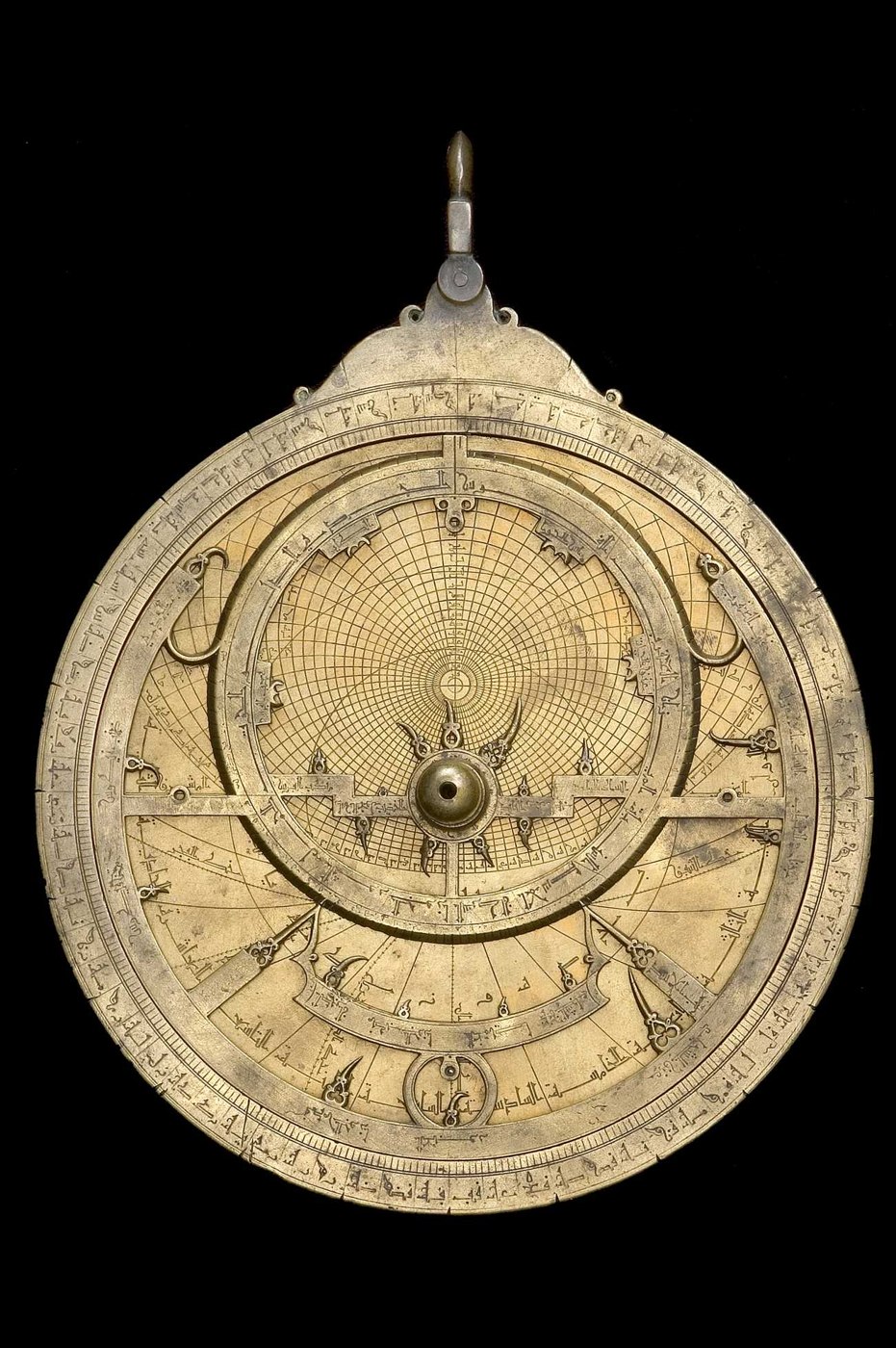
This 1221/2 astrolabe, crafted from brass in Seville by Muḥammad ibn Fattūḥ al-Khamā’irī, is held in the History of Science Museum collection at the University of Oxford. The mater and limb are constructed of two soldered pieces, with the limb featuring a degree scale. It is secured by a nut and bolt. The back of the astrolabe is engraved with seven distinct scales, including altitude, zodiacal, calendar, and shadow square functions. Four plates accompany the instrument, covering latitudes from 30° to 40°. Provenance records indicate that Lewis Evans purchased the piece in Paris from the dealer Vitali in 1910 before presenting it to the museum in 1924.

Front view of the astrolabe showing the rete, star pointers, and ecliptic scale.
Front view of the astrolabe showing the rete, star pointers, and ecliptic scale. — History of Science Museum, University of Oxford. Rights pending — permission not yet requested. Original source

Catalogue identity

Source
www.mhs.ox.ac.uk
Category
Tool · Arabic-inscribed astrolabe, Iberia
Maker / attribution
Muḥammad ibn Fattūḥ al-Khamā’irī
Reference
Not recorded
Catalogue / lot identifier
44141
Source-reported date
1221/2
Source-reported place
Seville

Source-reported attribution and specifications are not independent authentication. A listing does not establish present ownership, current display, availability or permission to reproduce.

Object description

Structural Design and Components

The astrolabe is constructed from brass and features a moorish arch-type throne fitted with an integrated base. A characteristic omega-shaped shackle is attached at the top to facilitate suspension. The main body consists of a mater and limb assembly, which is made from two separate pieces joined by solder.

The rete is an indicator-line type containing 29 stars, marked with hook-shaped pointers that originate from trefoil or bulbous bases. The central assembly is secured using a nut and bolt, allowing for the rotation of the rete over the set of four included plates, which are calibrated for latitudes ranging from 30° to 40°.

The back of the instrument is densely engraved with seven different scales. These include altitude markings in the upper quadrants, concentric scales for zodiacal signs, the calendar, and a perpetual calendar, as well as a shadow square and cotangent scales located in the lower sections.

Evidence for this section
  • “The throne is of the moorish arch type made of brass attached with integrated base made of brass and omega type shackle made of brass”
  • “The rete contains 29 stars.”
  • “The back contains 7 scales of the following types: Altitude; Zodiacal signs; Calendar; Perpetual calendar; Shadow square; Cotangent.”

Signatures and Inscriptions

The astrolabe is attributed to the maker Muḥammad ibn Fattūḥ al-Khamā’irī. Inscriptions are present on the instrument, specifically on the back of the throne, where the maker's name is recorded.

The rete includes labels for the twelve zodiacal signs in Arabic. These labels are inscribed along the ecliptic band, detailing the progression from Aries (al-Ḥamal) through to Pisces (al-Ḥūt). Additional numerical markings appear on the limb and back scales to support astronomical calculations.

Evidence for this section
  • “Maker Muḥammad ibn Fattūḥ al-Khamā’irī”
  • “The back of the throne bears the maker's inscription.”
  • “The zodiac on the rete is labelled: الحمل , الثور , الجوزا , السرطان , الاسد , السنبله , الميزان , العقرب , القوس , الجدي , الدلو , الحوت.”

Provenance and Accession

The instrument was accessioned into the History of Science Museum collection under the number 1924-0/2007, following its presentation by Lewis Evans in 1924. Documentary evidence associated with the collection indicates that Evans acquired the piece while in Paris in 1910.

The purchase was facilitated by a dealer named Vitali, who was based in Algeria at the time of the transaction.

Evidence for this section
  • “Presented by Lewis Evans in 1924”
  • “Evans records that he bought it in Paris through Vitali (a dealer based in Algeria) in 1910.”

Open research questions

  • What is the specific astronomical function of the 'Increment of fortune' scale located on the womb?
  • Are there visible remnants of repair or re-soldering on the mater or limb given the two-piece construction?

Source evidence

Recorded claims and source quotations for Astrolabe by Muḥammad ibn Fattūḥ al-Khamā’irī
FieldSource-reported valueSource quotation
MakerMuḥammad ibn Fattūḥ al-Khamā’irī“Muḥammad ibn Fattūḥ al-Khamā’irī”
Place of manufactureSeville“Seville”
Date1221/2“1221/2”
Inventory number44141“Inventory no. 44141”
Throne styleMoorish arch“The throne is of the moorish arch type”
Star count29“The rete contains 29 stars.”
ProvenancePurchased by Lewis Evans in 1910 via the dealer Vitali“Evans records that he bought it in Paris through Vitali (a dealer based in Algeria) in 1910.”

Visible details

  • Omega-type shackle at the top of the throne
  • Rete features 29 stars with hook pointers
  • Shadow square present on the back of the instrument
  • Nut and bolt central attachment mechanism

Research qualifications

  • Cotangent scale numerals are noted as too worn to read
  • Several star pointers are noted as damaged

Photograph identity and source facts were screened before import; rights clearance remains pending.

Consulted source

Astrolabe, inventory 44141 (Seville, 1221/2)

Reviewed 2026-10-26 · Record e2f5e447cc

Terms in this record

Glossary explanations for terms named in this object’s record.