
Skip to content
The Encyclopedia of Horology

Tool · Latin-inscribed astrolabe

Astrolabe

Partially verified

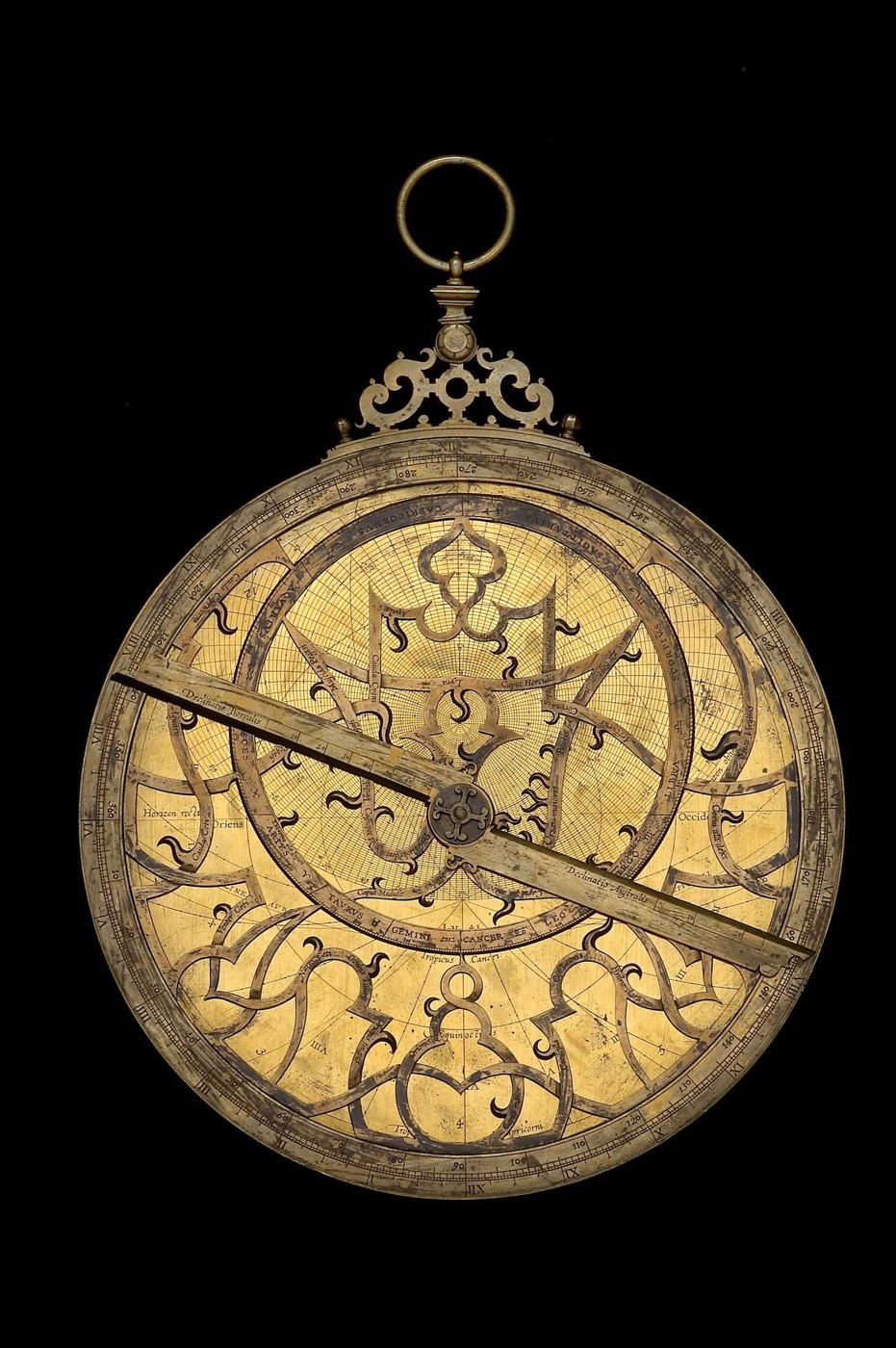
This late 16th-century brass astrolabe (inventory number 45365) from Flanders features a pierced throne with c-shaped scroll work and is secured with a simple, round cross-section ring and square, ornate shackle. The instrument consists of a two-piece, riveted mater and limb construction, containing three plates with latitudes ranging from 42° to 48°. The back displays seven distinct scales including degree, zodiacal signs, calendar, unequal hours, equal hours, and two shadow squares. The arsenius-type rete incorporates design elements attributed to both Mercator and Arsenius, marked with 48 stars identified by flamant pointers. The instrument includes a double-ended, counter-changed rule and alidade. A nut shaped as a Maltese cross secures the rete and plates, with the bolt integrated into the alidade. The object was purchased in 1952 from H. E. Backer and is held in the History of Science Museum, Oxford.

Full view of the astrolabe showing the rete, rule, and alidade.
Full view of the astrolabe showing the rete, rule, and alidade. — History of Science Museum, University of Oxford. Rights pending — permission not yet requested. Original source

Catalogue identity

Source
www.mhs.ox.ac.uk
Category
Tool · Latin-inscribed astrolabe
Maker / attribution
Not established
Reference
Not recorded
Catalogue / lot identifier
45365
Source-reported date
late 16th century
Source-reported place
Flanders
Source-reported serial
45365

Source-reported attribution and specifications are not independent authentication. A listing does not establish present ownership, current display, availability or permission to reproduce.

Object description

Construction and Design

The astrolabe is constructed primarily of brass and features a pierced throne designed with c-shaped scroll work. The support is attached via a screwed base. The ring is a plain, round cross-section rod, while the shackle is a square, ornate box-style component. The mater and limb are joined through a two-piece riveted construction.

The rete is of the arsenius type, incorporating design characteristics associated with both Mercator and Arsenius. It contains 48 stars, all indicated by flamant-style pointers. The zodiacal labels on the rete cover the standard twelve signs from Aries to Pisces. A bolt integrated into the alidade passes through the center to secure the rete and plates, and it is tightened with a nut shaped like a Maltese cross.

Evidence for this section
  • “The throne is of the pierced type with c-shaped scroll work support(s)”
  • “The rete is of the arsenius type. This rete combines design characteristics of both Mercator's retes and Arsenius's retes.”
  • “The rete is attached using a nut & bolt. The nut is in the shape of a Maltese Cross.”

Scales and Instrumentation

The back of the instrument contains seven functional scales: degrees, zodiacal signs, calendar dates, unequal hours, equal hours, and two shadow squares. The womb contains an ornate Quadratum nauticum with a full windrose. The plates are supplied in a set of three, covering latitudes from 42° to 48°.

The rule and the alidade are double-ended and counter-changed. The rule features declination scales on both arms, while the alidade is rigid and contains double sights for observation. The scales on the limb include a degree scale from 0 to 360 and a scale for equal hours.

Evidence for this section
  • “The back contains 7 scales of the following types: Degree; Zodiacal signs; Calendar; Unequal hours; Equal hours; Shadow square.”
  • “There are 3 plates with latitudes ranging from 42°0' to 48°0' .”
  • “Alidade Double-ended, counter-changed. The bolt that secures the rete and the plates is integrated into the alidade.”

Provenance and History

The instrument was acquired by the History of Science Museum, University of Oxford, in 1952. It was purchased from H. E. Backer, a London dealer who had offered a collection for sale that originally belonged to an unidentified collector in Rome.

The astrolabe's recorded history notes it formerly belonged to the Guinigi family of Lucca, Italy. The cataloguing identifies the object's origin as Flanders in the late 16th century, though no specific workshop or maker is identified.

Evidence for this section
  • “Purchased from H. E. Backer in 1952”
  • “The collection had been formed in {?}recent times by a collector in Rome. The astrolabe formerly belonged to the Guinigi family, of Lucca, Italy.”
  • “Place Flanders”

Open research questions

  • Could the specific design characteristics attributed to Mercator and Arsenius confirm a link to a known school or workshop?
  • Is there further historical documentation to verify the connection to the Guinigi family?

Source evidence

Recorded claims and source quotations for Astrolabe
FieldSource-reported valueSource quotation
Inventory number45365“Inventory number: 45365”
Place of originFlanders“Place Flanders”
Datelate 16th century“Date late 16th century”
AcquisitionPurchased from H. E. Backer in 1952“Purchased from H. E. Backer in 1952”
Throne stylePierced type with c-shaped scroll work“The throne is of the pierced type with c-shaped scroll work support(s)”
Rete typeArsenius type“The rete is of the arsenius type.”
Former ownerGuinigi family“The astrolabe formerly belonged to the Guinigi family, of Lucca, Italy.”

Visible details

  • Nut in the shape of a Maltese Cross
  • Pierced throne with c-shaped scroll work
  • Flamant star pointers on the rete
  • Square, ornate shackle

Research qualifications

  • Maker is not documented
  • Specific attribution to the Guinigi family is a provenance claim

Photograph identity and source facts were screened before import; rights clearance remains pending.

Consulted source

Astrolabe, inventory 45365 (Flanders, late 16th century)

Reviewed 2026-10-26 · Record 6dca6431fa

Terms in this record

Glossary explanations for terms named in this object’s record.