
Skip to content
The Encyclopedia of Horology

Pocket watch · Prototype pocket watch

American Watch Company Prototype Pocket Watch by Oliver B. Marsh

Partially verified

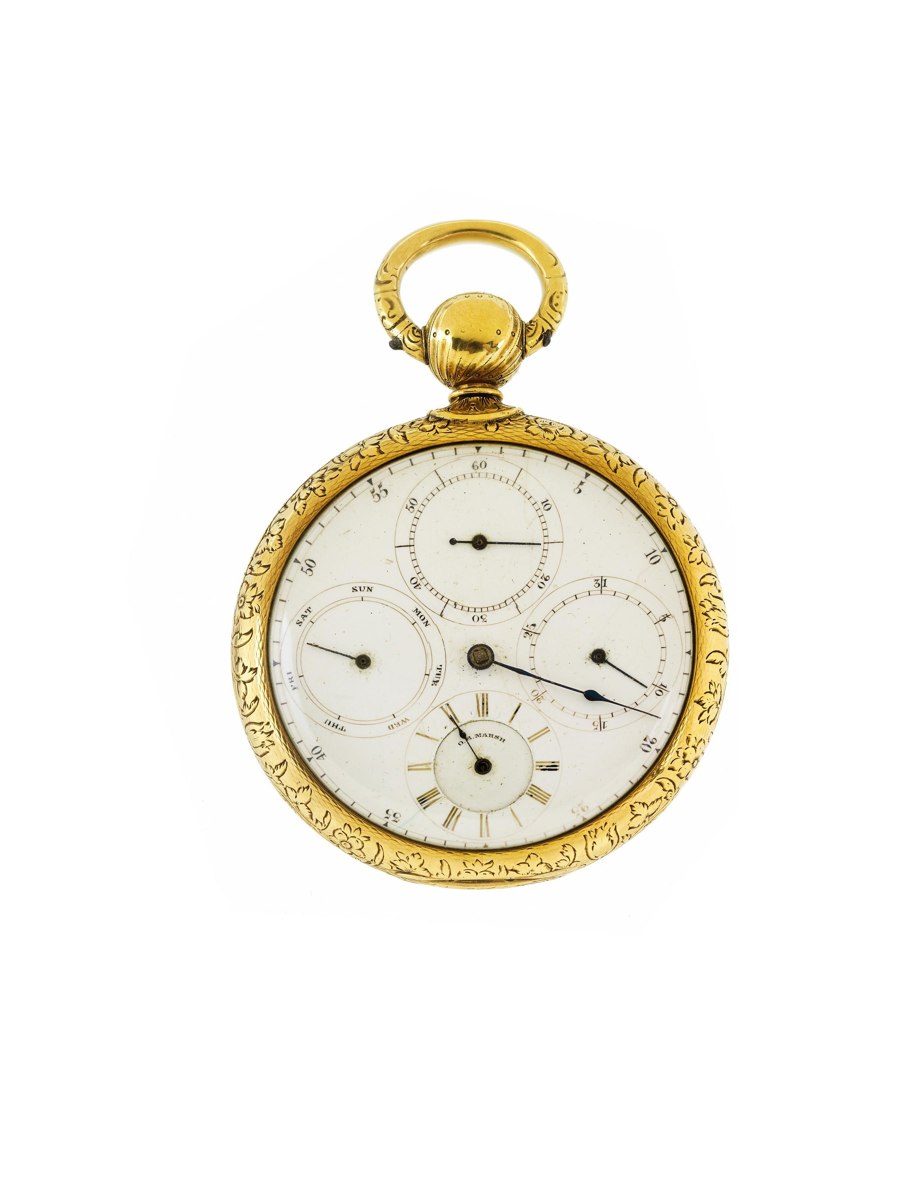
This prototype pocket watch is documented by the Smithsonian Institution as being made by Oliver B. Marsh for the early American Watch Company in Roxbury, Boston, Massachusetts. Dated to circa 1852 or 1849–1851, it represents one of seventeen largely hand-made prototype watches developed during the firm's experimental phase. The watch features an 18-karat gold case measuring approximately 3 1/8 inches high and a white enamel dial with an outer minute track. Four subsidiary dials display seconds at 12 o'clock, date at 3 o'clock, hours in Roman numerals at 6 o'clock inscribed 'O. B. MARSH', and days of the week at 9 o'clock.

Dial and bezel of the American Watch Company prototype pocket watch by Oliver B. Marsh
Dial and bezel of the American Watch Company prototype pocket watch by Oliver B. Marsh — National Museum of American History, Smithsonian Institution. Rights pending — permission not yet requested. Original source

Catalogue identity

Source
www.si.edu
Category
Pocket watch · Prototype pocket watch
Maker / attribution
Oliver B. Marsh
Reference
Not recorded
Catalogue / lot identifier
Source URL identifies the listing
Source-reported date
ca 1852
Country
United States

Source-reported attribution and specifications are not independent authentication. A listing does not establish present ownership, current display, availability or permission to reproduce.

Object description

Context and Provenance

This pocket watch is identified as a prototype designed and made by Oliver B. Marsh for the American Watch Company. It was developed during the firm's experimental phase at the Howard & Davis factory in Roxbury, Massachusetts.

The source provides two date ranges for the creation of the firm's initial prototypes: 1849–1851 and circa 1852. It is documented as one of seventeen prototypes largely hand-made by Oliver and David Marsh.

Evidence for this section
  • “Oliver B. Marsh, one of the firm's earliest watchmakers, designed and made this watch as a prototype.”
  • “seventeen watches, made mostly by hand by brothers Oliver and David Marsh.”
  • “date made 1849-1851”
  • “Date made ca 1852”

Dial and Visual Configuration

The timepiece features a white enamel dial with a peripheral minute track. The layout includes four subsidiary registers: seconds at 12 o'clock, date at 3 o'clock, Roman numerals for hours at 6 o'clock—bearing the inscription 'O. B. MARSH'—and days of the week at 9 o'clock.

The exterior of the 18-karat gold case features relief-carved floral and foliate motifs surrounding the bezel and the pendant base.

Evidence for this section
  • “The white- enamel dial indicated minutes around the rim and featured four smaller dials indicating hours (at 6:00) seconds (at 12:00), days of the week (at 9:00) and date (at 3:00).”
  • “The subsidiary dial at 6 o'clock displays Roman numerals and bears the inscription 'O. B. MARSH'.”
  • “Engraved floral and foliate relief ornamentation surrounds the gold bezel and the base of the pendant.”

Technical Construction

According to the documentation, these early prototypes featured eight-day movements with two mainsprings. The design utilized a 'going barrel,' which dispensed with the traditional fusee and chain mechanism to equalize the force of the unwinding spring.

The watch is housed in an 18-karat gold case measuring approximately 3 1/8 inches by 2 5/16 inches by 5/8 inches.

Evidence for this section
  • “The design of these first watches, eight-day movements with two mainsprings”
  • “the new American watch featured a mainspring in a "going barrel." This meant a watch without the traditional fusee and chain”
  • “gold, 18 k (case material)”
  • “overall: 3 1/8 in x 2 5/16 in x 5/8 in”

Open research questions

  • What are the precise structural differences between this prototype and the simpler production models developed after 1853?
  • Can the internal movement configuration be confirmed without disassembly of the museum object?

Source evidence

Recorded claims and source quotations for American Watch Company Prototype Pocket Watch by Oliver B. Marsh
FieldSource-reported valueSource quotation
Maker attributionOliver B. Marsh, for American Watch Co.“Oliver B. Marsh, for American Watch Co.”
Place madeUnited States: Massachusetts, Boston, Roxbury“United States: Massachusetts, Boston, Roxbury”
Case material18k gold“gold, 18 k (case material)”
Catalog number334625“catalog number 334625”
Dial configurationWhite enamel dial with peripheral minutes and four subsidiary registers“The white- enamel dial indicated minutes around the rim and featured four smaller dials indicating hours (at 6:00) seconds (at 12:00), days of the week (at 9:00) and date (at 3:00).”
Museum Catalog Number334625“catalog number 334625”
Credit LineGift of Mr. and Mrs. Joseph W. E. Bourgeois“Credit Line Gift of Mr. and Mrs. Joseph W. E. Bourgeois”

Visible details

  • Engraved floral and foliate relief ornamentation surrounds the gold bezel and the base of the pendant.
  • White enamel dial features four subsidiary dials positioned symmetrically at the cardinal points.
  • The subsidiary dial at 6 o'clock displays Roman numerals and bears the inscription 'O. B. MARSH'.
  • A single blued steel hand pivots centrally to indicate minutes against the outermost track.

Research qualifications

  • Source metadata lists two date ranges: '1849-1851' and 'ca 1852'.
  • The internal movement and case back are not shown in the available photograph.

Photograph identity and source facts were screened before import; rights clearance remains pending.

Consulted source

American Watch Company Prototype | Smithsonian Institution

Reviewed 2026-10-25 · Record ae170cfe97

Terms in this record

Glossary explanations for terms named in this object’s record.