
Skip to content
The Encyclopedia of Horology

Clock · Lantern clock

A William and Mary Brass Lantern Clock

Partially verified

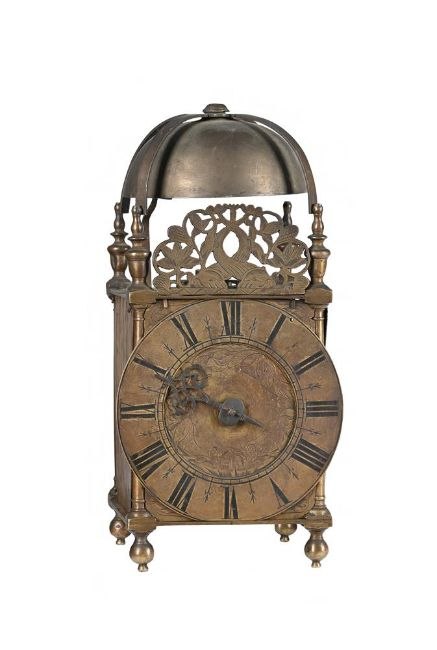
Dating to circa 1690 during the William and Mary period, this unsigned brass lantern clock is attributed to London. The posted movement features countwheel bell striking and Huygens' endless chain winding, with evidence of an early-to-mid 18th-century conversion from a short centre-swinging pendulum to an anchor escapement for a long rear-swinging pendulum. The front dial has an applied 6.25-inch Roman numeral chapter ring centered by engraved tulip sprays, wheatear half-hour markers, and a pierced iron hand. Constructed in a standard London third-period frame, it is supported by ball-turned feet below column-turned corner posts and topped with vase finials, a pierced dolphin fret, and a domed bell.

Frontal view of the William and Mary brass lantern clock showing the dial, single hand, dolphin fret, and bell
Frontal view of the William and Mary brass lantern clock showing the dial, single hand, dolphin fret, and bell — Dreweatts. Rights pending — permission not yet requested. Original source

Catalogue identity

Source
auctions.dreweatts.com
Category
Clock · Lantern clock
Maker / attribution
Not established
Reference
Not recorded
Catalogue / lot identifier
192
Source-reported date
circa 1690
Country
United Kingdom

Source-reported attribution and specifications are not independent authentication. A listing does not establish present ownership, current display, availability or permission to reproduce.

Object description

Dial and Ornamentation

The clock face features a 6.25-inch applied Roman numeral chapter ring with stylised wheatear half-hour markers. The dial centre is decorated with a concentric band of stylised leafy tulip sprays emerging from a three-petal flowerhead located above the six o'clock position.

The dial incorporates scroll-pierced iron hands and engraved leafy infill in the angles. The dial was originally designed with an alarm disc, though this feature was dispensed with during a subsequent conversion of the clock.

Evidence for this section
  • “dial with concentric band of stylised leafy tulip sprays issuing from a three-petal flowerhead positioned just above six o'clock”
  • “applied 6.25 inch Roman numeral chapter ring with stylised wheatear half hour markers and engraved leafy infill to angles”
  • “The dial was originally fitted with an alarm disc (alarm would have originally been on the frame backplate but dispensed with when the clock converted to long pendulum)”

Frame and Construction

The clock is built upon a standard London third-period frame featuring column-turned corner posts and ball-turned feet. The top is surmounted by a domed bell bearer and includes an iron hanging hoop on the rear edge of the top plate.

The front is decorated with a dolphin-inhabited, foliate-pierced and engraved fret. Current observations note that the brass side panels are later replacements secured by pins, the rear plate is a replacement, the rear right-hand leg of the bell bearer is missing, the top finial is truncated, and the original side frets are missing.

Evidence for this section
  • “the standard London third period frame with column turned corner posts beneath dolphin inhabited foliate pierced and engraved front fret, vase finials and domed bell bearer”
  • “the sides are rear with brass panels and the top plate fitted with an iron hanging hoop to the rear edge, on ball-turned feet, (lacking pendulum, weight and side frets)”
  • “The rear right hand leg of the bell bearer is missing and the top finial has been cut off”
  • “The brass side panels are later (new secured in place by pins set into the rear column caps and bases) and the rear plate is also a replacement.”

Mechanism and Conversion

The clock contains a posted countwheel bell-striking movement with Huygens' endless chain winding. It features space between the trains originally intended for a centre-swinging pendulum.

The mechanism was later converted to an anchor escapement for a long rear-swinging pendulum, a process estimated to have occurred in the early to mid-18th century. Evidence of this conversion includes repinioning of the wheel trains and spare holes on the top plate left by the original verge escapement.

Evidence for this section
  • “The posted countwheel bell striking movement with Huygens' endless chain winding, space between the trains for the previously fitted centre-swinging pendulum and later anchor escapement for a long pendulum swinging at the rear”
  • “Thbis conversion was probably undertaken in the early to mid 18th century”
  • “there are also spare holes to the top plate left over form the previous verge escapement”

Open research questions

  • What is the historical significance of the Francis Stemper attribution in relation to unsigned lantern clocks?
  • Are there specific horological characteristics common to London third-period frames that define this classification?

Source evidence

Recorded claims and source quotations for A William and Mary Brass Lantern Clock
FieldSource-reported valueSource quotation
Maker attributionUNSIGNED, LONDON“UNSIGNED, LONDON, CIRCA 1690”
DateCIRCA 1690“UNSIGNED, LONDON, CIRCA 1690”
Dimensions33.5cm high, 16cm wide, 17cm deep“33.5cm (13.25ind) high, 16cm (6.25ins) wide, 17cm (6.75ins) deep.”
Escapement and strikingPosted countwheel bell striking movement converted to anchor escapement“The posted countwheel bell striking movement with Huygens' endless chain winding, space between the trains for the previously fitted centre-swinging pendulum and later anchor escapement for a long pendulum swinging at the rear”
Frame featuresStandard London third period frame with dolphin front fret“the standard London third period frame with column turned corner posts beneath dolphin inhabited foliate pierced and engraved front fret, vase finials and domed bell bearer”
Maker AttributionUnsigned“UNSIGNED, LONDON, CIRCA 1690”
Dimensions33.5cm high, 16cm wide, 17cm deep“33.5cm (13.25ind) high, 16cm (6.25ins) wide, 17cm (6.75ins) deep.”
Design ComparisonDial engraving compared to work by Francis Stemper“The engraving to the dial centre of the present lot can be closely compared to a clock by Francis Stemper”

Visible details

  • Surmounted by a large dome-shaped bell secured by crossed arched straps
  • Applied chapter ring marked with Roman numerals and wheatear half-hour indices
  • Single pierced iron hand situated over an engraved brass dial center
  • Supported by four turned brass ball feet below corner columns

Research qualifications

  • The clock lacks its pendulum, weight, and original side frets as reported by the source.
  • The source reports the single hand, brass side panels, and rear plate are replacements, and the original alarm mechanism was removed.
  • The rear right-hand leg of the bell bearer is missing and the top finial has been cut off.

Photograph identity and source facts were screened before import; rights clearance remains pending.

Consulted source

A WILLIAM AND MARY BRASS LANTERN CLOCK

Reviewed 2026-10-25 · Record 47cfd12e4c

Terms in this record

Glossary explanations for terms named in this object’s record.