
Skip to content
The Encyclopedia of Horology

Clock · Floor-standing clock

A late 17th-century weight-driven wall clock by John Knibb, Oxford (now in a floor-standing case)

Partially verified

This lot features a late seventeenth-century weight-driven wall clock movement and dial by John Knibb of Oxford, housed in an associated miniature walnut-veneered floor-standing case. The square brass dial measures approximately 6.5 inches (16.2 cm) across, engraved with a wheatear border framing winged cherub spandrels, a silvered chapter ring, and a matted center signed 'Iohannes Knibb Oxon Fecit'. Source documentation reports a verge escapement with a short bob pendulum suspended on a knife edge, outside solid countwheel striking on a bell mounted above, and brass plates pinned to pillars with integral waisted finials.

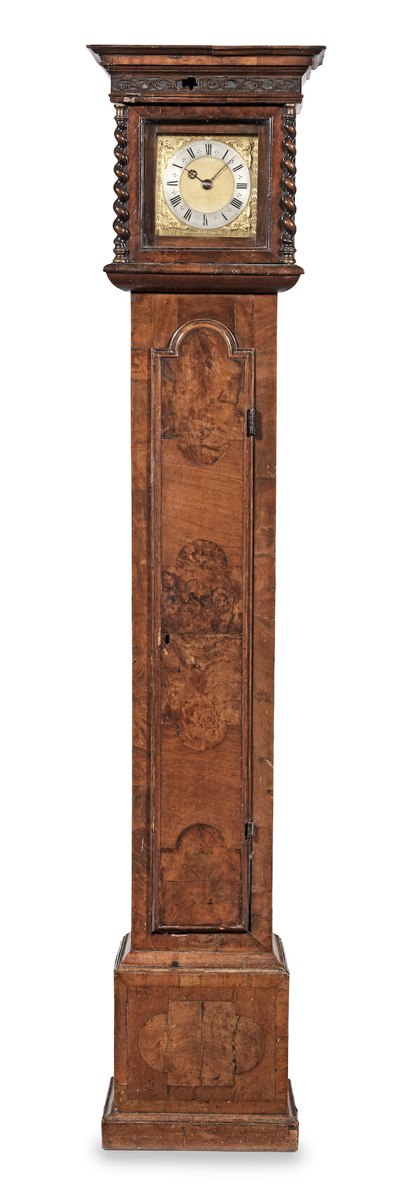
Full-length front view of the John Knibb clock in an associated walnut-veneered floor-standing case
Full-length front view of the John Knibb clock in an associated walnut-veneered floor-standing case — Bonhams. Rights pending — permission not yet requested. Original source

Catalogue identity

Source
www.bonhams.com
Category
Clock · Floor-standing clock
Maker / attribution
John Knibb
Reference
Not recorded
Catalogue / lot identifier
22
Source-reported date
late 17th century
Country
United Kingdom

Source-reported attribution and specifications are not independent authentication. A listing does not establish present ownership, current display, availability or permission to reproduce.

Object description

Dial and Inscriptions

The clock features a square brass dial framed by an engraved wheatear border enclosing winged cherub head spandrels and a silvered chapter ring with Roman and Arabic numerals. The center is described as finely matted and carries blued steel hands.

The dial is signed along the lower edge 'Iohannes Knibb Oxon Fecit'. The auction source lists conflicting measurements for the dial, stating both '6.5inch square', '16.2cms (6 3/8ths of an inch) square', and subsequently '8.3cms (3 5/16ths of an inch) square'.

Evidence for this section
  • “The 6.5inch square brass dial with wide engraved wheatear border framing winged cherubs head spandrels and the silvered Roman and Arabic chapter ring, signed along the lower edge 'Iohannes Knibb Oxon Fecit', the centre finely matted and with blued steel hands”
  • “The dial 16.2cms (6 3/8ths of an inch) square. The dial 8.3cms (3 5/16ths of an inch) square.”

Movement and Striking Train

The dial is secured to the weight-driven movement by four horizontal lugs pinned into brass top and bottom plates, which are catalogued as keyed into the corners of brass pillars cast with integral waisted finials and collet-like feet.

The going train is described as having a verge escapement and a short bob pendulum suspended on a knife edge in a bent brass back cock. The strike train features an outside solid countwheel striking on a bell mounted on a stand above, with hammer- and striking-detent arbors of circular section and a heavy solid brass fly.

Evidence for this section
  • “secured to the weight driven movement via four horizontal lugs pinned into the brass top and bottom plates which are themselves 'keyed' into the corners of the brass pillars cast with typical integral waisted finials and collet-like feet”
  • “the going train with verge escapement and short bob pendulum set on a knife edge in the bent brass back cock, the strike train with outside solid countwheel striking on the bell mounted on a stand above, the hammer- and striking-detent arbors of circular section and the heavy fly of solid brass.”

Associated Case and Labels

The clock is housed in an associated miniature floor-standing walnut-veneered case measuring 1.77 m (5 ft 7 in) high. The case features spiral columns flanking the hood door over a long trunk door and a panel base inlaid with shaped panels.

Two labels are recorded on the case assembly: an applied handwritten paper reading '1670' attached to the mask, and a label inside the trunk door reading '53', which the cataloguer speculates may be a collector's inventory number.

Evidence for this section
  • “Now contained in an associated miniature floor-standing walnut veneered case, the hood with spiral columns over a long door on a panel base inlaid with shaped panels.”
  • “The mask set with an applied handwritten dated paper '1670' and another label to the door interior '53' - possibly a collectors inventory number?”
  • “The case 1.77m (5ft 7in) high.”

Open research questions

  • What accounts for the contradictory dial dimensions in the source description (16.2 cm / 6 3/8 in vs. 8.3 cm / 3 5/16 in)?
  • What is the date, origin, and original purpose of the associated miniature walnut-veneered floor-standing case?
  • Can the collector's inventory label '53' or the handwritten '1670' mask label be matched to historical auction or collection records?

Source evidence

Recorded claims and source quotations for A late 17th-century weight-driven wall clock by John Knibb, Oxford (now in a floor-standing case)
FieldSource-reported valueSource quotation
Maker's signatureIohannes Knibb Oxon Fecit“signed along the lower edge 'Iohannes Knibb Oxon Fecit'”
Dial dimensions6.5 inches square (16.2 cm)“The 6.5inch square brass dial with wide engraved wheatear border framing winged cherubs head spandrels”
EscapementVerge escapement with short bob pendulum“the going train with verge escapement and short bob pendulum set on a knife edge in the bent brass back cock”
Striking mechanismOutside solid countwheel striking on an overhead bell“the strike train with outside solid countwheel striking on the bell mounted on a stand above”
Case height1.77 m (5 ft 7 in)“The case 1.77m (5ft 7in) high.”
Dial border decorationEngraved wheatear border“The 6.5inch square brass dial with wide engraved wheatear border framing winged cherubs head spandrels”
Mask label text1670“The mask set with an applied handwritten dated paper '1670'”
Door interior label text53“another label to the door interior '53' - possibly a collectors inventory number?”

Visible details

  • Slim floor-standing walnut-veneered case with barley-twist columns flanking the hood door.
  • Trunk door and plinth base feature inset shaped decorative veneer panels.
  • Square brass dial visible through the glazed hood door, showing winged cherub spandrels and a silvered Roman numeral chapter ring.
  • Carved frieze detail visible beneath the hood cornice.

Research qualifications

  • The floor-standing case is catalogued as associated rather than original to the wall clock movement.
  • Internal movement, escapement, and bell strike mechanism are concealed inside the case and not visible in the exterior photograph.

Photograph identity and source facts were screened before import; rights clearance remains pending.

Terms in this record

Glossary explanations for terms named in this object’s record.