
Skip to content
The Encyclopedia of Horology

Clock · Longcase clock

A late 17th century walnut longcase clock, Joseph Windmills

Partially verified

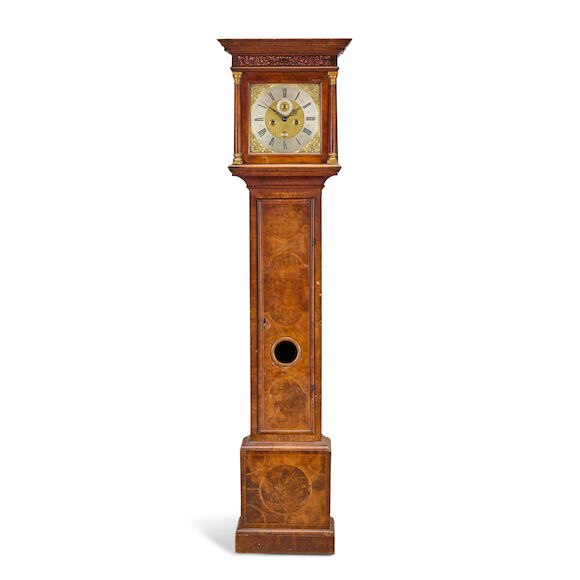
Attributed to Joseph Windmills of London, this late seventeenth-century English longcase clock stands two metres tall in a walnut case. The square-topped hood features a moulded cornice set above turned columns and concave throat moulding. The long trunk door displays feather-banded decoration, D-moulded edges, and inlaid burr walnut panels surrounding a circular pendulum lenticle. The eleven-inch square brass dial includes cherub spandrels, foliate scroll engraving, a silvered chapter ring with cruciform half-hour markers, a subsidiary seconds dial, and a date aperture. According to the source, the internal mechanism incorporates five knopped and finned latched pillars with an anchor escapement striking on an inside countwheel bell.

Full frontal view of the late 17th-century walnut longcase clock by Joseph Windmills
Full frontal view of the late 17th-century walnut longcase clock by Joseph Windmills — Bonhams. Rights pending — permission not yet requested. Original source

Catalogue identity

Source
www.bonhams.com
Category
Clock · Longcase clock
Maker / attribution
Joseph Windmills
Reference
Not recorded
Catalogue / lot identifier
394
Source-reported date
late 17th century
Country
United Kingdom

Source-reported attribution and specifications are not independent authentication. A listing does not establish present ownership, current display, availability or permission to reproduce.

Object description

Case Architecture and Decorative Veneers

Standing 2m (6ft 6.5ins) high, the clock case is executed in walnut. The hood features a square top and a moulded cornice set above turned 3/4 and 1/4 columns framing the dial door.

Below a concave throat moulding, the long trunk door incorporates feather-banded decoration, a D-moulded edge, and shaped inlaid panels of burr walnut centred by a pendulum viewing lenticle. The trunk rests upon a cross-banded and panel-inlaid base.

Evidence for this section
  • “The square topped hood with moulded cornice over turned 3/4 and 1/4 columns, the concave throat moulding over a long trunk door with feather banded decoration, D-moulded edge and shaped inlaid panels of burr walnut centred by a lenticle on a cross banded and panel inlaid base.”
  • “2m (6ft 6.5ins) high.”

Dial Composition and Inscription

The face is an 11-inch square brass dial decorated with corner cherub spandrels interspersed with engraved foliate scrolls. The silvered Roman and Arabic chapter ring features fancy cruciform half-hour markers.

The dial is signed between VII and V. It surrounds a matted dial centre fitted with ringed winding squares, a subsidiary seconds dial, and a circular date aperture.

Evidence for this section
  • “The 11 inch square brass dial with cherub spandrels interspersed by engraved foliate scrolls, the silvered Roman and Arabic chapter ring with fancy cruciform half-hour marks signed between VII and V enclosing the matted centre with ringed winding squares, subsidiary seconds and circular date aperture”

Reported Movement and Associated Elements

According to the auction catalogue description, the movement is constructed with five knopped and finned latched pillars. It employs an anchor escapement and strikes on a bell via an inside countwheel mechanism.

The clock is listed as accompanied by two period brass weights and a pendulum. These internal movement plates, pillars, and weights are reported by the source rather than verifiable from the external photograph.

Evidence for this section
  • “the movement with five knopped and finned latched pillars, anchor escapement with inside countwheel striking on a bell.”
  • “Together with two period brass weights and a pendulum.”

Open research questions

  • Are the latched pillars, wheel trains, and escapement components original to the late seventeenth century, or do they show later historic interventions?
  • Does the plinth base retain its original height and framing, or has it undergone skirting reduction or base rebuilding?
  • Are the two brass weights and pendulum original to the clock or period-matched associations?

Source evidence

Recorded claims and source quotations for A late 17th century walnut longcase clock, Joseph Windmills
FieldSource-reported valueSource quotation
MakerJoseph Windmills, London“Joseph Windmills, London”
Dial dimensions11 inches square“11 inch square brass dial”
Escapement and strikingAnchor escapement with inside countwheel striking on a bell“anchor escapement with inside countwheel striking on a bell”
Case decorationLong trunk door with feather banded decoration and burr walnut panels centred by a lenticle“long trunk door with feather banded decoration, D-moulded edge and shaped inlaid panels of burr walnut centred by a lenticle”
Movement pillarsFive knopped and finned latched pillars“five knopped and finned latched pillars”
Height2m (6ft 6.5ins)“2m (6ft 6.5ins) high.”
Maker attributionJoseph Windmills, London“Joseph Windmills, London”
Accompanying accessoriesTwo period brass weights and a pendulum“Together with two period brass weights and a pendulum.”
Hood columnsTurned 3/4 and 1/4 columns“turned 3/4 and 1/4 columns”

Visible details

  • Square-topped hood flanked by turned columns and topped with a moulded cornice.
  • Trunk door has a circular pendulum viewing lenticle in the lower half.
  • Square dial displays a silvered chapter ring with Roman numerals and matted centre.

Research qualifications

  • Internal movement, weights, and pendulum are described in text but not visible in the provided photo.
  • Exact manufacturing year is not specified beyond the late 17th century.

Photograph identity and source facts were screened before import; rights clearance remains pending.

Consulted source

Bonhams : A late 17th century walnut longcase clock Joseph Windmills, London

Reviewed 2026-10-21 · Record 5c2b657e22

Terms in this record

Glossary explanations for terms named in this object’s record.