Glossary · Regulation
Free pendulum
A precision system in which the timekeeping pendulum is almost undisturbed.
Explanation
A free pendulum is arranged to minimise disturbance from the mechanism that maintains its swing and counts time. Free does not mean entirely undriven: air resistance and suspension losses still require an impulse. The aim is to separate accurate oscillation from as much mechanical work as possible, rather than claim an ideal pendulum that needs no energy.
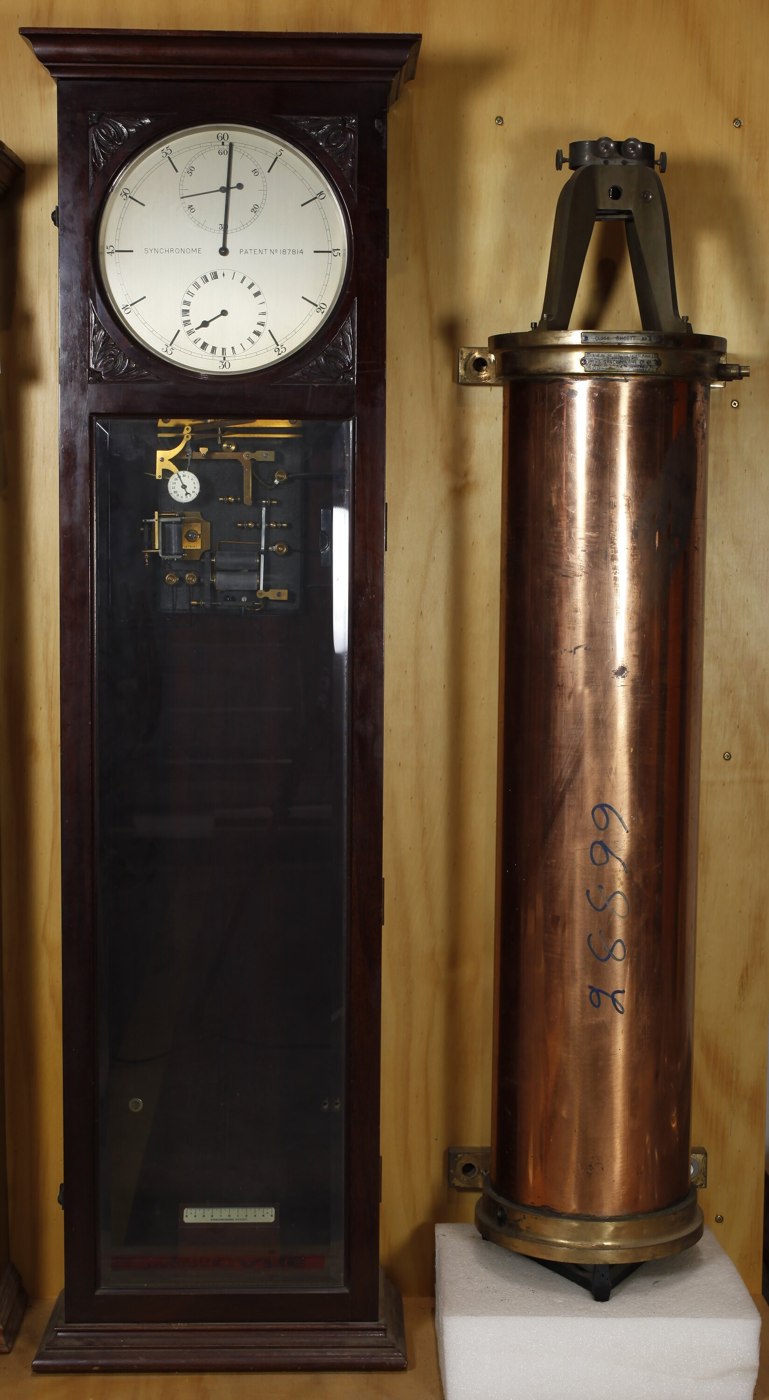
The Shortt–Synchronome system uses a master pendulum in a low-pressure enclosure and a separate secondary clock. The master provides the time reference; the secondary drives the indication and helps release the master's periodic impulse. Low pressure reduces air effects but is not a perfect vacuum, and the master still interacts briefly with its impulse mechanism. The system should not be confused with an ordinary clock whose pendulum continuously operates an escapement.
What to record
- Identify the master enclosure and the separate secondary clock.
- Distinguish synchronising signals from the energy that maintains the pendulum.
- Check the documented system before applying the term free pendulum to a clock.
Historical electrical clocks may combine fragile suspensions, stored mechanical energy and old wiring. Do not energise or adjust an unassessed system.
In the object catalogue
Catalogued objects whose own source record mentions “Free pendulum”. The quoted line shows where; it is the seller’s or museum’s wording, not independent verification.