
Skip to content
The Encyclopedia of Horology

Clock · Free Pendulum Clock

Free Pendulum Clock No. 5

Partially verified

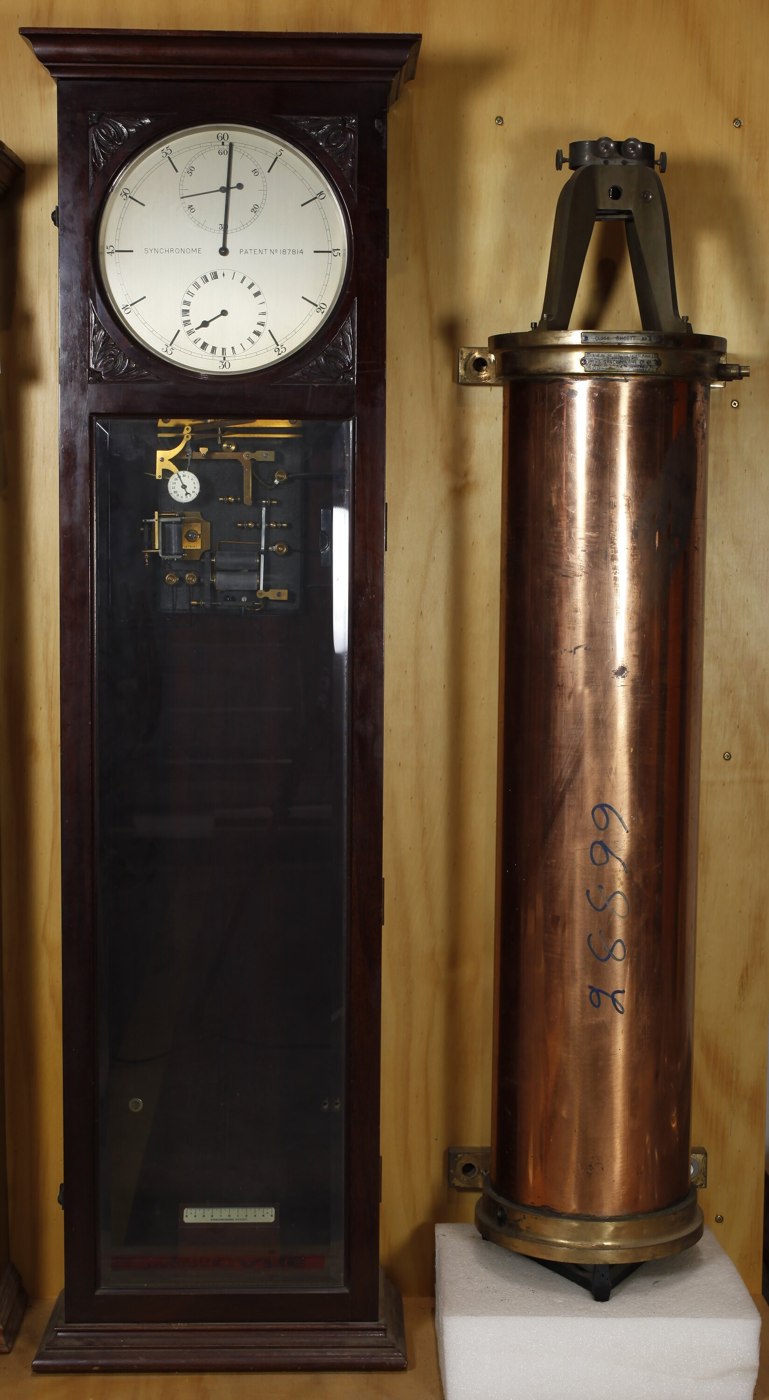
This Shortt impulse clock, designated No. 5, was designed by William Hamilton Shortt and manufactured by the Synchronome Co Ltd in 1925. The horological system consists of a free pendulum housed in an evacuated brass cylinder and a slave pendulum within a Synchronome clock case. The two pendulums are integrated through a hit-and-miss synchronizer that maintains precise sympathy between the movements, allowing the slave clock to trigger the gravity arm of the master clock and impart an impulse to the free pendulum. Approximately 100 such clocks were produced for international observatory use. This specific example was originally installed at the Melbourne Observatory in 1925 to manage the time service. It was later moved to the Post-Master General's (P.M.G.) Research Laboratories in 1945, and subsequently transferred to South Australia in 1955 for continued operation until 1968.

The Shortt free pendulum clock (right) paired with its slave clock (left).
The Shortt free pendulum clock (right) paired with its slave clock (left). — Museums Victoria. Rights pending — permission not yet requested. Original source

Catalogue identity

Source
collections.museumsvictoria.com.au
Category
Clock · Free Pendulum Clock
Maker / attribution
William Hamilton Shortt and Synchronome Co Ltd
Reference
Not recorded
Catalogue / lot identifier
ST 28899
Source-reported date
1925
Source-reported place
England
Source-reported serial
No.5

Source-reported attribution and specifications are not independent authentication. A listing does not establish present ownership, current display, availability or permission to reproduce.

Object description

Mechanism and Operation

The Shortt impulse clock operates using a dual-pendulum system. The master unit, a free pendulum, is suspended within an evacuated brass cylinder to minimize air resistance. A slave pendulum, contained within a standard Synchronome clock case, provides the timekeeping display and the power to maintain the master pendulum's cycle.

The slave and master pendulums operate in sympathy regulated by a hit-and-miss synchronizer. The slave clock is responsible for the release of the gravity arm that provides the necessary impulse to the free master pendulum. This interaction ensures the precision required for observatory timekeeping standards during the early 20th century.

Evidence for this section
  • “The clock comprises a free pendulum in an evacuated brass cylinder, and a slave pendulum in a Syncrhonome clock.”
  • “the slave clock accomplishes the release of the gravity arm of the master clock and gives an impulse to the free pendulum.”

Ownership and Service History

Commissioned in 1925, Clock No. 5 was initially installed at the Melbourne Observatory, where it served as the primary instrument for the site's time service. This usage continued for two decades until 1945.

In 1945, the clock was transferred to the Post-Master General's (P.M.G.) Research Laboratories to support civil time service operations in Victoria. By 1955, the clock was relocated to South Australia under the management of the P.M.G., where it remained in use until its retirement in 1968.

Evidence for this section
  • “Shortt no. 5 was installed in the Melbourne Observatory in 1925, to run the Melbourne Observatory time service.”
  • “transferred to the P.M.G. in South Australia, where it was used until 1968.”

Physical Configuration

The system is visually distinguished by its two-part assembly: the slave clock housed in a tall, wooden, glass-fronted case and the master pendulum in an upright, cylindrical metal vessel. The slave clock dial bears the mark 'SYNCHRONOME' and 'PATENT Nº 187814'.

The overall height of the configuration is 140 cm. The vacuum-sealed cylinder serves as the protected housing for the master element, while the slave case contains the electrical components and the escapement mechanism visible behind the glass.

Evidence for this section
  • “The clock comprises a free pendulum in an evacuated brass cylinder”
  • “Overall Dimensions, dimensions: 20 cm (Length), 40 cm (Width), 140 cm (Height)”

Open research questions

  • What is the current mechanical state of the hit-and-miss synchronization mechanism?
  • Are there specific wear patterns on the gravity arm release linkage indicating its period of 1945-1968 service?

Source evidence

Recorded claims and source quotations for Free Pendulum Clock No. 5
FieldSource-reported valueSource quotation
ManufacturerSynchronome Co Ltd“Manufacturer, name: Synchronome Co Ltd”
DesignerWilliam Hamilton Shortt“Designer, name: Shortt, William Hamilton”
Registration NumberST 28899“Registration number: ST 28899”
ProvenanceMelbourne Observatory“Shortt no. 5 was installed in the Melbourne Observatory in 1925”
Dimensions140 cm Height“140 cm (Height)”
Operational MechanismHit-and-miss synchronizer“The two pendulums swing together in precise sympathy, using a hit-and-miss synchronizer”

Visible details

  • Slave clock features a prominent white dial with Synchronome branding.
  • The master pendulum is contained within an upright sealed copper or brass cylinder.
  • The system includes an electrical impulse mechanism visible inside the glass-fronted slave case.
  • Registration number ST 28899 is inscribed on the copper cylinder.

Research qualifications

  • The specific long-term mechanical condition of the interior pendulum components is not detailed.
  • The exact date of the transfer of the clock between specific P.M.G. laboratory divisions is identified in general terms only.

Photograph identity and source facts were screened before import; rights clearance remains pending.

Terms in this record

Glossary explanations for terms named in this object’s record.