
Component record · Train
Coupling Clutch (Lateral Clutch)
Partially verifiedIn a lateral-clutch chronograph, the pivoted coupling lever and its transmission wheel that swing sideways to connect the running train to the chronograph centre wheel.
What it does
Starts and stops the chronograph by putting a continuously turning driving wheel into, or out of, mesh with the chronograph seconds wheel.
How it works
A driving wheel fixed to the fourth-wheel arbor turns all the time the watch runs. The coupling lever carries a transmission wheel permanently meshed with the driving wheel. When the chronograph is started, the column wheel or cam lets the lever swing so that the transmission wheel also meshes with the chronograph centre wheel, which then turns with the train.
The teeth are very fine, often of a sawtooth form, to limit the jump of the seconds hand at the moment of engagement. The depth of engagement is usually set by an eccentric screw or stud: too deep and the train is loaded and the hand trembles, too shallow and the hand stutters or slips.
Stopping swings the lever back and a brake brings the chronograph wheel to rest. Because the wheels mesh only when running, a lateral clutch puts extra load on the train while the chronograph is in use.
Evolution
Lateral clutches were standard in hand-wound chronographs such as the Valjoux and Lemania families. The swinging (oscillating) pinion is a later lateral variant, while the vertical clutch became common in modern automatic chronographs.
Known variations
- Coupling lever with transmission wheel
- Swinging (oscillating) pinion
- Column-wheel or cam control of the coupling lever
Identification for collectors
- A pivoted lever carrying a small wheel between the fourth-wheel driving wheel and the chronograph centre wheel
- A brief jump or stutter of the seconds hand on starting is characteristic of lateral coupling
Common failure modes
- Wrong depth causing a trembling or stuttering seconds hand
- Worn fine teeth
- Weak lever spring or worn eccentric adjustment
Photographs
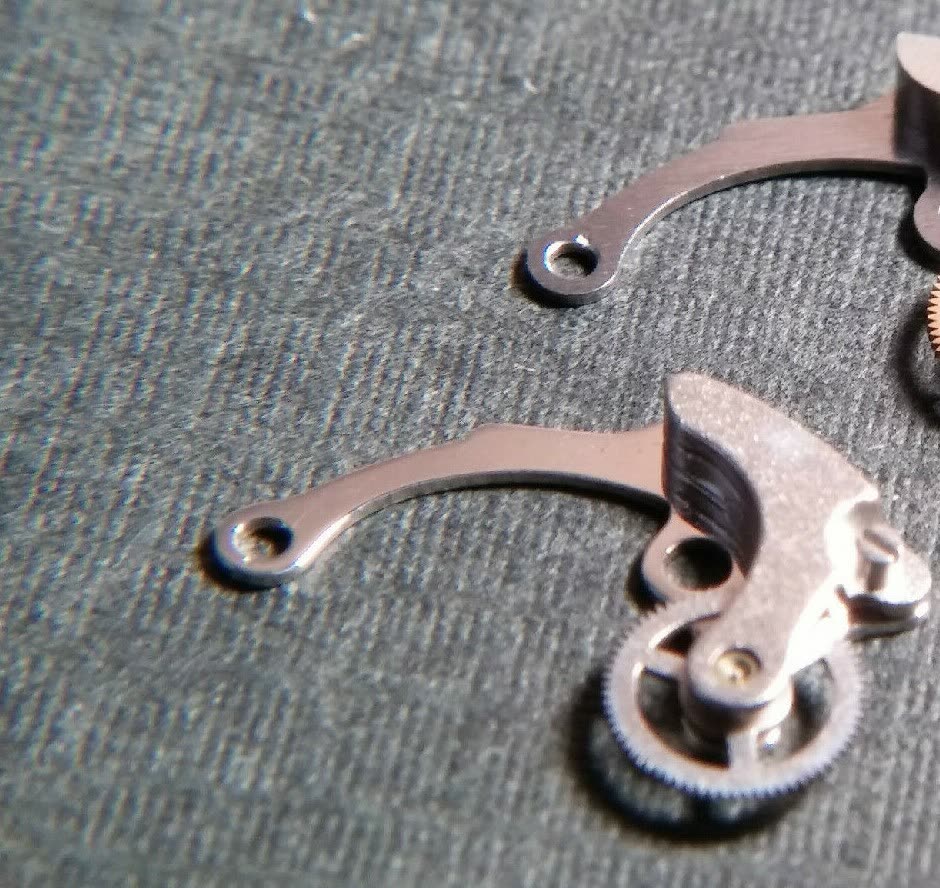
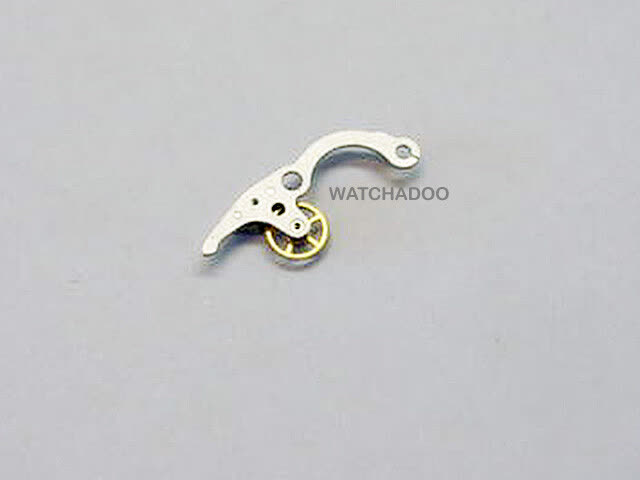
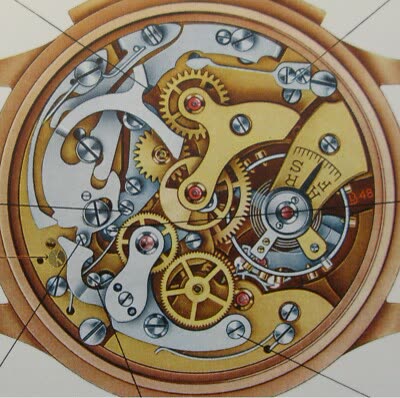
Photographs are illustrative examples of the type, not necessarily the exact object described. Verify details against the source file page.
Sources & references
- Fried, H. B., The Watch Repairer's Manual
- de Carle, D., Watch and Clock Encyclopedia
- Reymondin, C.-A., et al., The Theory of Horology (Swiss Federation of Technical Colleges)
Where sources disagree, the disagreement is stated rather than resolved silently.