
Component record · Keyless work
Operating Lever (Chronograph)
Partially verifiedThe chronograph lever moved by the start/stop pusher, which steps the column wheel round or moves the cam that controls the chronograph's other levers.
What it does
Converts each press of the pusher into one controlled step of the chronograph's control system, so starting, stopping and resetting happen in the correct order.
How it works
In a column-wheel chronograph the operating lever carries a pawl. Each press of the pusher swings the lever, and the pawl advances the ratchet teeth at the foot of the column wheel by one step; a jumper holds the wheel in its new position. The columns then lift or drop the coupling, brake and hammer levers.
In cam (shuttle) chronographs the operating lever moves a cam or shuttle plate that performs the same functions with stamped parts, a design used in widely produced calibres such as the Valjoux 7750.
A return spring brings the lever back to rest after every press. If the pawl or spring is worn, the column wheel may fail to advance or may advance two steps.
Evolution
Cam-operated systems were introduced to reduce cost and simplify production, while column-wheel control remained associated with high-grade chronographs.
Known variations
- Column-wheel operating lever with pawl
- Cam or shuttle operating lever
- Separate reset operating lever for the hammers
Identification for collectors
- The lever directly behind the start/stop pusher, ending at the column wheel's ratchet or at the cam
Common failure modes
- Worn pawl tip causing missed or double steps
- Broken or weak return spring
- Pusher wear making the lever travel incomplete
Photographs
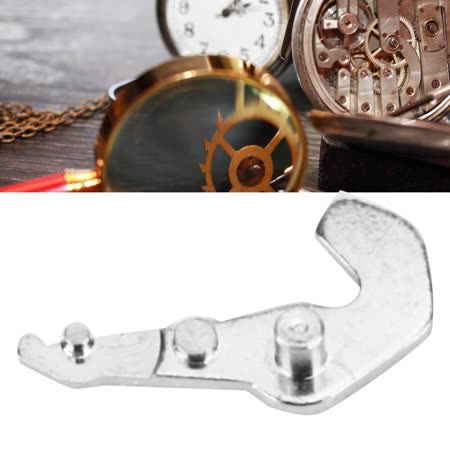
Photographs are illustrative examples of the type, not necessarily the exact object described. Verify details against the source file page.
Sources & references
- Fried, H. B., The Watch Repairer's Manual
- de Carle, D., Watch and Clock Encyclopedia
- Reymondin, C.-A., et al., The Theory of Horology (Swiss Federation of Technical Colleges)
Where sources disagree, the disagreement is stated rather than resolved silently.