
Component record · Train
Chronograph Reset Hammer
Partially verifiedThe pivoted steel lever, or set of levers, whose faces strike the heart cams on the chronograph arbors to return the hands to zero.
What it does
Resets the chronograph seconds, minute counter and (where fitted) hour counter in one movement when the reset pusher is pressed.
How it works
Pressing the reset pusher lets a spring drive the hammer against the heart cams. Each hammer face pushes its cam until the cam turns to its lowest point, which corresponds to zero, so the hands snap back regardless of where they were stopped.
In column-wheel chronographs the hammer is blocked by the column wheel while the chronograph runs, so pressing reset cannot damage the mechanism; in flyback chronographs the hammer acts while the chronograph is running and the train restarts at once.
Separate hammers for seconds and minutes, or a two-part 'floating' hammer, are used so that both faces meet their cams firmly together.
Evolution
Hammer forms developed from single-arm hammers to multi-faced and self-adjusting designs that reset several counters at once with even pressure.
Known variations
- Single hammer with several faces
- Separate hammers for seconds, minute and hour counters
- Articulated or floating hammers that equalise pressure
Identification for collectors
- Hands that stop slightly off zero after reset point to hammer or heart-cam faults
Common failure modes
- Worn hammer faces
- Hammer misadjusted so one counter does not reach zero
- Weak hammer spring
- Hands forced on their arbors out of alignment with the cams
Photographs
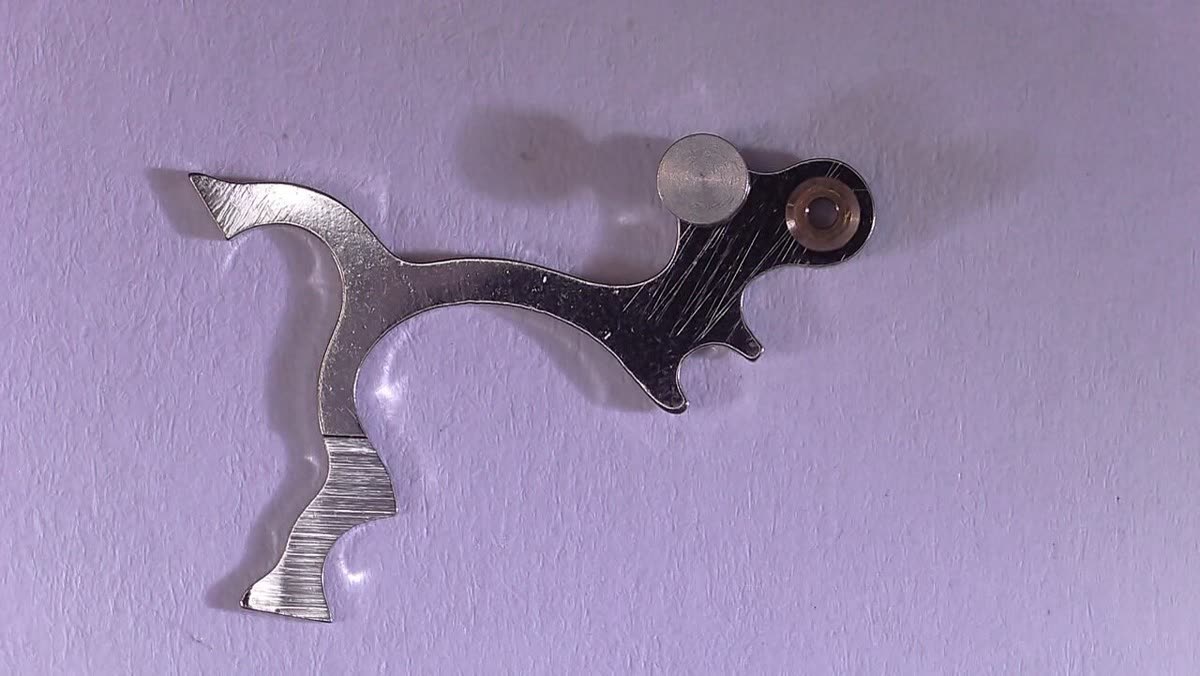
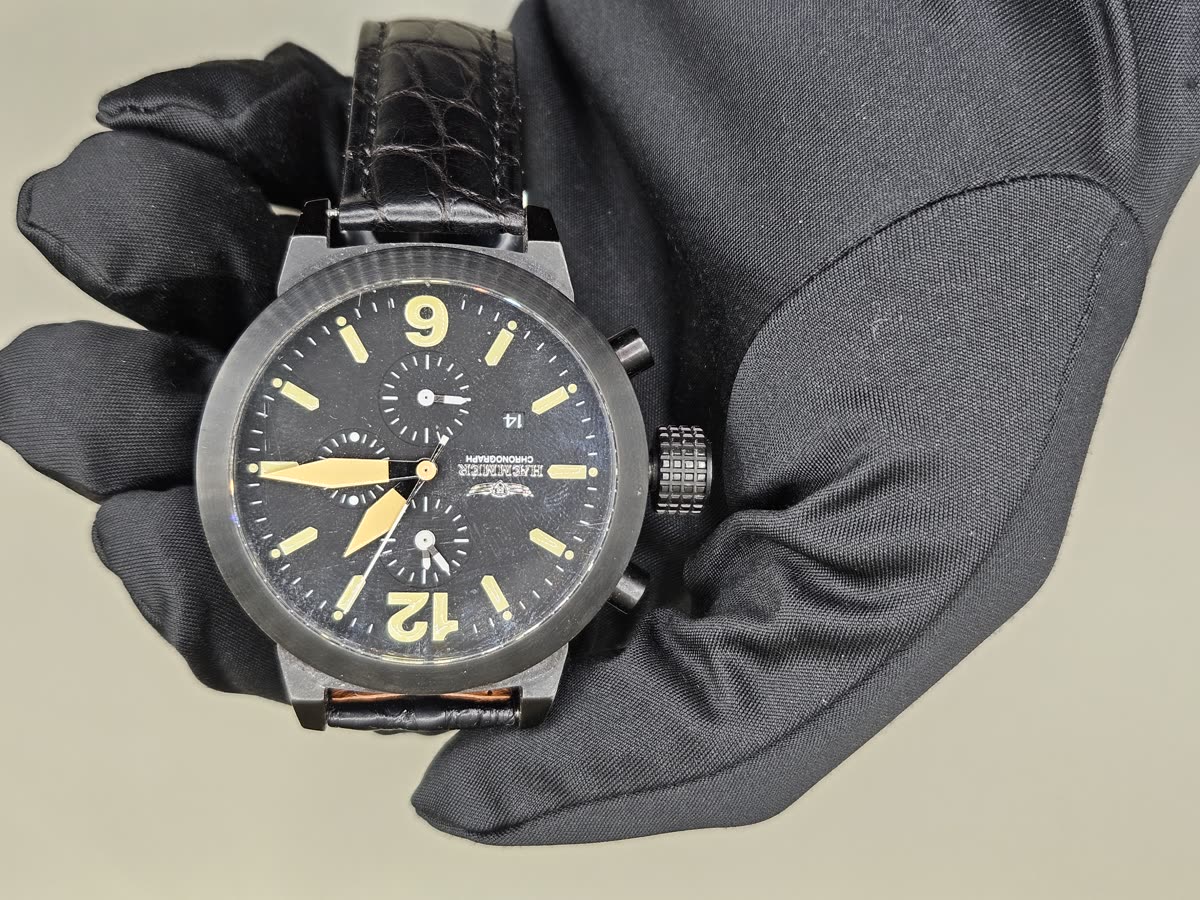
Photographs are illustrative examples of the type, not necessarily the exact object described. Verify details against the source file page.
Sources & references
- Fried, H. B., The Watch Repairer's Manual
- de Carle, D., Watch and Clock Encyclopedia
- Reymondin, C.-A., et al., The Theory of Horology (Swiss Federation of Technical Colleges)
Where sources disagree, the disagreement is stated rather than resolved silently.