
Skip to content
The Encyclopedia of Horology

Pocket watch · Pair-cased verge pocket watch

William Kipling Pair-Cased Pocket Watch with Verge Escapement

Partially verified

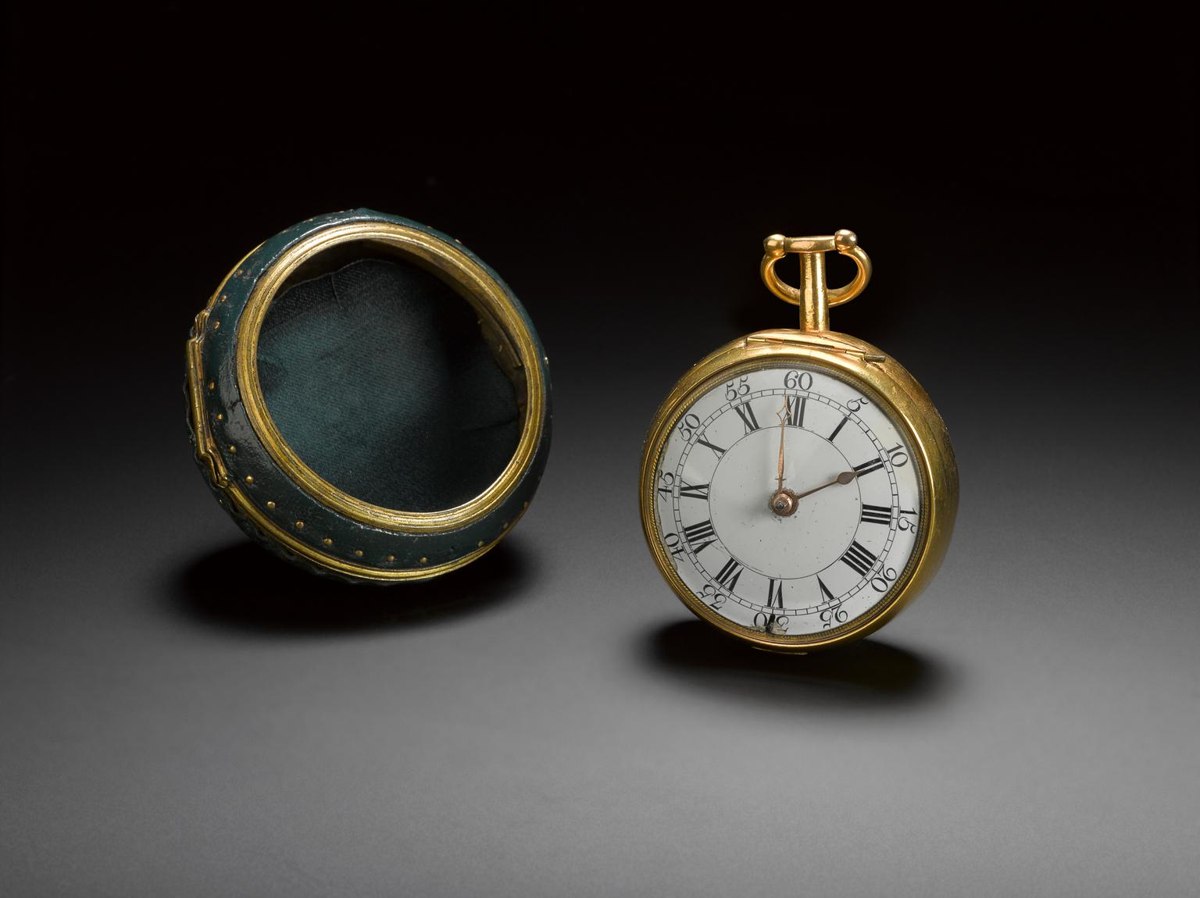
This English pair-cased pocket watch with a verge escapement was made in London between 1705 and 1737 by watchmaker William Kipling. The assembly features an inner gold-toned case and a separate outer casing constructed from pinchbeck and leather. Its white enamel dial displays black Roman numerals for the hours and an outer track with Arabic numerals marked at five-minute intervals. The source reports that the movement is inscribed 'Will Kipling no.483' and incorporates silver pillars, with its jewelled endstone removed. The watch forms part of the Science Museum Group collection.

Front view of the inner watch displaying the enamel dial, placed next to the open leather and pinchbeck outer case
Front view of the inner watch displaying the enamel dial, placed next to the open leather and pinchbeck outer case — The Board of Trustees of the Science Museum, London. Rights pending — permission not yet requested. Original source

Catalogue identity

Source
collection.sciencemuseumgroup.org.uk
Category
Pocket watch · Pair-cased verge pocket watch
Maker / attribution
William Kipling
Reference
Not recorded
Catalogue / lot identifier
1916-125
Source-reported date
1705-1737
Country
United Kingdom
Source-reported serial
483

Source-reported attribution and specifications are not independent authentication. A listing does not establish present ownership, current display, availability or permission to reproduce.

Object description

Dial and Visual Features

The timepiece features a white enamel dial with black Roman hour numerals and an outer track with Arabic numerals for five-minute intervals.

The assembly includes an inner case with an integral pendant bow, paired with an outer casing composed of pinchbeck and leather.

Evidence for this section
  • “White enamel dial with black Roman hour numerals and outer Arabic five-minute markings.”
  • “Dark leather outer casing trimmed with metallic pins or studs and a gold-toned rim.”
  • “Gold-toned inner case with an integral pendant bow at the top.”

Movement Construction

The watch utilizes a verge escapement mechanism. The movement is inscribed 'Will Kipling no.483'.

The movement incorporates silver pillars. The source reports that the jewelled endstone has been removed.

Evidence for this section
  • “Movement inscribed 'Will Kipling no.483'”
  • “The movement consists of silver pillars (jewelled endstone removed).”

Attribution and Identification

The watch is attributed to William Kipling, a maker active in London during the early 18th century. The institution dates the production to between 1705 and 1737.

The watch is identified by the object number 1916-125 and is held within the Science Museum Group collection.

Evidence for this section
  • “made by Will Kipling, a watchmaker working in London in the early-eighteenth century.”
  • “Made: 1705-1737 in London”
  • “Object Number: 1916-125”

Open research questions

  • What is the functional implication of the removed jewelled endstone on the verge movement?
  • How does the serial number 483 relate to the broader catalog of William Kipling's work?

Source evidence

Recorded claims and source quotations for William Kipling Pair-Cased Pocket Watch with Verge Escapement
FieldSource-reported valueSource quotation
MakerWilliam Kipling“maker: William Kipling”
Date of Manufacture1705-1737“Made: 1705-1737 in London”
Object Number1916-125“Object Number: 1916-125”
Movement InscriptionWill Kipling no.483“Movement inscribed 'Will Kipling no.483'”
MaterialsPinchbeck, leather, brass and enamel“Materials: pinchbeck , leather , brass and enamel”
Movement FeaturesSilver pillars (jewelled endstone removed)“The movement consists of silver pillars (jewelled endstone removed).”
MaterialsPinchbeck, leather, brass, and enamel“Materials: pinchbeck , leather , brass and enamel”

Visible details

  • White enamel dial with black Roman hour numerals and outer Arabic five-minute markings.
  • Dark leather outer casing trimmed with metallic pins or studs and a gold-toned rim.
  • Gold-toned inner case with an integral pendant bow at the top.

Research qualifications

  • The movement and its pillar construction are not visible in this dial-side photograph.
  • The source notes that the jewelled endstone has been removed.

Photograph identity and source facts were screened before import; rights clearance remains pending.

Terms in this record

Glossary explanations for terms named in this object’s record.