
Skip to content
The Encyclopedia of Horology

Pocket watch · Pocket watch

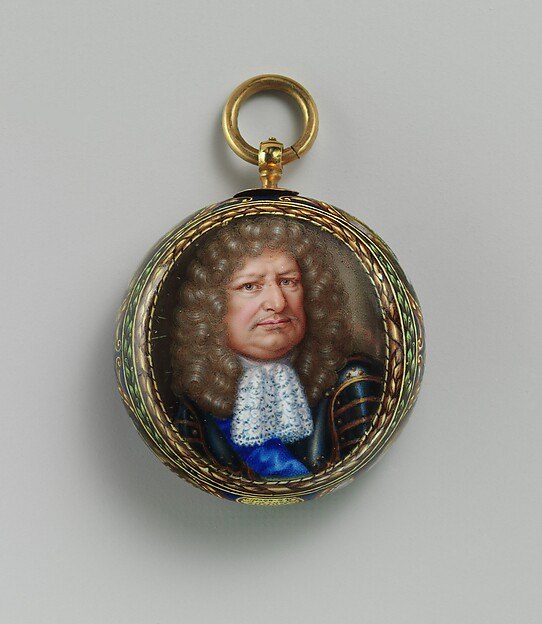
Watch with portrait of Frederick William, the Great Elector

Partially verified

This horological object is a pocket watch, accessioned by the Metropolitan Museum of Art (17.190.1522), featuring a case and movement produced in distinct regions and eras. The case is constructed of gold with painted enamel decoration and was made in Geneva by the Swiss case maker Jean-Pierre Huaud, known as the younger Huaud (1655–1723), and is dated to approximately 1688. The enamel work features a portrait of Frederick William, the Great Elector of Brandenburg-Prussia. The watch movement, composed of brass and steel, was produced around 1750 in Berlin by the Swiss watchmaker Johann G. Racine, who was recorded as active in Berlin in 1748. The object measures 1 9/16 inches (4 cm) in diameter for the case and 1 1/4 inches (3.2 cm) for the back plate. The assembly combines Swiss case-making traditions with mid-18th-century German movement construction.

The enamel portrait of Frederick William, the Great Elector, on the case of the watch
The enamel portrait of Frederick William, the Great Elector, on the case of the watch — The Metropolitan Museum of Art, Gift of J. Pierpont Morgan, 1917. Rights pending — permission not yet requested. Original source

Catalogue identity

Source
orbiscollectibles.com
Category
Pocket watch · Pocket watch
Maker / attribution
Johann G. Racine; Jean-Pierre Huaud
Reference
Not recorded
Catalogue / lot identifier
17.190.1522
Source-reported date
case ca. 1688, movement ca. 1750
Source-reported place
Switzerland/Germany

Source-reported attribution and specifications are not independent authentication. A listing does not establish present ownership, current display, availability or permission to reproduce.

Object description

Case and Enamel Decoration

The watch is housed in a gold case decorated with painted enamel, created by the Geneva-based maker Jean-Pierre Huaud. The enameling depicts the portrait of Frederick William, the Great Elector, who served as the Elector of Brandenburg and Duke of Prussia from 1640 until 1688.

The case design integrates the portrait with surrounding decorative elements, reflecting the artistic style of the younger Huaud. The case is dated to approximately 1688, aligning with the end of the Elector's rule.

Evidence for this section
  • “The case, dated to around 1688, was created and enamelled in Geneva by the Swiss case maker Jean-Pierre Huaud, known as the younger Huaud (1655–1723), and depicts the portrait of the Great Elector near the end of his rule.”

Movement and Construction

The internal mechanism is manufactured from brass and steel and was produced in Berlin around 1750. The watchmaker, Johann G. Racine, was a Swiss craftsman active in Berlin, with records of his activity dating to 1748.

The movement plate features engraved text including 'Racine' and 'Berlin', alongside a regulation sub-dial marked with 'Avan' and 'Retar'. A pierced, scrolling balance bridge is visible on the top of the movement plate.

Evidence for this section
  • “The movement was made subsequently around 1750 in Berlin by Johann G. Racine, a Swiss watchmaker recorded as active in Berlin in 1748.”
  • “Movement: brass and steel”

Provenance and Identification

The watch is held by the Metropolitan Museum of Art under the accession number 17.190.1522. It represents a combination of components produced in different horological centers, with a Swiss-made case and a German-made movement added decades later.

The association between the watch's components and its subject matter is based on institutional documentation. No specific catalogue references have been transcribed for this object.

Evidence for this section
  • “The Metropolitan Museum of Art holds this object as 17.190.1522”
  • “This watch unites components produced decades apart across Swiss and German centres.”

Open research questions

  • What is the specific history of the assembly of the 1688 case with the 1750 movement?
  • Are there similar horological examples of mismatched period components from the Huaud and Racine workshops?

Source evidence

Recorded claims and source quotations for Watch with portrait of Frederick William, the Great Elector
FieldSource-reported valueSource quotation
Maker (watchmaker)Johann G. Racine“Watchmaker: Johann G. Racine (Swiss, active Berlin, recorded 1748)”
Maker (enameler/case maker)Jean-Pierre Huaud“Case maker: Jean-Pierre Huaud, known as the younger Huaud (Swiss, 1655–1723)”
Case dateca. 1688“case ca. 1688”
Movement dateca. 1750“movement ca. 1750”
Case materialPainted enamel on gold“Case: painted enamel on gold”
Movement materialBrass and steel“Movement: brass and steel”
Case diameter1 9/16 in. (4 cm)“Diameter (case): 1 9/16 in. (4 cm)”
Back plate diameter1 1/4 in. (3.2 cm)“Diameter (back plate): 1 1/4 in. (3.2 cm)”

Visible details

  • Painted enamel portrait on case back
  • Pierced gold balance bridge on movement
  • 'Racine' and 'Berlin' engraved on the movement back plate
  • Regulation dial with 'Avan' and 'Retar' text

Research qualifications

  • The exact provenance of the union between the case and movement is not documented.
  • The identification of the portrait subject relies on museum records.

Photograph identity and source facts were screened before import; rights clearance remains pending.

Consulted source

Watch with portrait of Friedrick Wilhelm, the Great Elector

Reviewed 2026-11-02 · Record 0bf0edc999

Terms in this record

Glossary explanations for terms named in this object’s record.