
Skip to content
The Encyclopedia of Horology

Clock · Table clock

Viennese Empire-Style Walnut Table Clock

Partially verified

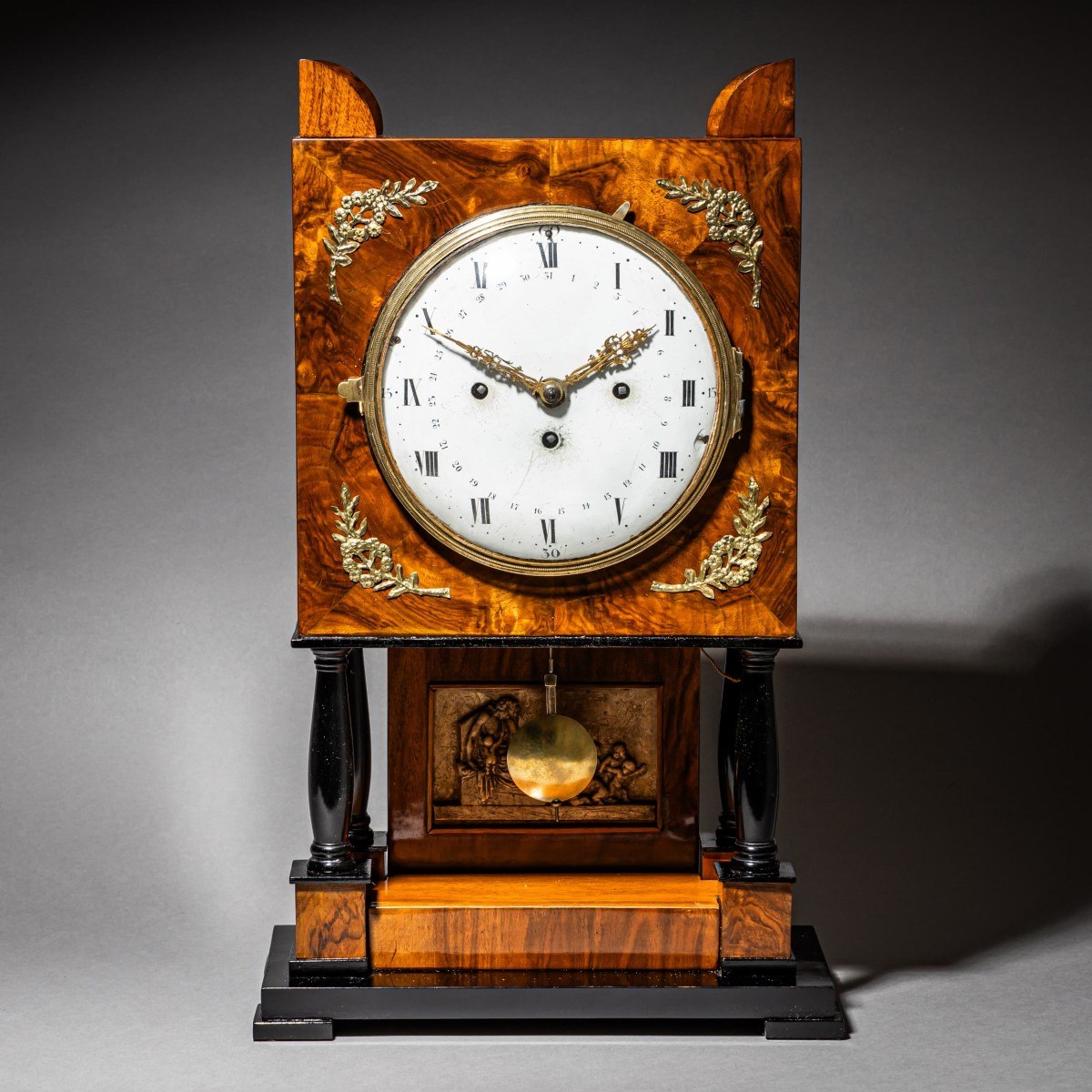
According to the seller, this 19th-century table clock dates to circa 1820 and originates from Vienna, executed in an Empire or Consulat style. The clock features a walnut-veneered architectural case supported by ebonized blackened columns set upon a stepped base. Surrounding the glazed circular bezel on the upper section are four foliate brass corner appliqués. The dial features Roman numerals for the hours, accompanied by inner date numbers and pierced gilt metal hands. Beneath the upper case, a circular brass pendulum swings in front of a rectangular relief panel depicting sculpted figures.

Frontal view of the Viennese Empire-style walnut and ebonized table clock
Frontal view of the Viennese Empire-style walnut and ebonized table clock — EHRL fine art & antiques. Rights pending — permission not yet requested. Original source

Catalogue identity

Source
www.proantic.com
Category
Clock · Table clock
Maker / attribution
Not established
Reference
1755246
Catalogue / lot identifier
Source URL identifies the listing
Source-reported date
Circa 1820
Country
Austria

Source-reported attribution and specifications are not independent authentication. A listing does not establish present ownership, current display, availability or permission to reproduce.

Object description

Architectural Case and Decorative Mounts

The clock is presented as a table clock measuring 49 cm in height, 30 cm in width, and 14.5 cm in depth. The listing records the case material as walnut, featuring blackened columns and a blackened base, adorned with brass appliqués.

Visual observation of the case reveals an upper section ornamented with four foliate brass spandrel appliqués at the corners. A circular brass pendulum bob is positioned between two blackened columns in front of a rectangular figural relief panel, mounted upon a stepped base combining walnut veneer and ebonized elements.

Evidence for this section
  • “Table clock in a walnut case with blackened columns and base.”
  • “The case is adorned with brass appliques.”
  • “Width: 30 Height: 49 Depth: 14.5”
  • “Four foliate brass spandrel appliqués adorn the corners of the upper walnut case.”
  • “Circular brass pendulum bob hangs between two blackened ebonized columns in front of a figural relief panel.”

Dial and Indication Layout

The seller describes the movement as featuring a brass dial with Roman numerals, a second hand with Arabic numerals, and a date ring. However, direct visual observation notes that the dial face appears white or silvered rather than bare brass.

The dial displays black Roman hour numerals alongside an inner date ring, indicated by ornate pierced metal hands. Three winding arbors are visibly positioned across the dial face.

Evidence for this section
  • “The movement features a brass dial with Roman numerals, a second hand with Arabic numerals and a date ring.”
  • “White or silvered dial with black Roman hour numerals and inner date ring.”
  • “Ornate pierced metal hands with three winding arbors visible on the dial face.”

Attribution and Documentation Limitations

The listing classifies the piece within the Consulat and Empire styles, dating it to the 19th century (circa 1820) with Vienna cited as the place of origin. No maker name, signature, or serial number is recorded in the source text.

While three winding arbors and a pendulum bob are visually identifiable, technical specifications of the movement, escapement, and chiming or striking functions are not detailed in the source documentation. Any assessment of mechanical operation rests solely on unverified seller claims.

Evidence for this section
  • “Table Clock, Vienna, Circa 1820”
  • “Period: 19th century”
  • “Style: Consulat, Empire”
  • “Ornate pierced metal hands with three winding arbors visible on the dial face.”

Open research questions

  • What movement caliber and escapement type are installed inside the case?
  • Are there any maker stamps or workshop marks on the movement plates, dial plate, or figural relief panel?
  • Is the dial face silvered brass, enamel, or another treated substrate beneath the reported brass composition?

Source evidence

Recorded claims and source quotations for Viennese Empire-Style Walnut Table Clock
FieldSource-reported valueSource quotation
OriginVienna“Table Clock, Vienna, Circa 1820”
PeriodCirca 1820 / 19th century“Period: 19th century”
Case MaterialWalnut with blackened columns and base“Table clock in a walnut case with blackened columns and base.”
DecorationsBrass appliqués“The case is adorned with brass appliques.”
DimensionsHeight 49 cm, Width 30 cm, Depth 14.5 cm“Width: 30 Height: 49 Depth: 14.5”
Style DesignationConsulat, Empire“Style: Consulat, Empire”
Reported ConditionGood condition (seller-reported)“Condition: Good condition”

Visible details

  • White or silvered dial with black Roman hour numerals and inner date ring.
  • Ornate pierced metal hands with three winding arbors visible on the dial face.
  • Four foliate brass spandrel appliqués adorn the corners of the upper walnut case.
  • Circular brass pendulum bob hangs between two blackened ebonized columns in front of a figural relief panel.
  • Stepped base combines walnut veneer with ebonized plinth elements.

Research qualifications

  • Source claims the movement features a 'brass dial', but visually the dial appears white or silvered with a brass bezel.
  • Movement details, escapement, and rear case construction are not documented in the provided source material.

Photograph identity and source facts were screened before import; rights clearance remains pending.

Consulted source

Proantic: Table Clock, Vienna, Circa 1820

Reviewed 2026-10-21 · Record ff7009a1d9

Terms in this record

Glossary explanations for terms named in this object’s record.