
Skip to content
The Encyclopedia of Horology

Clock · Bracket clock

Victorian Mahogany Twin-Fusee Bracket Clock

Partially verified

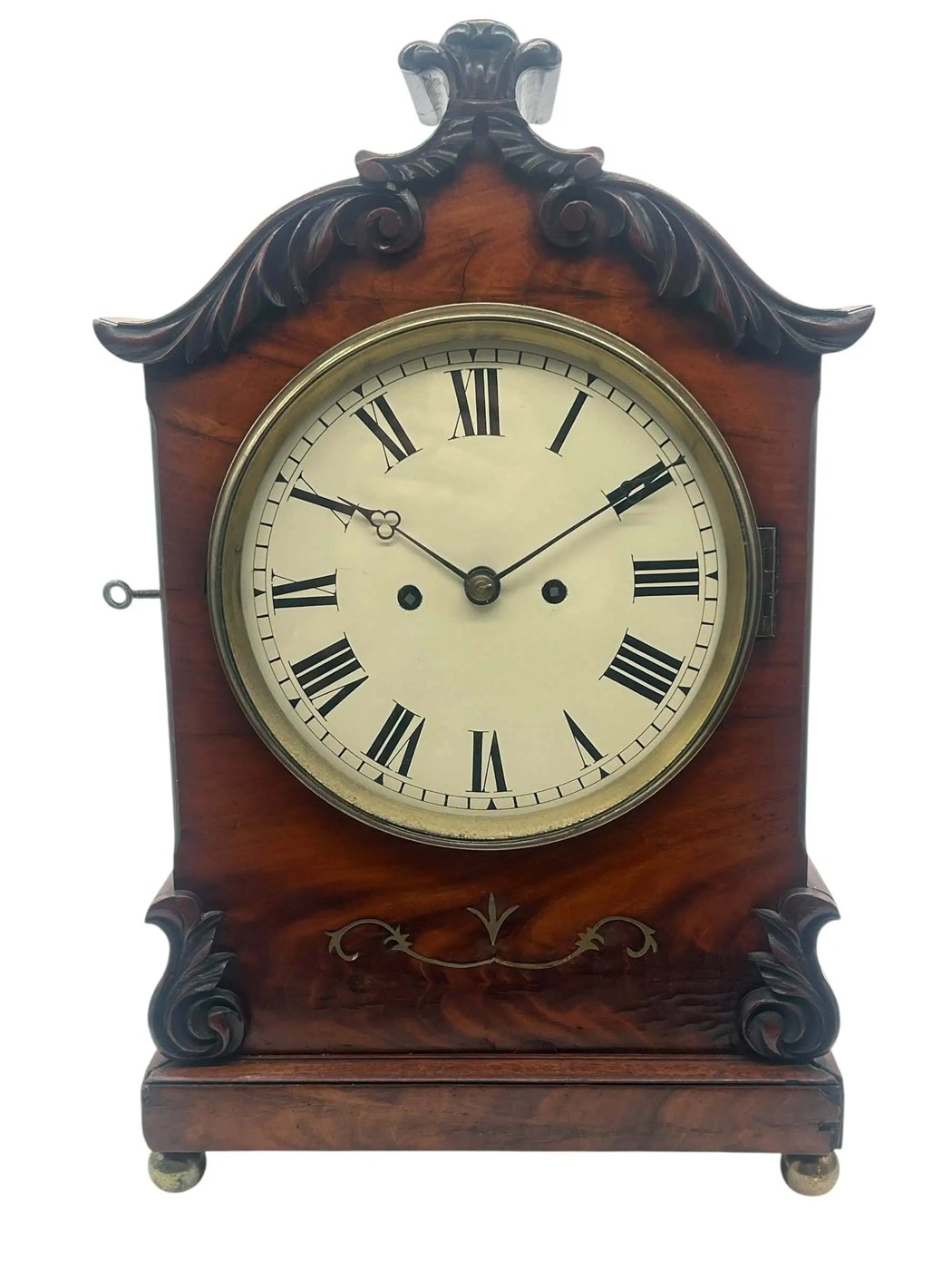
This Victorian bracket clock is constructed with a solid mahogany case featuring a prominent grain and honey-patina. The clock houses an 8-day mechanical twin-fusee movement, which manages both the timekeeping train and an hour-striking train that utilizes an internal bell. The dial is painted with Roman numerals and is fitted with blued-steel hands. The rear of the clock features a glazed door providing visual access to the brass movement, complemented by acoustic side frets. Dimensions are recorded as 48cm in height, 30cm in width, and 16cm in depth. The object is supplied with its original pendulum and winding key. According to the auction description, the movement is in full working order, having been maintained to provide reliable timekeeping and striking, while the external mahogany housing exhibits minor signs of age consistent with its antique status.

Frontal view showing the mahogany case, painted dial with Roman numerals, and blued-steel hands.
Frontal view showing the mahogany case, painted dial with Roman numerals, and blued-steel hands. — Vintage Clocks UK. Rights pending — permission not yet requested. Original source

Catalogue identity

Source
vintageclocks.uk
Category
Clock · Bracket clock
Maker / attribution
Not established
Reference
Not recorded
Catalogue / lot identifier
Source URL identifies the listing
Source-reported date
circa 1870
Source-reported place
England
Source-reported serial
JN155

Source-reported attribution and specifications are not independent authentication. A listing does not establish present ownership, current display, availability or permission to reproduce.

Object description

Case and Dial

The clock is housed in a solid mahogany case, which the provided text describes as possessing a deep, warm honey-patina and highly figured grain. The design includes decorative carved elements atop the clock and at the base, with side acoustic frets incorporated to allow sound transmission.

The dial is painted and features black Roman numerals. The clock is equipped with original blued-steel hands. Access to the internal mechanism is provided via a glazed rear door, allowing for visual inspection of the movement. The entire assembly sits on four feet.

Evidence for this section
  • “Enclosed within a rich, beautifully figured solid mahogany case”
  • “Painted dial with crisp Roman numerals”
  • “Original, finely cut blued-steel hands.”

Movement and Escapement

The clock operates on an 8-day mechanical twin-fusee movement. The use of dual fusees provides power to both the timekeeping and striking trains, aiming to ensure consistent power delivery. The escapement is a traditional English anchor recoil mechanism.

The striking train is designed to sound the full hour count on an internal bell. The auction description reports that the movement is in full working order, maintaining time and striking reliably.

Evidence for this section
  • “8-day mechanical twin-fusee movement (striking and timekeeping trains).”
  • “Traditional English anchor recoil escapement.”
  • “Powerfully strikes the full hour count on a beautifully resonant internal bell.”

Condition and Accessories

The mahogany case is described as being in solid condition with a luster that shows signs of age. The auction description notes that the timepiece is currently in full working order, with the pendulum and winding key included as part of the set.

Regarding maintenance, the auction listing states that the pendulum is intended to be unhooked during transport to prevent damage to the movement plates or fusee lines.

Evidence for this section
  • “In superb, full working order. Ticks strongly, keeps excellent time, and strikes reliably.”
  • “Sold complete with its original heavy pendulum and matching winding key.”
  • “The mahogany structure is solid with a beautiful luster, showing only minor, authentic signs of age”

Open research questions

  • What specific maker or retailer might be identified by further examination of the movement plates, beyond the SKU provided?
  • Are there any identifiable marks or stamps on the movement plates that could help confirm the specific regional origin within England?

Source evidence

Recorded claims and source quotations for Victorian Mahogany Twin-Fusee Bracket Clock
FieldSource-reported valueSource quotation
PeriodLate Victorian, circa 1870“Period: Late Victorian, circa 1870.”
Movement type8-day twin-fusee“8-day mechanical twin-fusee movement (striking and timekeeping trains).”
EscapementEnglish anchor recoil“Traditional English anchor recoil escapement.”
Dimensions48cm x 30cm x 16cm“Measures 48cm high, 30cm wide, 16cm deep”
SKUJN155“SKU: JN155”
Case materialSolid mahogany“Enclosed within a rich, beautifully figured solid mahogany case”
Striking mechanismInternal bell“Powerfully strikes the full hour count on a beautifully resonant internal bell.”

Visible details

  • Painted dial with Roman numerals
  • Solid mahogany case with ornamental carved details
  • Internal bell for hour striking

Research qualifications

  • The exact maker is not identified in the provided description
  • The precise nature of the 'minor, authentic signs of age' is not detailed

Photograph identity and source facts were screened before import; rights clearance remains pending.

Terms in this record

Glossary explanations for terms named in this object’s record.