
Skip to content
The Encyclopedia of Horology

Clock · Bracket clock

Victorian mahogany architectural bracket clock

Partially verified

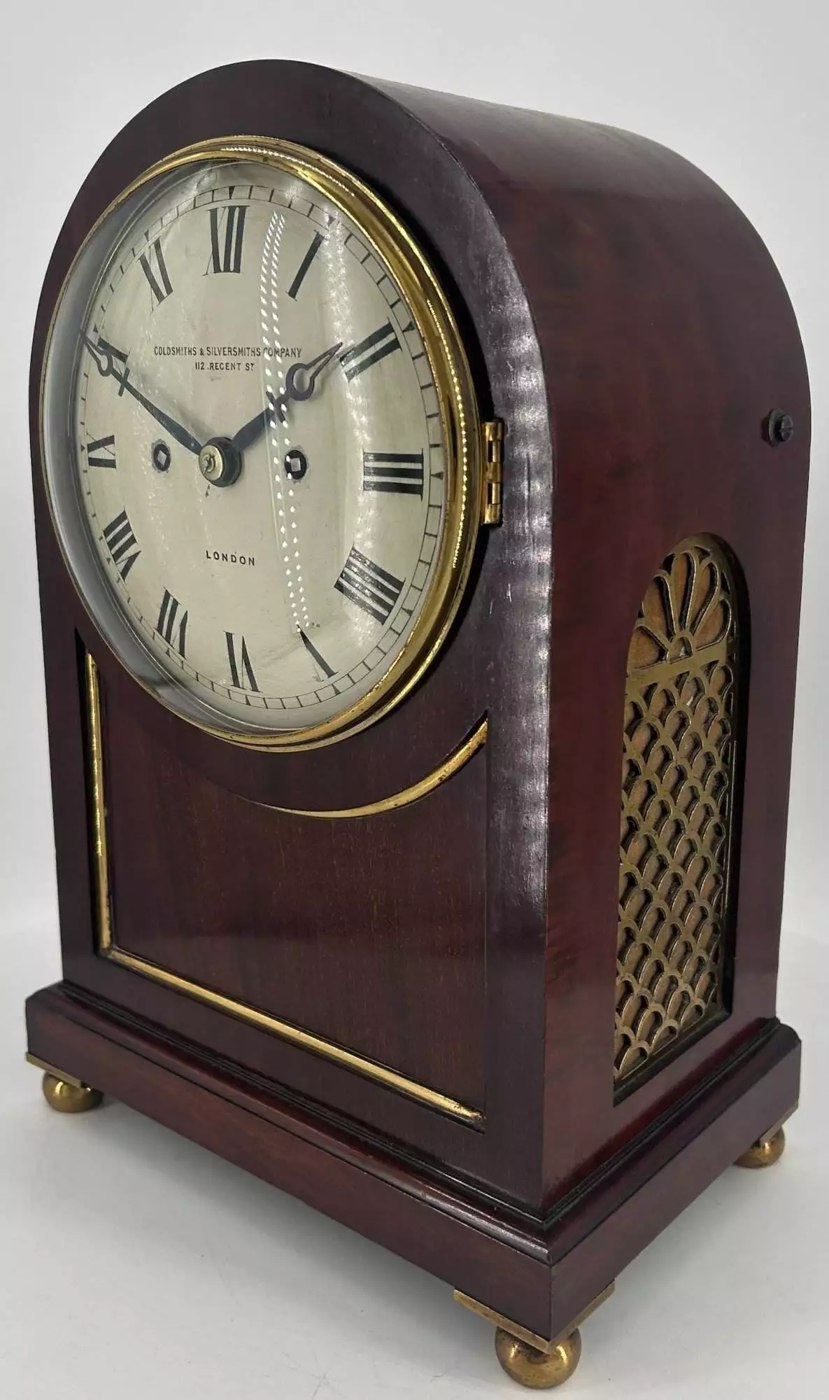
This Victorian-era bracket clock features an architectural mahogany case and is attributed to the London-based makers Alstons & Hallam. The clock is powered by an original twin fusee movement that strikes on a gong. The circular silvered dial, which is inscribed with the maker's details, features black Roman numerals and original hands, protected by a glazed bezel. The case construction incorporates decorative side panels featuring carved fretwork and a hinged rear door with a glass panel, allowing for a clear view of the movement within. The clock stands on four brass feet. The object is recorded as being in working order, with general signs of wear commensurate with its age. It is accompanied by its original winding key. Measuring approximately 46cm in height, 32cm in width, and 19.5cm in depth, the piece remains in its original finished state.

Side view of the Victorian mahogany bracket clock showing the carved brass fretwork side panel and the brass bezel.
Side view of the Victorian mahogany bracket clock showing the carved brass fretwork side panel and the brass bezel. — Vintage Clocks UK. Rights pending — permission not yet requested. Original source

Catalogue identity

Source
vintageclocks.uk
Category
Clock · Bracket clock
Maker / attribution
Goldsmiths & Silversmiths Company
Reference
Not recorded
Catalogue / lot identifier
Source URL identifies the listing
Source-reported date
circa 1840
Source-reported place
England
Source-reported serial
2141

Source-reported attribution and specifications are not independent authentication. A listing does not establish present ownership, current display, availability or permission to reproduce.

Object description

Case Construction

The clock is housed in an architectural-style mahogany case, supported by four brass feet. The design includes side panels featuring intricate, symmetrical brass fretwork that allows air circulation while obscuring the inner cavity. The front features a brass-rimmed glazed bezel that protects the dial.

To the rear, the clock is fitted with a hinged glass-paneled door. This configuration provides a clear view of the clock's internal movement. The wood retains its original finish, though the auction description reports signs of minor age and cosmetic wear consistent with the object's age.

Evidence for this section
  • “Architectural mahogany case”
  • “The case sides have carved panels”
  • “the back door is a glass paneled door, so the movement is fully visible”

Dial and Inscriptions

The clock features a circular silvered dial marked with black Roman numerals and simple black hands. The source text notes the dial is stamped with the maker's name.

Visual evidence reveals an inscription on the dial: 'Goldsmiths & Silversmiths Company, 112 Regent St, London'. This contradicts the source's primary attribution to 'Alstons & Hallam'. The dial shows minor surface wear consistent with age.

Evidence for this section
  • “Original silver dial”
  • “The Dial is stamped with the makers name on all original”

Movement

The clock is powered by a mechanical twin fusee movement. This mechanism is designed to strike the time on a gong. The movement is reported to be in working order and was recently serviced by the current vendor.

The internal components are visible through the glass rear door, confirming the presence of the twin fusee system. The clock is supplied with its original winding key to facilitate operation.

Evidence for this section
  • “The movement is an original twin English fusee which strikes a gong”
  • “Working Order, recently serviced”

Open research questions

  • Can the discrepancy between the attributed maker (Alstons & Hallam) and the dial signature (Goldsmiths & Silversmiths Company) be resolved?
  • Is the Goldsmiths & Silversmiths Company signature original to the dial or a later addition?

Source evidence

Recorded claims and source quotations for Victorian mahogany architectural bracket clock
FieldSource-reported valueSource quotation
MakerAlstons & Hallam“made by Alstons & Hallam of London”
Datecirca 1840“Circa 1840”
MovementTwin fusee gong striking“Twin fusee gong striking movement”
Case materialMahogany“Architectural mahogany case”
Dimensions46cm x 32cm x 19.5cm“Measures 46cm high by 32cm wide & 19.5cm deep”
SKU2141“SKU: 2141”

Visible details

  • Decorative brass fretwork side panels
  • Glass-paneled rear door allowing movement inspection
  • Four brass feet at the base
  • Silvered dial with Roman numerals

Research qualifications

  • Dial inscription discrepancy between source text and photo
  • Exact dating to 1840 remains an attribution

Photograph identity and source facts were screened before import; rights clearance remains pending.

Terms in this record

Glossary explanations for terms named in this object’s record.