Skip to content
The Encyclopedia of Horology

Clock · Mantel clock

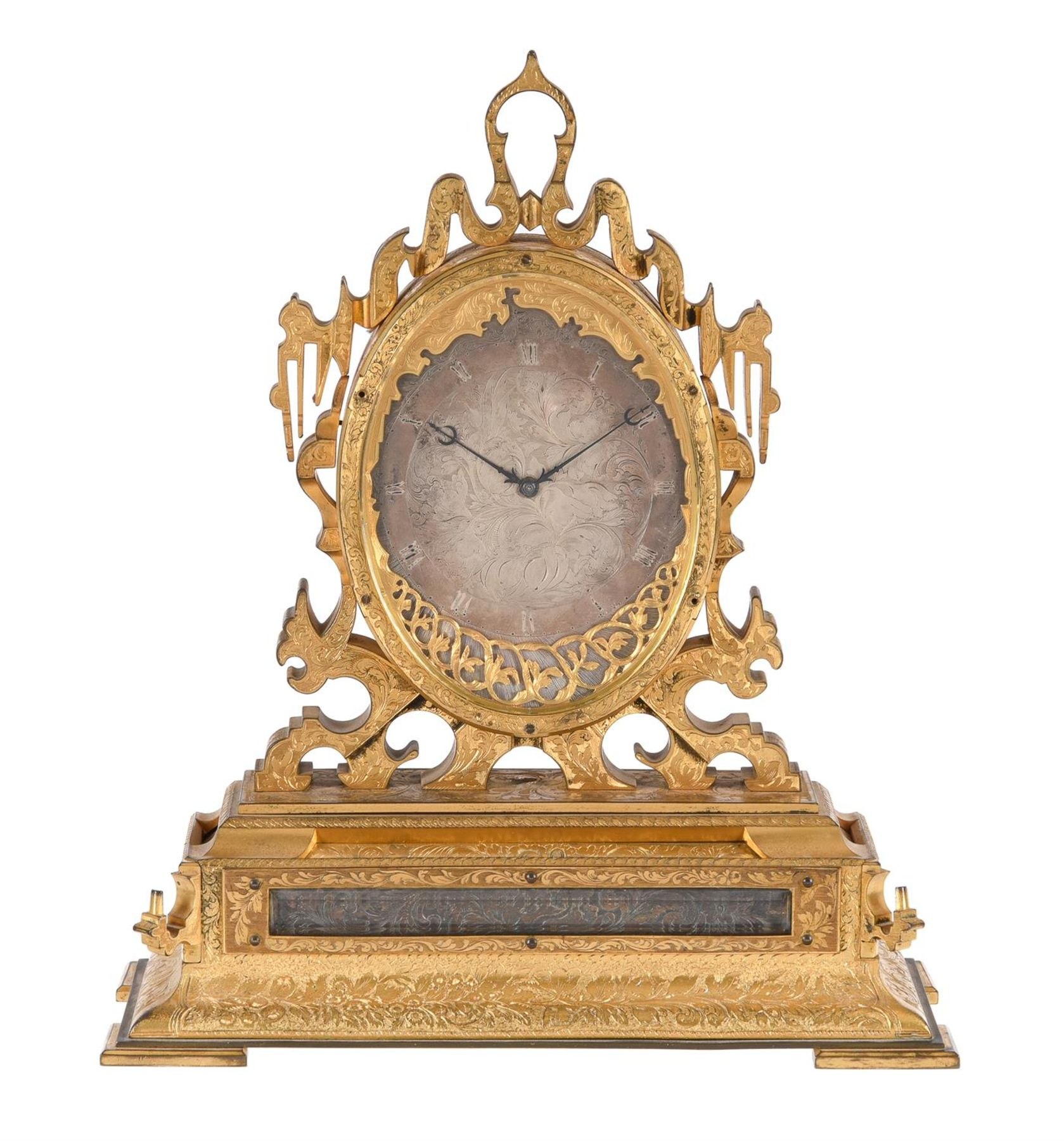
Victorian Engraved Gilt Brass Mantel Clock

Partially verified

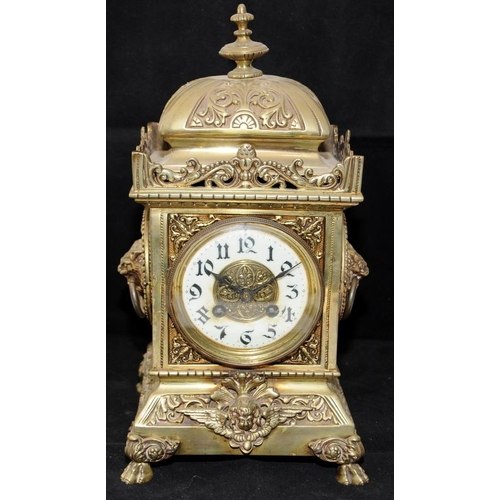
This mid-19th-century Victorian mantel clock is executed in the style of Thomas Cole and attributed by the source to Edward Winter Robins of London. The gilt brass case features an oval movement housing an eight-day, twin going-barrel gong-striking mechanism with a horizontally planted platform lever escapement. The front displays a silvered brass oval Roman numeral dial framed by pierced foliate scroll masks. The oval case is supported within an openwork scroll outline strap frame featuring a top carrying loop, all mounted on an engraved plinth adorned with hunting and agricultural motifs.

Front view of the engraved gilt brass mantel clock on plinth base
Front view of the engraved gilt brass mantel clock on plinth base — Dreweatts. Rights pending — permission not yet requested. Original source

Catalogue identity

Source
auctions.dreweatts.com
Category
Clock · Mantel clock
Maker / attribution
Edward Winter Robins (attributed)
Reference
Not recorded
Catalogue / lot identifier
124
Source-reported date
mid 19th century
Source-reported place
United Kingdom
Source-reported serial
2895

Source-reported attribution and specifications are not independent authentication. A listing does not establish present ownership, current display, availability or permission to reproduce.

Object description

Identity and Attribution

The mantel clock is unsigned. The auctioneer proposes an attribution to Edward Winter Robins of London, based on stylistic parallels to the work of Thomas Cole and a comparison to a signed timepiece numbered 2878. The item is dated to the mid-19th century.

The case is numbered 2895 on the lower edge behind the front bezel. Biographical records note Edward Winter Robins was registered as a manufacturer and watchmaker in London between 1857 and 1859.

Evidence for this section
  • “Unsigned but probably by Edward Winter Robins, London, mid 19th century”
  • “(the case numbered 2895 to the lower edge behind the front bezel)”
  • “The current lot can be compared to a timepiece of related design signed by Edward Winter Robins and numbered 2878”
  • “Edward Winter Robins was registered as a manufacturer at 4 Red Lion Street, Clerkenwell and as a watchmaker at 28 Queens Road, Bayswater in 1857”
Case Construction

The clock is housed in an oval case featuring leafy scroll engravings on a line-hatched ground. It is suspended within an openwork scroll-pattern strap frame with a carrying loop at the top.

The base is an elaborate plinth with recessed panels and cavetto moldings. The rear panel is engraved with a scene of two shire horses with a plough, and the reverse includes an equestrian stag hunt engraving.

Evidence for this section
  • “the oval case further decorated with leafy scrolls onto a line-hatched ground”
  • “the whole supported within an abstracted pierced scroll outline strap frame surround incorporating carrying loop to the top”
  • “the rear with panel finely engraved with an equestrian stag hunt”
  • “the rear with engraved scene of two shire horses with a plough over pad feet”

Dial and Mechanism

The dial is a 4-inch wide silvered brass oval featuring Roman numerals and engraved naturalistic leafy sprays. It is set within a gilt brass mask featuring foliate scrollwork. The time is indicated by blued steel speared crescent hands.

The movement is an eight-day, five-columnar pillar, twin going-barrel, gong-striking mechanism with truncated oval plates. It utilizes a horizontally planted gilt platform lever escapement with a three-arm monometallic balance.

Evidence for this section
  • “the 4 inch wide silvered brass oval Roman numeral dial with fine naturalistic leafy spray engraved”
  • “with unusual speared crescent blued steel hands”
  • “eight-day five columnar pillar twin going-barrel gong-striking movement with oval plates truncated at the apex”
  • “horizontally planted gilt platform lever escapement regulated by sprung three-arm monometallic balance”

Open research questions

  • What specific archival or maker-mark records link serial number 2895 directly to the known workshop of Edward Winter Robins beyond stylistic comparison?
  • Are there any visible hallmarks or maker signatures hidden beneath the current mountings that could confirm the attribution?

Source evidence

Recorded claims and source quotations for Victorian Engraved Gilt Brass Mantel Clock
FieldSource-reported valueSource quotation
AttributionProbably by Edward Winter Robins, London“Unsigned but probably by Edward Winter Robins, London, mid 19th century”
MovementEight-day five columnar pillar twin going-barrel gong-striking movement“The eight-day five columnar pillar twin going-barrel gong-striking movement with oval plates truncated at the apex”
Case Number2895“(the case numbered 2895 to the lower edge behind the front bezel)”
Height33 cm (13 inches)“33cm (13ins) high.”

Visible details

  • Oval silvered dial set within an ornate pierced gilt brass frame with a top carrying loop
  • Elongated rectangular plinth base with stepped moulding and engraved panels
  • Blued steel speared crescent hands centered on the dial

Research qualifications

  • The clock is unsigned; attribution to Edward Winter Robins is proposed by the auctioneer based on serial proximity and styling compared to a signed example
  • Movement plates and platform escapement are internal and not visible in the primary exterior photograph

Photograph identity and source facts were screened before import; rights clearance remains pending.

Consulted source

A fine Victorian engraved gilt brass mantel clock in the style of Thomas Cole

Reviewed 2026-10-22 · Record 41bec30d75

Terms in this record

Glossary explanations for terms named in this object’s record.